Microsoft 365 Copilot just got a significant upgrade. OpenAI’s GPT-5.6 — the company’s latest production model family — is now the preferred model powering the productivity suite used by hundreds of millions of enterprise users worldwide. The transition, confirmed this week by both OpenAI and Microsoft, marks the most substantial capability leap Copilot has received since its initial launch, and introduces a feature called Cowork that moves the product from AI assistant to AI executor.
For enterprise technology buyers, the timing is significant. Microsoft has been navigating intensifying competition in the enterprise AI space from Google’s Gemini for Workspace, Anthropic’s Claude-powered enterprise tools, and a rapidly expanding field of AI-native productivity startups. GPT-5.6’s arrival in Copilot is designed to reassert Microsoft’s position at the top of the enterprise stack — and the early benchmarks suggest it has the substance to back that claim.
What GPT-5.6 Brings to the Table
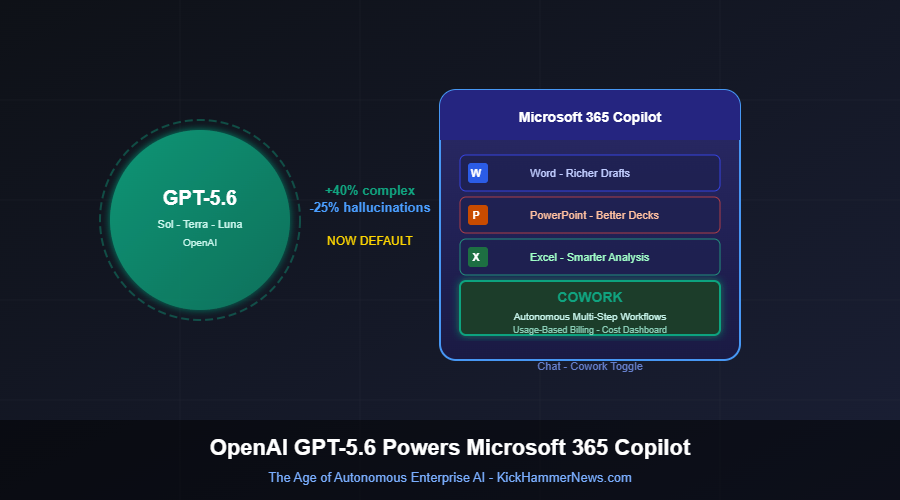
GPT-5.6 is not a single model but a family of three: Sol (flagship), Terra (enterprise-optimized), and Luna (high-volume, cost-efficient). Microsoft 365 Copilot deploys these models contextually depending on the task at hand, routing complex multi-step requests to Sol while using Terra and Luna for faster, more routine queries. The result, according to Microsoft’s internal benchmarks, is 40% better handling of complex queries and 25% fewer hallucinations compared to the previous generation of Copilot.
Those numbers matter in the enterprise context. Hallucinations — cases where an AI model confidently states something that is factually incorrect — have been one of the primary barriers to enterprise adoption of AI-assisted workflows, particularly in regulated industries like finance, healthcare, and legal services. A 25% reduction doesn’t eliminate the problem, but it moves the needle meaningfully for use cases where accuracy is non-negotiable.
Across individual Microsoft 365 applications, the upgrade is similarly visible. In Word, Copilot with GPT-5.6 is designed to convert rough ideas into substantially more complete drafts with fewer rounds of iteration — reducing what Microsoft product teams internally call the “prompt-revise-prompt” loop that has frustrated many enterprise users. In PowerPoint, Copilot can now generate presentation drafts with stronger visual balance and more coherent narrative structure. In Excel, the model’s improved reasoning capabilities translate to better formula generation and more accurate natural language data analysis.
Cowork: The Shift from Assistant to Executor
The most consequential change in this update isn’t the underlying model — it’s what that model enables. Copilot Cowork, launching alongside the GPT-5.6 integration, is Microsoft’s answer to a question that has been building for more than a year: what happens when users stop wanting AI to help them do their work, and start wanting AI to do their work?
Cowork is built on GPT-5.6’s capacity to sustain coherent, goal-directed behavior across multi-step workflows. Rather than returning a draft or recommendation for the user to act on, Cowork can carry a task from an initial instruction through to a finished result — autonomously navigating the steps in between, making decisions, and handling exceptions without requiring the user to stay in the loop at every turn.
The practical implications are substantial. A finance manager who previously needed to prompt Copilot for a data pull, review the output, prompt for formatting, paste into PowerPoint, and request a narrative summary can now give a single instruction — “Pull Q3 cost center data, summarize the variances, and build me a deck for Thursday’s review” — and return to a completed artifact. Cowork handles the sequencing, the application switching, and the judgment calls along the way.
The Microsoft 365 Copilot app makes Cowork accessible through a toggle that sits alongside the existing Chat interface, giving users explicit control over whether they want a conversational AI experience or an autonomous execution mode. That design choice reflects lessons learned from earlier agentic AI deployments, where users were often uncertain whether an AI system was about to respond or act, with sometimes costly consequences when the answer turned out to be “act.”
Enterprise Controls and Cost Management
The autonomy that makes Cowork powerful also makes it potentially expensive, and Microsoft has built a dedicated cost management layer to address that concern head-on. Cowork operates on usage-based billing, with enterprises paying for the compute consumed by autonomous workflow execution rather than a flat per-seat subscription.
To give IT administrators visibility and control, Microsoft is launching a Cost Management Dashboard in the Microsoft 365 admin center. The dashboard provides real-time monitoring of Cowork credit consumption by user, team, and workflow type, along with budget cap tools that prevent any individual user or department from inadvertently running up a significant bill on an ambitious but runaway task.
For CIOs and CFOs who have been cautious about agentic AI adoption partly because of cost unpredictability, the dashboard represents a meaningful concession from Microsoft — an acknowledgment that autonomous AI execution requires the same financial guardrails that enterprises apply to cloud infrastructure spending.
Competitive Context
The GPT-5.6 rollout lands in a market that has grown considerably more crowded since Microsoft first launched Copilot. Google’s Gemini for Workspace has made significant inroads in enterprises that are heavily invested in Google’s productivity stack, and Anthropic has developed a growing roster of enterprise customers via its API and through partnerships with major systems integrators.
The competitive stakes are high. Enterprise productivity software is one of the largest and most defensible segments of the software market, and AI is rapidly becoming the primary battleground for differentiation within it. Microsoft’s advantage — a deeply embedded installed base, tight integration between Copilot and the underlying Microsoft 365 data layer, and an exclusive partnership with OpenAI — remains formidable. But that advantage is not permanent, and the pressure to ship meaningful capability improvements on a regular cadence is intense.
GPT-5.6’s deployment in Copilot is Microsoft’s signal that it intends to maintain the pace. By bringing the most capable version of OpenAI’s production model family into the enterprise productivity stack before competitors can respond, the company is reinforcing its position at the center of enterprise AI adoption rather than the periphery of it.
What Comes Next
The launch of Cowork is widely expected to trigger a rapid expansion of the autonomous workflow category inside enterprise software. If users and IT administrators respond positively to Cowork’s model — explicit human-initiated task delegation to an AI executor, with cost controls and output review — expect competing vendors to accelerate their own agentic workflow features.
For Microsoft, the near-term roadmap centers on deepening Cowork’s integration with external enterprise systems. The company has already confirmed that Copilot connectors for SAP, Salesforce, ServiceNow, and Workday will be expanded to give Cowork agents access to data and workflows that live outside the Microsoft 365 ecosystem. That expansion will be critical for making Cowork genuinely useful across the full range of workflows that enterprise knowledge workers manage.
In the longer arc, GPT-5.6’s arrival in Copilot marks a milestone in the maturation of enterprise AI: the point at which AI in the workplace stopped being primarily a drafting aid and became, for the first time, a credible executor of multi-step business processes. Whether that transition unfolds smoothly — or opens new categories of enterprise risk that tools like AIR Security were built to address — will be one of the defining technology stories of the next twelve months.
Sources: OpenAI | Microsoft Community Hub | Quartz


