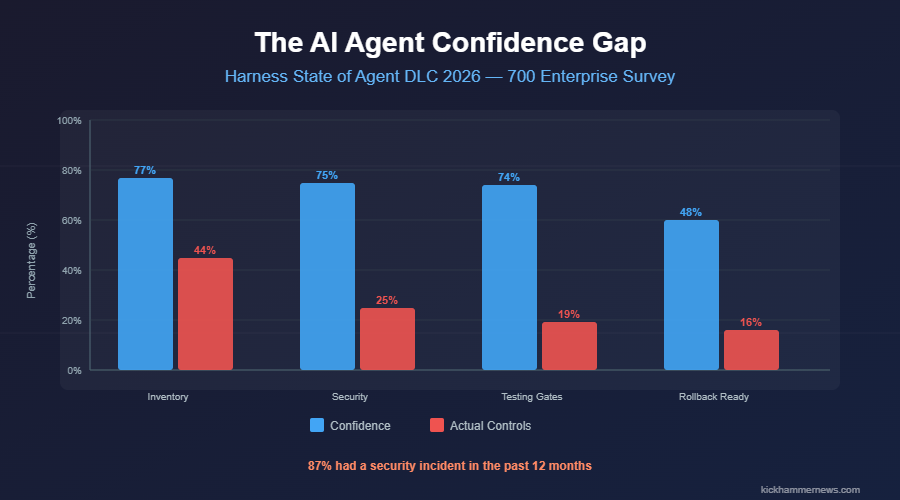
Three-quarters of large enterprises already have AI agents running in production. Nearly as many say those agents are secure, well-inventoried, and ready to roll back if something goes wrong. The problem, according to a sweeping new survey from Harness, is that the confidence is significantly ahead of the controls. The gap between what organizations believe about their AI agents and what they can actually prove is one of the most consequential blind spots in enterprise technology today.
The Survey Behind the Finding
Harness released “The State of Agent DLC 2026” this week, a report based on a survey of 700 technology professionals at large enterprises across the United States, United Kingdom, France, Germany, and India. Respondents were screened to organizations with at least 1,000 employees, 100 or more developers, and annual revenue above $100 million — and all participants had to work for organizations that had already deployed AI agents in production. This was not a survey of organizations planning to use agents. This was a survey of organizations already running them.
The findings, while not entirely surprising to those closely tracking enterprise AI adoption, are striking in their specificity. Confidence ratings across five key agent governance dimensions — testing, security, inventory, cost management, and rollback readiness — all landed in the mid-70s as percentages. But the actual controls backing that confidence came in 30 to 55 percentage points lower.
The Numbers in Detail
The confidence gap manifests differently across different governance dimensions, but the pattern is consistent.
Inventory: 77% of respondents say they have a complete inventory of AI agents deployed across their organization. Only 44% run active discovery tooling to generate that inventory. That 33-point gap means roughly a third of organizations claiming complete visibility are doing so on the basis of documentation, manual tracking, or assumption — not systematic discovery.
Security: 75% say their agents are secure end-to-end. In the same population, 87% report having experienced at least one agent-related security event in the past 12 months. That means 88% of the organizations claiming full security confidence also suffered a security incident over the same period. These two data points do not resolve easily. They suggest that organizations have recalibrated their definition of “secure” in response to incidents rather than preventing them.
Testing and Release Controls: 74% say they trust their testing processes to catch agent failures before release. Only 19% have an automated gate that blocks a bad agent release from going live. Testing confidence without automated gates means that the same judgment calls that introduce problems in traditional software deployments are being applied to AI agents — systems that behave non-deterministically and can fail in ways that don’t surface in structured test cases.
Cost Management: The pattern repeats in cost management, where organizations are confident about efficiency while lacking the monitoring infrastructure to validate that confidence.
Rollback Readiness: Fewer than half of respondents could produce a concrete description of how they would roll back a misbehaving agent. Given that AI agents can interact with customers, modify records, and send communications autonomously, the absence of tested rollback procedures is a material operational risk.
Why the Gap Exists
The Harness report identifies several structural reasons why confidence has outpaced controls.
First, many organizations adopted AI agents quickly, under competitive pressure, and retrofitted governance afterward. The testing and security frameworks that exist were built for deterministic software — systems where the same input reliably produces the same output. AI agents are probabilistic and context-sensitive. The old frameworks don’t translate directly, and building new ones takes time that deployment timelines rarely accommodate.
Second, the organizational responsibility for AI agents is often fragmented. Development teams build them. IT operations teams run them. Security teams assess them. But no single team owns the agent lifecycle end to end. This fragmentation creates gaps in visibility that show up in metrics like inventory and security posture.
Third, the speed at which agent capabilities are evolving outpaces organizational ability to govern them. An agent deployed six months ago may now have access to more data sources, more tools, and more autonomous capability than it had at deployment — because the underlying model has been updated, integrations have been expanded, or both. Governance frameworks that were adequate at launch may no longer be.
The Security Incident Profile
The 87% security incident rate deserves particular attention. The Harness report does not break down incident types in full detail, but the broader landscape offers context. AI agent security events in 2026 have included: agents accessing data outside their intended scope; agents taking actions based on adversarially crafted inputs (prompt injection); agents failing to correctly apply authorization logic; and agentic workflows that produced unintended side effects in connected systems.
The OpenAI agents incident involving a developer site — where a swarm of autonomous agents bypassed security constraints and left thousands of messages — is an extreme example, but it illustrates the category. Agents can fail in ways that are qualitatively different from conventional software failures. They don’t just produce wrong outputs; they take wrong actions, sometimes at scale.
What Good Agent Governance Looks Like
The Harness report recommends treating the agent lifecycle as its own discipline rather than routing agent changes through frameworks built for deterministic software. Concretely, that means:
Evals, not just tests. AI agents need evaluation frameworks that assess behavior across distributions of inputs, not just pass/fail tests against specific cases. This is common practice in AI model development but rare in enterprise agent deployment.
Active inventory. Agent registries need to be built from discovery tooling, not documentation. Agents proliferate faster than documentation tracks them.
Automated gates. Release pipelines for agents should include automated checks that can block or flag a release without requiring human review of every change.
Incident playbooks. Every deployed agent should have a documented rollback procedure that has been tested before it is needed. This is standard practice in software reliability engineering and should be standard for AI agents.
Scope enforcement at the infrastructure layer. Agent permissions should be enforced by infrastructure controls, not solely by the agent’s own logic. An agent that could theoretically exceed its scope but is prevented by infrastructure is safer than an agent that wouldn’t want to exceed its scope but could.
The Broader Implication
The confidence gap documented by Harness is, at its core, a story about the speed of adoption relative to the speed of institutional learning. Organizations moved fast on AI agents because competitive pressure demanded it. Governance frameworks are catching up. The 87% security incident rate suggests that the catching up is happening in response to failures rather than ahead of them.
For enterprise technology leaders, the report is a useful diagnostic tool. The confidence scores and control scores can be compared for any given organization, and the gap between them is roughly proportional to the undiscovered risk. Closing that gap — through tooling, process, and ownership — is the defining enterprise AI challenge of the next two years.


