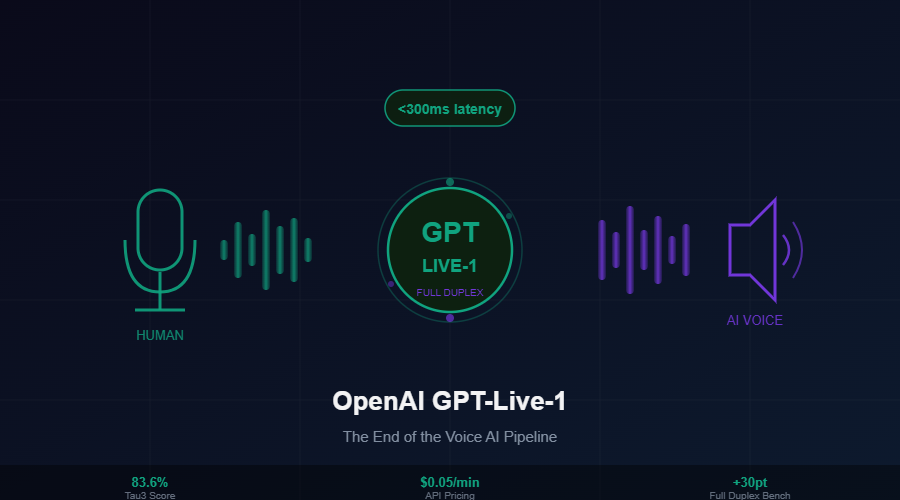
OpenAI just made a move that could fundamentally change how we interact with AI systems. On September 10, 2026, the company launched GPT-Live-1, a full-duplex voice AI model that can listen and speak simultaneously — and it’s already turning heads across the developer community and enterprise world alike.
The model is now available through the API at $0.05 per minute, a price point that makes it accessible for production deployments. But the more important story isn’t the price — it’s what GPT-Live-1 actually does that its predecessors could not.
The Problem With Every Previous Voice AI
To understand why GPT-Live-1 matters, you have to understand the ugly compromise that powered voice AI for years. Most conversational voice products — including earlier versions of ChatGPT Voice — were built on what’s called a cascaded pipeline: your speech gets transcribed to text, the text goes into an LLM, the LLM outputs text, and then that text gets converted back to speech. It’s a round trip with several stops, and each stop adds latency, artifacts, and opportunities for things to go wrong.
This architecture meant voice AI always felt a little… off. Responses came with a perceptible delay. Interruptions were messy — the model had to stop, re-process, and start over. Backchanneling signals like “mm-hmm” or “right” were either ignored or caused the pipeline to reset entirely. Conversations felt like turn-taking exercises rather than natural dialogue.
GPT-Live-1 abandons this pipeline entirely. It’s a native, end-to-end voice model that processes audio input and generates audio output without any text intermediate. The model listens and speaks in parallel — full duplex — which is what makes natural conversation possible.
What Full Duplex Actually Means in Practice
In a half-duplex conversation (walkie-talkie style), one party speaks while the other waits. In full duplex (phone call style), both parties can be active simultaneously. GPT-Live-1 operates like the latter.
This means several things that feel small but are enormous in practice. Interruptions work: when you cut in mid-sentence, GPT-Live-1 notices and adapts immediately. It doesn’t need to finish its thought and then address yours — it can pivot in real time, just like a human would. Pauses are understood contextually: the model distinguishes between a thoughtful pause and a genuine “your turn.” It doesn’t rush to fill silence, but it doesn’t stay frozen waiting for a formal signal either. Backchannels are handled: if you say “yeah” or “uh-huh” while GPT-Live-1 is speaking, it registers that you’re listening and engaged — and can adjust its pace, depth, or direction accordingly.
OpenAI reports a 30-point improvement on the Full Duplex Bench evaluation over GPT-Realtime-2.1, the previous best-in-class model. That benchmark measures conversational naturalness, interruption handling, and latency — the three axes where voice AI has traditionally struggled most.
Benchmark Results: A Different Category of Performance
GPT-Live-1 doesn’t try to handle the heavy cognitive lifting itself. Instead, it delegates: the voice layer manages the live conversation, while a backend model — your choice, including GPT-6 Astra — handles the deeper reasoning, tool calls, and agentic actions.
When paired with GPT-6 Astra at medium reasoning effort, the combination completed 83.6% of Tau3 tasks on the first attempt. The previous system, GPT-Realtime-2.1, scored 45.7% on the same benchmark. That’s not an incremental improvement — it’s a different category of performance.
Tau3 is significant because it measures multi-step voice tasks that require maintaining context over an extended interaction. It’s closer to a real-world conversation than most AI benchmarks, which makes the jump from 45.7% to 83.6% genuinely meaningful.
The Architecture: What OpenAI Changed
The architectural shift from cascaded pipeline to end-to-end audio model is non-trivial. OpenAI trained GPT-Live-1 directly on audio-in, audio-out examples rather than relying on ASR (automatic speech recognition) and TTS (text-to-speech) modules. This means the model learns conversational patterns — rhythm, prosody, backchanneling, emotional tone — from raw audio data rather than inferring them from transcribed text.
The tradeoff? GPT-Live-1 dropped the image input capability that GPT-Realtime-2.1 had. The model is voice-specialized. OpenAI has framed this as a deliberate design choice: by narrowing the scope to audio, the team could optimize deeply for conversational quality rather than building a multimodal jack-of-all-trades.
The per-minute pricing also reflects this architectural separation. The $0.05/minute covers the voice layer; backend model usage (reasoning, tool calls, etc.) is billed separately. This gives developers flexibility to choose the right backend for their specific use case without paying for GPT-6 Astra’s full reasoning capabilities when a lighter model would do.
Who This Is For
The launch documentation points to several clear use cases: customer service agents, voice-first mobile experiences, real-time translation, and autonomous phone agents. Customer service is the obvious high-volume play. Voice pipelines with natural interruption handling could dramatically reduce the friction of automated phone support, one of the most universally loathed consumer experiences.
For developers, the API design is worth noting. GPT-Live-1 is explicitly designed to work within larger agent frameworks — it’s not positioning itself as a standalone product but as a composable voice interface for any agentic application. That architectural stance, combined with the per-minute pricing, makes it far more accessible than building proprietary voice stacks from scratch.
The Competitive Landscape
OpenAI isn’t the only team working on this problem. Google’s Project Astra has demonstrated real-time conversational ability with multimodal input. Eleven Labs and Hume AI have been pushing expressiveness in synthetic voice. And on the agent side, Anthropic’s Claude Voice Mode (launched in July 2026) has been doing cross-app audio integration with Opus and Sonnet.
What distinguishes GPT-Live-1 is the combination of full-duplex architecture, an open API, competitive pricing, and the benchmark data to back up the claims. The Tau3 score in particular gives enterprise teams a concrete metric to evaluate against their own workloads.
What’s Next
OpenAI has said little about the roadmap beyond GPT-Live-1. But the obvious next step is multimodal reintegration — bringing vision back into the live audio experience without sacrificing the conversational naturalness that makes GPT-Live-1 compelling in the first place.
For now, GPT-Live-1 represents the most significant advancement in voice AI in several years. The $0.05/minute entry point is low enough for serious experimentation, and the benchmark performance is compelling enough that any team building voice-first products should have it in active testing by next week.


