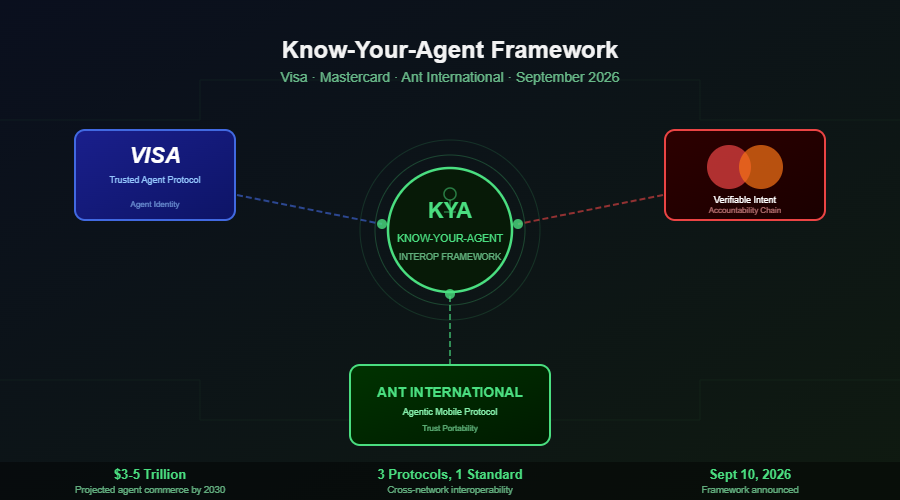
Three of the most powerful names in global payments have spent the last few years building competing systems for how AI agents should handle transactions. On September 10, 2026, they stopped competing and started collaborating. The result is the Know-Your-Agent (KYA) framework — and if it sticks, it could determine how trillions of dollars flow through AI-driven commerce over the next decade.
The announcement came from Ant International, Mastercard, and Visa simultaneously, a rare moment of public alignment among organizations that typically view each other as rivals. The three had each built their own protocols: Visa developed Trusted Agent Protocol, Mastercard created Verifiable Intent, and Ant International designed Agentic Mobile Protocol. All three were functional. None of them talked to each other.
That fragmentation was becoming a serious problem.
Why AI Agents Need Their Own Payment Identity Layer
When a human buys something online, the payment system needs to answer one question: is this the cardholder? There’s an established infrastructure for that — card numbers, billing addresses, CVVs, 3D Secure challenges, biometric authentication on mobile devices.
When an AI agent buys something on a human’s behalf, the question becomes more complicated: Is this a real AI agent? Which human authorized it? With what spending scope? Under what conditions? For how long?
These questions don’t have clean answers in the existing payment infrastructure. A human can be authenticated. An agent is a program running on a server, possibly operating across multiple platforms simultaneously, possibly spawning sub-agents to complete parts of a task, almost certainly not present in any way that traditional authentication can capture.
The absence of a standard has created a patchwork of workarounds. Some AI shopping agents store user credentials directly — a serious security exposure. Others use tokenized payment methods that give agents broad access when they only need narrow access. Enterprise deployments have built bespoke identity solutions that don’t generalize across platforms. The KYA framework is designed to solve this at the infrastructure level rather than leaving every platform to solve it individually.
What Know-Your-Agent Actually Establishes
The KYA architecture operates on three principles: identity verification, accountability, and trust portability.
Identity verification is the KYC equivalent for agents. Before an AI agent can transact, it needs to be registered with a participating network using credentials that establish what it is, who built it, who deployed it, and on whose behalf it operates. These credentials are verifiable in real time by merchants and platforms without requiring a direct call back to the original issuing authority.
Accountability is the chain of responsibility. Under KYA, every transaction initiated by an AI agent carries a clear mapping back to the human principal who authorized the action. This matters for fraud resolution, regulatory compliance, and dispute management.
Trust portability is perhaps the most commercially significant piece. A merchant on one platform can recognize and accept a KYA-verified agent from another platform without requiring a separate onboarding process. This is the interoperability piece that the three competing protocols couldn’t provide individually.
The framework also establishes what it calls “trust signals” — machine-readable attributes that indicate an agent’s authorization scope, spending limits, geographic restrictions, and behavioral history. A merchant can evaluate these trust signals in milliseconds and decide whether to accept the transaction without human intervention.
The $3–5 Trillion Stakes
Ant International, Visa, and Mastercard have jointly projected that AI agents will orchestrate between $3 trillion and $5 trillion of global consumer commerce by 2030. That projection appears in the official announcement documents and is being cited widely in payments industry analysis.
Whether or not the exact figure lands, the directional claim is hard to dispute. Agentic AI is already handling routine consumer transactions — flight bookings, subscription management, recurring purchases, comparison shopping, inventory restocking. The volume is growing quarter over quarter as AI assistants become more capable and more trusted by consumers.
The current friction isn’t in the AI capabilities. It’s in the payment infrastructure. An AI agent that can identify the best price for a product, apply the right coupon, time the purchase for a sale, and handle returns has limited value if it can’t actually complete the transaction reliably, securely, and in compliance with the relevant regulations. KYA is designed to remove that bottleneck.
How the Three Protocols Will Converge
The announcement is careful to call KYA a “collaboration” rather than a merger or replacement of the existing protocols. Visa’s Trusted Agent Protocol, Mastercard’s Verifiable Intent, and Ant International’s Agentic Mobile Protocol each have existing deployments and developer ecosystems. Those don’t disappear overnight.
What KYA provides is a semantic and technical bridge: a shared vocabulary for agent identity claims, a common API surface for trust verification, and agreed-upon minimum standards for what counts as adequate authentication for various transaction types.
The practical effect for developers: an AI agent built to comply with any one of the three existing protocols should, after an adaptation period, be able to transact across networks that run on any of the other two. The integration complexity and duplicative compliance work that currently plague cross-network agentic deployments should diminish substantially.
The Regulatory Dimension
The KYA announcement lands in a complex regulatory environment. The EU’s AI Act, now in its enforcement phase, imposes transparency requirements on AI systems that make decisions with material consequences for consumers — and purchasing decisions qualify. The US, following the passage of the Great American AI Act in June 2026, is working through its own ruleset for commercial AI.
KYA aligns well with both frameworks’ accountability requirements: the chain-of-trust architecture produces exactly the kind of audit trail that regulators want to see. Whether that was a deliberate design choice or a fortunate coincidence isn’t clear from the announcement materials, but the alignment gives the framework a significant tailwind in enterprise adoption.
Financial institutions in particular are watching KYA closely. Banks that issue cards under the Visa and Mastercard networks need to understand what liabilities they’re accepting when their cards are used by AI agents rather than by cardholders directly. KYA’s accountability framework gives those institutions a foundation to build their agent-specific card products on.
What Developers and Businesses Should Do Now
KYA is in its early days. The framework has been announced; implementations are still being built. But the trajectory is clear enough that forward-looking teams should start thinking about it now.
For businesses deploying AI agents to handle customer transactions — whether that’s expense management, supply chain procurement, or consumer shopping assistants — the KYA framework suggests a consolidation around the major payment networks rather than custom solutions. Building to the Visa, Mastercard, or Ant International standards, and anticipating KYA interoperability, is a safer long-term bet than building proprietary payment infrastructure.
For developers building agentic platforms, the key question is: what is your authentication and authorization story for payment actions? KYA gives you a framework to answer that question in a way that will be recognized across ecosystems rather than just within your own platform.
For everyone else, the upshot is simpler: the plumbing for AI agent commerce is being built right now, by the people who built the plumbing for human commerce. The next few years will determine whether that plumbing works smoothly enough that AI-mediated purchasing becomes routine — or whether friction and fragmentation slow the transition. The odds just got better that it works.


