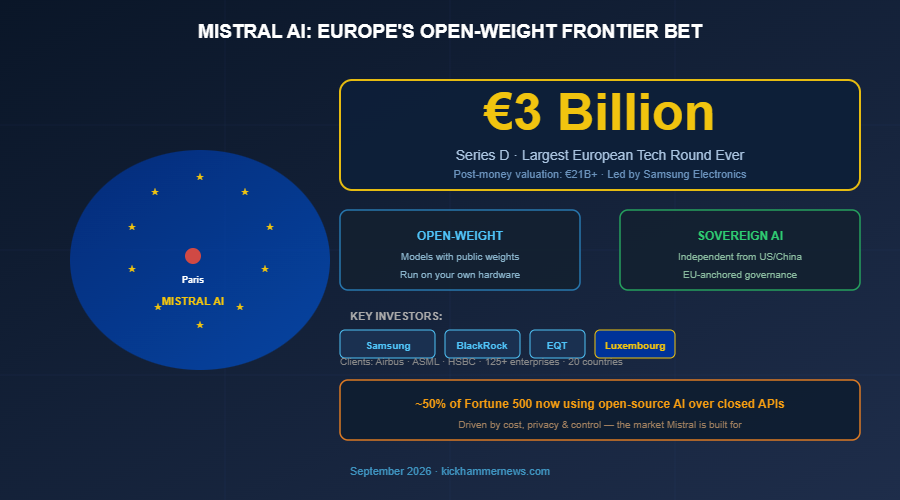
Six days ago, a Paris-based AI company that barely existed three years ago closed the largest equity fundraising round in European technology history. Mistral AI announced €3 billion in a Series D round led by Samsung Electronics, co-led by Scaleup Europe Fund managed by EQT, and joined by Advent, BlackRock funds, and — in an unusual move — the Grand Duchy of Luxembourg itself. The post-money valuation now sits above €21 billion.
The number is striking. The context is more interesting. Mistral is not raising this capital to build closed, proprietary models behind API paywalls in the style of OpenAI or Anthropic. It is raising capital to make open-weight AI competitive at the frontier — to prove that sovereign, auditable, and deployable-on-your-own-infrastructure AI can match what the closed labs produce.
If that bet pays off, it reshapes the entire industry. If it doesn’t, Mistral will have spent €3 billion trying.
The Open Weight Distinction
To understand why this round matters, it helps to understand the distinction Mistral is making. “Open-weight” AI refers to models whose weights — the numerical parameters that encode everything the model has learned — are publicly released. This is different from open-source software in important ways; the training data and training process may remain proprietary even if the weights are released. But releasing weights means that any organization, anywhere, can download and run the model on its own hardware, fine-tune it for specific tasks, and deploy it without any dependency on the model developer’s API or infrastructure.
This is not just a philosophical position for Mistral. It is a business model built around a specific thesis: that enterprises, governments, and infrastructure providers will increasingly refuse to run their critical AI workloads on APIs they don’t control, through companies they can’t audit, in datacenters located in jurisdictions with different legal frameworks.
That thesis has been gaining evidence. According to a recent report, roughly half of the Fortune 500 now uses open-source AI over rented APIs, with cost, privacy, and customization cited as the primary drivers. The trend Mistral is betting on is real, and it is accelerating.
Samsung in the Lead
The choice of Samsung as lead investor is not incidental. Samsung is one of the world’s largest producers of HBM memory, the high-bandwidth memory that makes running large language models at scale physically possible. Samsung is also a major consumer electronics company with hundreds of millions of devices that could run or connect to on-device AI. And Samsung operates its own semiconductor fab operations in a world where access to compute has become a geopolitical question.
A Samsung-led investment in an open-weight AI company is not just financial. It is a statement about vertical integration: Samsung benefits from a world in which AI runs on diverse hardware, not exclusively on NVIDIA chips communicating with OpenAI servers. The interests align cleanly.
The other investors tell a similar story. Scaleup Europe Fund and EQT represent European institutional capital looking for a European AI champion. The Grand Duchy of Luxembourg’s participation is particularly notable — a national government directly investing in frontier AI infrastructure is a new kind of sovereign bet, not on raw military capability but on economic and technological independence.
The Sovereignty Angle
Mistral’s announcement used the word “sovereign” prominently, and the choice of language is deliberate. In European policy circles, AI sovereignty has become a defining concern: the question of whether European governments, businesses, and institutions can build and deploy AI systems without depending on American or Chinese infrastructure.
The EU AI Act, now in active enforcement, has added regulatory pressure to this concern. Enterprises operating in the EU face transparency requirements, documentation obligations, and in some cases outright prohibitions on certain AI use cases. Running a closed American API means trusting that the API provider’s compliance posture aligns with your regulatory obligations. Running an open-weight model on your own infrastructure means you can audit the system yourself.
Mistral has positioned itself explicitly at the intersection of these concerns. The company now operates across 20 countries and serves over 125 global enterprises including Airbus, ASML, and HSBC. These are not startups running experimental prototypes. They are major industrial and financial institutions that have made Mistral central to mission-critical operations — precisely the use case where sovereignty, auditability, and control matter most.
The Competition
Mistral is not alone in the open-weight space. Meta’s Llama series has become the most downloaded family of open-weight models in history, and Meta’s resources dwarf Mistral’s even after this round. DeepSeek’s V4 Flash model, released in early August, has demonstrated that Chinese open-weight research can produce systems that beat leading closed models on agentic benchmarks.
What Mistral offers that neither Meta nor DeepSeek can match is European identity and governance. For governments, regulated industries, and enterprises that face specific concerns about data sovereignty or regulatory exposure, a model whose development is anchored in Paris, whose investors include European institutional funds and a European national government, and whose business model does not depend on advertising revenue or geopolitical alignment with any particular great power — that is a genuinely differentiated product.
Whether differentiation on governance is sufficient to compete on performance is the question Mistral’s €3 billion is meant to answer. The company has signaled that a significant portion of the capital will go toward expanding its frontier research capacity — training more powerful models, not just commercializing existing ones. This is the part of the announcement that matters most: Mistral is not just raising distribution capital. It is raising research capital to close the gap with the frontier labs.
What €21 Billion Buys
At a €21 billion valuation, Mistral is pricing itself as a company that will matter at the frontier, not just as a sovereign-aligned alternative for enterprises that can’t use American models. That is a bold claim for an organization that, as of its founding in 2023, did not exist.
Three years later, it has the largest equity fundraise in European tech history, a Samsung-led investor syndicate that spans institutional Europe and global semiconductor manufacturing, and a commercial footprint in some of the world’s most demanding industries.
The €3 billion will buy compute, researchers, and time. Whether it buys Mistral a seat at the frontier table — alongside OpenAI, Anthropic, Google DeepMind, and xAI — is the bet that every investor in this round has just made.
The open-weight AI thesis has never had more money behind it. The next eighteen months will determine whether it also has the right models.


