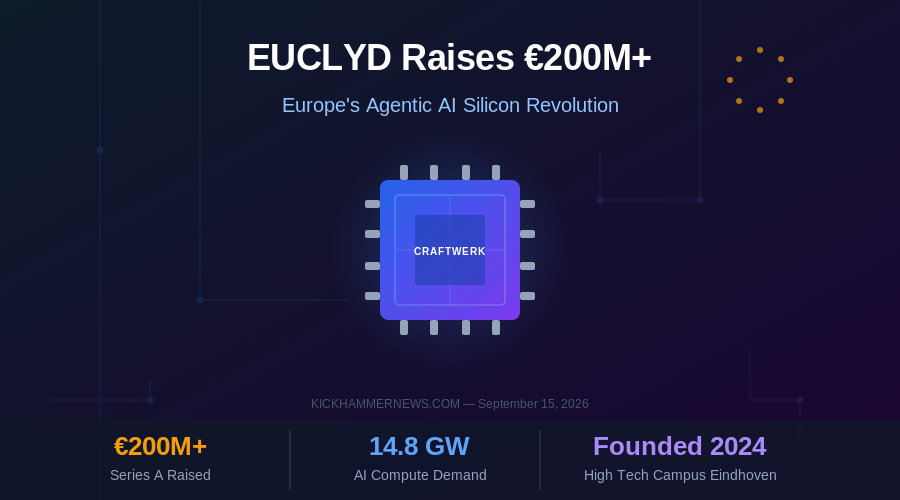
In a landmark moment for European technology, Eindhoven-based semiconductor startup EUCLYD has raised more than €200 million in a Series A funding round—one of the largest first institutional raises ever seen for a European deep-tech company. The announcement, made today, signals a major push to break what the company calls the “AI efficiency wall” and positions Europe as a serious contender in the global race to build the next generation of AI hardware.
A New Kind of AI Silicon
EUCLYD was founded in 2024 at High Tech Campus Eindhoven—often called the “smartest square kilometer in the world”—by Kastrup and Atul Sinha, veterans of the semiconductor and AI industries. In just two years, the company has developed what it claims is a fundamentally different approach to powering artificial intelligence workloads.
At the heart of EUCLYD’s offering are two products. The first, called craftwerk, is described by the company as the world’s first “agentic AI silicon”—a chip purpose-built not just for inference or training, but for running autonomous AI agents that need to reason, plan, and act over extended timeframes. The second product, the craftwerk station CWS, is billed as the world’s lowest-power exascale AI factory, promising to deliver unprecedented computational density with a fraction of the energy consumption of current GPU-based systems.
This distinction matters enormously. The AI industry is facing a dual crisis: skyrocketing compute costs and an energy consumption problem that is straining power grids across the United States, Europe, and Asia. EUCLYD’s non-GPU architecture is designed to attack both problems simultaneously. Rather than piling more GPU clusters into data centers—each requiring megawatts of power and billions of dollars in infrastructure—EUCLYD aims to deliver the same or greater inference throughput at dramatically lower energy cost.
The Backers Behind the Bet
The Series A was co-led by Samsung, Somerset Capital Partners, the EQT-managed Scaleup Europe Fund, and Innovation Industries, with additional participation from EIFO (Denmark’s export and investment fund), imec.xpand, the Brabant Development Agency, and Quadri. The diversity of the investor syndicate—spanning Asian tech giants, European sovereign-linked funds, and specialized deep-tech investors—underscores the global appetite for alternatives to the GPU duopoly that Nvidia currently dominates.
Perhaps the most eyebrow-raising name attached to this round is Peter Wennink, the former President and CEO of ASML, the Dutch company whose extreme ultraviolet lithography machines are an indispensable link in the semiconductor supply chain. Wennink, who stepped down from ASML in 2024 after a decade at the helm, has joined EUCLYD’s board as Chairman. His involvement lends the startup significant institutional credibility—and sends a clear signal to the semiconductor world that EUCLYD is not just another flashy pitch deck.
“Peter Wennink’s involvement is not cosmetic,” said one European tech investor familiar with the round. “He knows how to build a hardware company at scale, and he knows how to navigate the geopolitics of the semiconductor world. That’s exactly what EUCLYD needs as it moves from prototype to production.”
Why Now, and Why Eindhoven?
The timing of EUCLYD’s raise is no accident. The AI infrastructure buildout has created enormous demand for compute, but that demand is increasingly running into hard physical limits. Power availability is constraining data center expansion across major markets. The U.S. Senate recently passed the GRID Act precisely to address the energy demands of AI data centers, and countries from Germany to Singapore are grappling with similar questions about how to power the AI revolution sustainably.
Eindhoven, meanwhile, has emerged as one of Europe’s most vibrant technology clusters. Home to ASML, NXP Semiconductors, and a constellation of spin-offs from Philips, the region has deep engineering talent in photonics, chip design, and advanced manufacturing. EUCLYD’s founding on the High Tech Campus places it inside an ecosystem that few other locations in the world can match.
“Europe has always been strong in the physics and engineering of semiconductors,” said a spokesperson for Innovation Industries. “What EUCLYD is doing is taking that tradition and applying it to one of the most important problems of our generation: making AI sustainable.”
Challenging the GPU Paradigm
EUCLYD enters a competitive landscape that includes established players like Nvidia, AMD, and Intel, as well as a growing cohort of AI chip startups—Groq, Cerebras, SambaNova, and Tenstorrent among them—all pitching alternatives to GPU-heavy deployments. But EUCLYD’s focus on agentic AI silicon carves out a distinct niche.
The rise of autonomous AI agents—systems that can browse the web, write and execute code, manage files, and take actions on behalf of users over hours or days—has created new compute requirements that GPUs were not designed to meet. Agents need to maintain context over long time horizons, make rapid decisions, and operate efficiently at smaller batch sizes than the massive parallel workloads that GPUs were optimized for. A chip designed from first principles for this new paradigm of computing could offer significant advantages.
“Agentic workloads are fundamentally different from training runs,” noted one AI infrastructure researcher. “You need chips that can handle diverse, low-latency tasks at high efficiency. The craftwerk architecture, if it delivers on its promises, could be a very good fit for the agent era.”
What Comes Next
EUCLYD has not yet announced production timelines or disclosed which AI labs or cloud providers might become early customers, but the scale of the funding—and the stature of its backers—suggests the company is serious about moving fast. The €200M+ round will fund continued silicon development, tape-out costs, and the buildout of the craftwerk station CWS product line.
For Europe’s technology ecosystem, the raise is a rare moment of genuine optimism. At a time when the AI landscape is dominated by American hyperscalers and Chinese state-backed programs, a two-year-old Dutch startup landing a quarter-billion-euro bet on homegrown chip innovation is the kind of headline the continent has been waiting for.
Whether EUCLYD can translate its ambitious architecture into silicon that ships on time and performs as advertised remains to be seen. But with Peter Wennink in the chairman’s seat, Samsung at the table, and €200M in the bank, Europe’s answer to Nvidia just became a lot harder to dismiss.
*Sources: EU-Startups, Bloomberg, PR Newswire, Unite.AI, Techzine Global*


