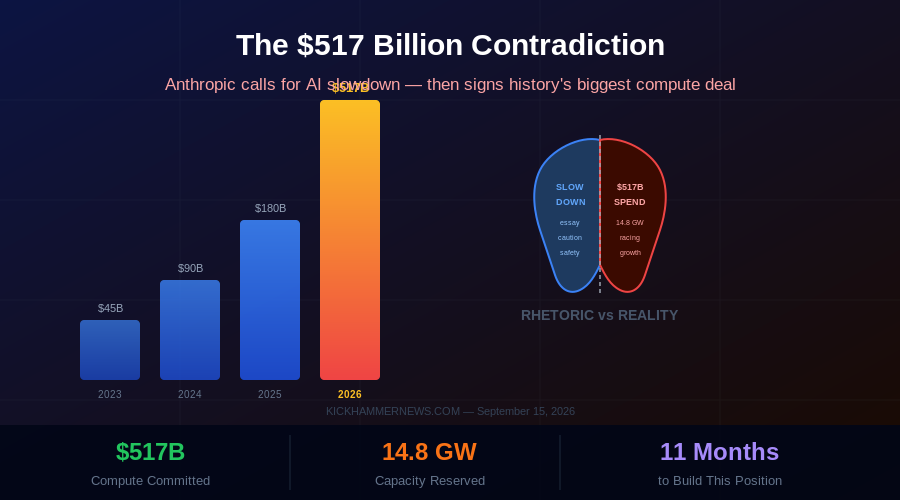
In the annals of corporate double-speak, it will be hard to top this one. Dario Amodei, CEO of Anthropic and one of the most prominent voices calling for careful, measured development of artificial intelligence, has published an essay urging the AI industry to slow down. Meanwhile, behind closed doors, Anthropic has quietly agreed to $517 billion in compute commitments—more than the GDP of most countries—covering 14.8 gigawatts of capacity and spanning at least a dozen providers including AWS, Google, and SpaceX.
The gap between Amodei’s public rhetoric and his company’s private behavior has set the technology world buzzing, raising pointed questions about the sincerity of AI safety advocacy, the relentless economics of frontier model development, and whether any company, however well-intentioned, can actually afford to slow down.
The Scale of the Commitment
The $517 billion figure, first reported by The Information, is almost incomprehensibly large. To put it in context: it is nearly triple the roughly $180 billion estimate that Anthropic disclosed to investors through 2029. It covers 14.8 gigawatts of compute capacity—enough to power a small nation. Four additional deals were struck since July alone, suggesting the commitments are still growing.
The deals span a striking range of providers. AWS is a major partner, anchoring a $100 billion, ten-year agreement signed in April 2026 that alone provides access to up to five gigawatts for training and operating Claude models. Google is also in the mix, alongside SpaceX—reflecting both Anthropic’s need for sheer compute scale and the increasingly intertwined nature of the AI infrastructure ecosystem.
The structure of many of these deals is particularly notable. Industry sources describe them as “take-or-pay” agreements—meaning Anthropic owes minimum payments whether or not it actually uses the capacity it has reserved. That is a massive financial bet: a wager that AI demand will continue growing aggressively enough to justify reserving more power than many countries use to keep the lights on.
The Essay That Started the Conversation
Amodei published his essay, titled “The Urgency of Slowdown,” in August 2026, amid growing debate in Washington and Silicon Valley about the pace of frontier AI development. In it, he argued that the AI industry is moving faster than society’s ability to understand and manage the risks, and called on peers to voluntarily pace themselves at the frontier. The essay drew praise from AI safety researchers and criticism from competitors who called it self-serving.
But the timing proved awkward when reporting about Anthropic’s compute commitments emerged. Critics were quick to point out that a company signing $517 billion in take-or-pay compute deals is not exactly positioning itself for a leisurely stroll. If Anthropic genuinely believed the industry should slow down, critics asked, why was it reserving enough compute capacity to train models that don’t exist yet for years to come?
Amodei and Anthropic have pushed back on this characterization. The argument, as best as it can be reconstructed from public statements, goes something like this: Anthropic believes it is safer to have safety-focused labs at the frontier than to cede ground to developers less focused on safety. Securing compute is not about racing ahead recklessly—it is about ensuring that Anthropic remains a relevant voice in shaping where AI goes, rather than being left behind while others race ahead without the same commitments to responsible development.
It is a coherent argument. It is also, skeptics note, exactly the argument that every participant in a race makes when they want to justify running faster while telling everyone else to slow down.
The Broader Pattern
Anthropic is not alone in this dynamic. OpenAI, Google DeepMind, Meta, and virtually every other major AI developer talks about safety, responsibility, and the importance of careful governance—while simultaneously spending tens of billions on compute, hiring aggressively, and racing to release new model generations faster than competitors. The compute numbers reveal what the press releases obscure: every major player believes, at a gut level, that whoever builds the most powerful AI first will have an enormous and perhaps irreversible advantage.
This is sometimes called the “race dynamic” in AI circles, and it is the central challenge facing both the industry and policymakers. Even developers who genuinely believe safety matters have strong structural incentives to keep accelerating, because stepping off the treadmill unilaterally means watching competitors surge ahead. Anthropic’s $517 billion commitment is perhaps the clearest illustration yet of how powerful those incentives are.
The contradiction does not make Amodei a hypocrite, necessarily. Running hard while calling for everyone to slow down might reflect a genuine strategic calculation: the best way to influence where frontier AI goes is to be at the frontier. But it does raise uncomfortable questions about whether voluntary slowdown—the policy Amodei’s essay advocates for—can ever be more than aspiration when the structural incentives point so strongly in the other direction.
What $517 Billion Buys
To understand what Anthropic is actually building toward with these commitments, it helps to think about what 14.8 gigawatts of compute capacity enables. For reference, training GPT-4 reportedly required on the order of 25,000 Nvidia A100 GPUs for roughly 90 to 100 days. The next generation of models—whatever Anthropic calls them—will likely require far more. Capabilities that currently seem out of reach, from genuine scientific reasoning to reliable autonomous agents operating over weeks or months, almost certainly require orders of magnitude more compute than today’s frontier systems.
In that context, Anthropic’s commitments start to look less like a company planning to slow down and more like one planning to sprint. The 14.8 gigawatts is not operational today; it represents reserved future capacity. But the take-or-pay structure means Anthropic is betting its balance sheet that it will need—and can monetize—that capacity before the contracts expire.
The Financial Risk Nobody Talks About
Hidden inside the story of astronomical spending is a more mundane but arguably more important risk: what happens if AI adoption doesn’t scale as fast as these commitments assume?
The take-or-pay structure is the tell. If Anthropic was confident it would use every gigawatt it reserved, there would be no reason to mention the minimum payment obligations. But the fact that these deals come with floors—payments owed even if demand softens—means Anthropic is making a bet about the future trajectory of AI adoption that is difficult to unwind. If a regulatory crackdown, a major safety incident, or simply slower-than-expected enterprise adoption causes AI demand to plateau, Anthropic could find itself paying for compute it doesn’t need, at a scale that would dwarf the write-downs that have embarrassed other technology companies in past cycles.
The company crossed into profitability for the first time in the most recent quarter, a milestone celebrated across the AI industry. But profitability at current scale is very different from profitability at the scale these commitments imply.
A Defining Moment for AI’s Soul
Whatever one makes of the contradiction at the heart of Anthropic’s position, the $517 billion number is a Rorschach test for how you see the AI moment we’re living through. It can be read as evidence that safety and acceleration are ultimately incompatible—that even the most thoughtful actors in the space cannot resist the pull of the race. Or it can be read as evidence that Anthropic has decided the only way to keep AI development on a safe trajectory is to be the one doing it, at scale, faster than anyone else.
Dario Amodei wants AI to slow down. His company just committed half a trillion dollars to making sure it doesn’t have to.
*Sources: The Information, Yahoo Finance, Forkast News, Investing.com, ExplainX.ai*


