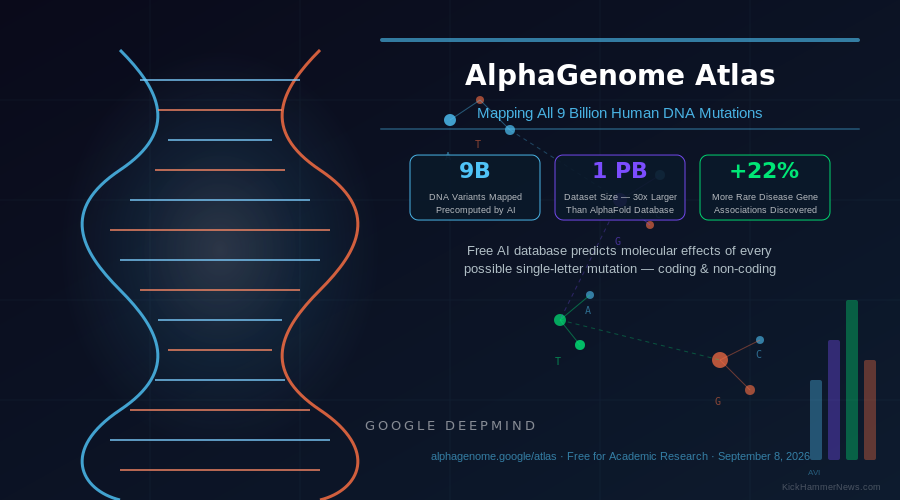
For decades, one of the most formidable challenges in genetic medicine has been a simple but staggering problem of scale: the human genome contains roughly 3 billion DNA base pairs, and any single one of them can mutate into one of three alternative letters. That means there are approximately 9 billion possible single-nucleotide variants in the human genome. Testing each one in a laboratory would require many human lifetimes. Prioritizing which variants matter — and why — has been a slow, expensive, and often frustrating art.
Google DeepMind just changed that.
On September 8, 2026, the company unveiled AlphaGenome Atlas, a free, 1-petabyte database that contains precomputed AI predictions for the molecular effects of all 9 billion possible single-letter DNA mutations in the human genome. The resource, available at alphagenome.google/atlas, is being described by researchers as the most comprehensive catalogue of genetic variant effects ever created — and the implications for disease research are profound.
From Protein Structures to the Genome’s Regulatory Dark Matter
To understand why AlphaGenome Atlas matters, it helps to recall AlphaFold. When DeepMind released its protein structure prediction database in 2022 and expanded it to over 200 million structures, the life sciences community experienced what many called a step-change in structural biology. Labs that previously spent months determining a protein’s 3D shape could now look it up in seconds.
AlphaGenome Atlas aims to do something similar — but for the regulatory layer of the genome rather than protein structures. Proteins only account for about 2% of human DNA. The remaining 98%, long dismissed as “junk,” is now understood to orchestrate when and how genes are switched on or off. It is also where the vast majority of trait-associated variants discovered in genome-wide association studies actually live. This regulatory non-coding genome has resisted systematic interpretation, in large part because the combinatorial space was simply too large to analyze manually.
AlphaGenome Atlas tackles that head-on. Built on DeepMind’s existing AlphaGenome model — which can already predict how genetic variants affect molecular biology — the new Atlas precomputes AlphaGenome’s predictions for every possible single-nucleotide variant across the entire genome, creating a giant reference catalogue that researchers can query without running the model themselves.
“Our own workflows in the lab can be streamlined quite a bit because we don’t actually have to compute anything,” said psychiatrist Jonathan Sebat in Scientific American. “We literally can just look up everything.”
The AVI Score: One Number to Rule Them All
Buried within the Atlas is one of its most practical innovations: the AlphaGenome Variant Impact (AVI) score. Rather than asking researchers to navigate thousands of molecular predictions per variant — RNA splicing effects, chromatin accessibility, gene expression changes across hundreds of cell types — the AVI score condenses all of that into a single number ranking a mutation’s likely biological impact.
The score is deliberately comprehensive. It integrates predictions from both AlphaGenome and AlphaMissense (DeepMind’s earlier model for protein-coding variants), meaning it works across the full genome: the 2% of DNA that codes for proteins and the 98% that doesn’t. In benchmark testing against pathogenicity databases and rare disease datasets, DeepMind reports the AVI score delivers best-in-class performance.
Each AVI score also comes with feature attributions — a breakdown of which biological processes (RNA splicing, chromatin accessibility, conservation, transcription factor binding) are predicted to be most disrupted by a given variant. This gives researchers both a fast shortlist and a mechanistic explanation to follow up on.
Real-World Results: From Epilepsy to BMI
The Atlas was not released as a theoretical exercise. DeepMind’s external research collaborators have already been testing it on real, unsolved problems — with striking results.
Rare disease diagnosis. The GREGoR Consortium, a cross-institutional effort coordinated through the Broad Institute of MIT and Harvard, applied the AVI score to prioritize candidate variants in patients with unexplained rare diseases. In one case, researchers led by Laura Covill and Anne O’Donnell-Luria identified a non-coding variant in the DNM1 gene — a gene strongly associated with epileptic encephalopathy — that had been overlooked in previous analyses. AlphaGenome’s predictions showed precisely how the variant functioned: it created a spurious splice site, causing the cell’s machinery to produce an abnormally extended protein. The prediction was subsequently validated experimentally.
Population genetics. Gareth Hawkes, a Medical Research Council fellow at the University of Exeter, applied AlphaGenome Atlas to whole-genome sequencing data from over 54,000 participants in the UK Biobank. By grouping rare non-coding variants according to their predicted molecular effects, Hawkes uncovered 22% more non-coding genetic associations that would otherwise have been statistically invisible. These included regulatory variants affecting circulating levels of PLA2G7 (linked to aging) and EGLN1 (a critical cellular oxygen sensor). When he focused the same approach on body mass index, restricting attention to the top 1% of non-coding variants by AVI score, he identified 19 genetic regions associated with BMI.
Molecular biology. Julia Zeitlinger and Melanie Weilert at the Stowers Institute for Medical Research used the Atlas’s compendium of over 2,500 recurrent DNA sequence motifs — the “words” of the genome — to categorize which transcription factors merely alter DNA accessibility versus which ones also activate gene expression. The work, according to Zeitlinger, gives researchers “a searchable dictionary for non-coding DNA.”
Scale and Accessibility
The AlphaGenome Atlas is more than 30 times larger than the AlphaFold Database at launch. At 1 petabyte, the dataset itself is not downloadable in full, but DeepMind has built an intuitive web portal that allows any academic researcher to type in a variant and immediately retrieve predictions — no coding experience required. An API is also available for programmatic access, and the Atlas has been integrated into Google’s Antigravity agentic research platform, allowing scientists to incorporate variant lookups into automated analysis pipelines.
Access for non-commercial use is free from today. Commercial access through Google Cloud is expected to follow shortly.
Limitations and Caveats
DeepMind is careful about what the Atlas is — and is not. The predictions describe molecular effects: how a given DNA change is expected to affect gene regulation, splicing, and protein biology. They are not diagnoses. A high AVI score is evidence to be weighed alongside clinical data and experimental results, not a standalone verdict.
The Atlas also covers only single-nucleotide variants — one-letter changes in the DNA sequence. Insertions, deletions, copy-number variants, and structural rearrangements, which also drive substantial disease burden, are not included in this release. DeepMind frames the current Atlas as a baseline rather than an endpoint, noting that as AlphaGenome improves, future versions of the Atlas will become more comprehensive and precise.
The Broader Picture
AlphaGenome Atlas arrives during a period of accelerating AI involvement in biology. Over the past few years, AI has moved from predicting protein folding to designing novel proteins, from analyzing medical images to drafting clinical notes. What DeepMind has done with the Atlas is compress decades of potential experimental work into a queryable database — not replacing laboratory science, but fundamentally changing what questions scientists choose to pursue in the lab.
For anyone working in genomics, rare disease research, drug target discovery, or population genetics, the Atlas represents a new starting point. The map of every possible DNA mutation now exists. The question is what researchers choose to do with it.
AlphaGenome Atlas is available now at alphagenome.google/atlas for academic research.


