*September 15, 2026* | By KickHammer Tech
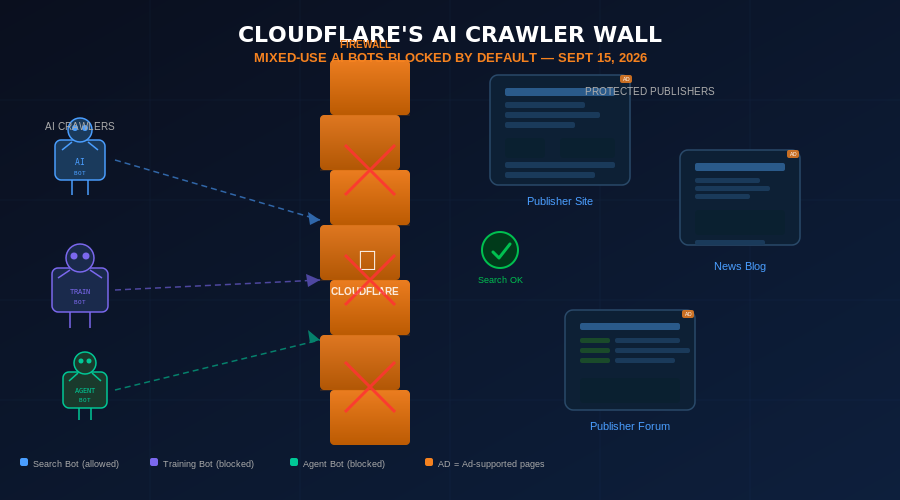
Today marks a turning point in the ongoing battle over who gets to profit from the world’s published content. Starting this morning, Cloudflare — the company that protects and accelerates roughly 20% of all internet traffic — has flipped the switch on a policy months in the making: by default, AI crawlers that blend search indexing, agent retrieval, and model training into a single bot are now blocked from any ad-supported page on its network.
The internet’s invisible architecture just chose a side.
What Changed at Midnight
On July 1, 2026, Cloudflare gave every customer access to a new traffic sorting panel that divides automated web crawlers into three distinct categories: Search, Agent, and Training. Site owners could review which bots fell into which bucket and adjust permissions accordingly. It was opt-in — a grace period of sorts.
That grace period ended today.
As of September 15, 2026, the default posture for new Cloudflare customers, any new domains added by existing customers, and all existing free-plan users has changed. On pages that display advertising, the Training and Agent categories are now blocked without any publisher needing to lift a finger. Search crawlers — think traditional Googlebot for web indexing — remain allowed by default.
For the roughly 52% of crawler traffic on Cloudflare’s network now classified as AI-related (up from just 22% in spring 2025), this is a seismic shift.
The Mixed-Use Crawler Problem
The crux of the issue is what Cloudflare calls the “mixed-use” crawler: a single bot that blends multiple jobs under one user-agent string. A crawler from a major AI company might simultaneously be indexing a site for search results, pulling page content to feed a real-time AI agent, and harvesting data to train the next generation of a large language model — all in one pass, indistinguishable from a normal search crawler.
Publishers had no practical way to consent to one use while blocking another. Robots.txt, the traditional mechanism for signaling crawler permissions, was never designed for this level of nuance. It’s a blunt instrument for a problem that now requires surgical precision.
Cloudflare’s solution is to require AI companies to disaggregate their crawlers. Under the new policy, a company like Google would need to deploy distinct crawlers with distinct user-agent strings for each function: one for traditional search indexing, another for Gemini’s AI agents, and a separate one for training data collection. Publishers can then choose, in granular detail, which activities they permit on their properties.
Why Ad-Supported Pages Are Ground Zero
The policy’s focus on ad-supported pages is deliberate and strategically significant. Display advertising remains the lifeblood of the open web — news sites, blogs, forums, specialist publications. These are also, not coincidentally, the richest sources of high-quality human-written text that AI companies covet for training data.
The economic logic is straightforward. When an AI crawler scrapes an article, it consumes the content without triggering the ad impressions that fund its creation. Worse, it may help build AI products that eventually replace the user who would have visited — and seen ads — in the first place. Publishers have long complained that AI companies are strip-mining the web without compensation. Cloudflare’s policy turns that complaint into enforceable infrastructure.
According to Cloudflare’s own market analysis, AI training crawlers now account for more than half of all automated requests on its network. That’s not a niche problem. That’s the new normal — and publishers had been largely powerless to address it until now.
Who Gets Blocked — and Who Doesn’t
The scope of today’s change is significant but not unlimited. The new defaults apply to:
- New Cloudflare customers signing up from today forward
- New domains added to existing Cloudflare accounts
- All existing free-plan customers — which represents a substantial portion of the web’s smaller publishers
Enterprise and business-tier customers who were already using Cloudflare before today are not automatically switched — they retain their existing configurations, though they can opt into the new defaults or customize their settings via the traffic management panel.
Critically, site owners remain in control. A publisher who wants to allow AI training crawlers — perhaps in exchange for a licensing deal — can whitelist specific bots. The policy doesn’t prohibit AI training from happening; it simply changes who has to take action to allow it. The burden has shifted from publishers having to block scrapers to AI companies having to negotiate access.
The Ripple Effects for AI Developers
For teams building AI agents and retrieval-augmented generation (RAG) systems, today’s change creates immediate operational headaches. If your agent uses a crawler that Cloudflare classifies as mixed-use — or if you simply haven’t registered a distinct user-agent string for agent retrieval — you may find your system hitting walls on millions of publisher sites without warning.
The developer community has been tracking this deadline closely, noting that many smaller AI startups and open-source agent frameworks haven’t updated their crawler configurations. Requests that returned content last week may now return 403 errors or Cloudflare challenge pages.
The practical advice for agent builders: audit your crawler’s user-agent string today, ensure it accurately identifies the crawler’s purpose, and check whether Cloudflare recognizes it as a distinct, single-purpose bot. If your agent retrieval system shares infrastructure with a training pipeline, that architecture may now need to be redesigned.
A New Web Forming
Zoom out, and today feels like the end of an era. The early web operated on an implicit social contract: content was freely available to all comers, human or bot. Search engines built empires on that openness, and publishers benefited from the traffic those engines returned.
Generative AI broke that contract. It vacuumed up content to build products that answer questions directly — no click required, no ad impression served, no publisher compensated. The web’s publishers tolerated it at first, then grew angry, then began filing lawsuits. Cloudflare’s policy is the infrastructure layer catching up with that anger.
It won’t be the last such move. Similar discussions are underway at CDN and hosting providers across the industry. Browser makers, DNS operators, and search engines are all grappling with how to navigate a web where the old rules of access no longer reflect economic reality.
What Cloudflare has done is give publishers a default that actually protects them — and given AI companies a clear signal: if you want the web’s content, you’re going to have to negotiate for it.
The age of free scraping is over. The era of content licensing has begun.
*Sources: Cloudflare Blog, TechCrunch, Help Net Security, NovaProxy, fastCRW, AI Insider Tech*


