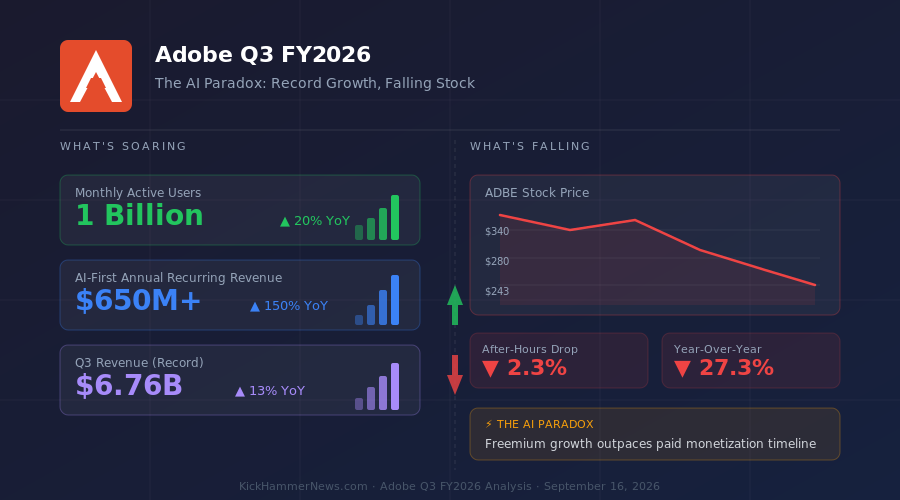
Adobe delivered what should have been a triumphant earnings report on September 10, 2026. The creative software giant surpassed $6.76 billion in quarterly revenue for the first time, blew past analyst estimates, raised its full-year guidance, and announced that monthly active users across its entire portfolio had crossed 1 billion for the first time in company history. Its AI-first annual recurring revenue is growing at 150% year-over-year. By every operational metric, Adobe is executing at a remarkable level.
And yet, shares fell 2.3% in after-hours trading to $243.08. As of today, Adobe stock is down more than 27% year-over-year.
Welcome to the AI paradox of 2026: the companies generating the most impressive AI growth numbers are often being punished by the same investors who demanded AI strategies three years ago.
The Numbers Behind the Milestone
Adobe’s fiscal Q3 2026 results, reported after markets closed on September 10, came in ahead of expectations on nearly every key metric. Revenue of $6.76 billion exceeded the analyst consensus of $6.69 billion and grew 13% year-over-year. Non-GAAP earnings per share came in at $6.13, ahead of the $6.08 estimate.
The headline number that captured most attention was users. Adobe now serves more than 1 billion monthly active users across its creative, document, and marketing cloud offerings — a figure that has grown more than 20% year-over-year. Within that, creative freemium monthly active users crossed 100 million, a staggering 70% jump compared to the same period last year. Adobe attributed much of this growth to its Firefly generative AI tools, which are freely accessible to non-paying users as part of a freemium strategy designed to build the top of the funnel.
The AI revenue metrics were equally striking. Adobe’s AI-first ending annual recurring revenue now exceeds $650 million and is growing at more than 150% year-over-year. Firefly ending ARR grew 40% sequentially in the quarter — a rate that, if sustained, would make it a multi-billion dollar business within 18 months.
The Market’s Skepticism
So why the after-hours selloff?
The answer lies in what Wall Street calls “monetization timing risk.” Adobe is generating massive user growth through its freemium AI strategy, but converting those users to paying subscribers remains the central unproven challenge. Investors noted that while monthly active users crossed 1 billion, the company’s subscriber growth in its core Digital Media segment, which includes Creative Cloud, grew at a more measured pace.
Adobe management acknowledged on the earnings call that converting AI-native users to paid subscriptions remains a “multi-quarter journey.” That language, combined with Q4 guidance that, while raised, came in at the low end of what some analysts had modeled, was enough to tip sentiment negative.
The cautious reaction reflects a broader dynamic in enterprise and creative software markets in 2026. AI tools have dramatically lowered the barrier to creation, drawing in hundreds of millions of casual users who are content to use free tiers. Turning them into paying customers requires product hooks, habit formation, and pricing models that are still being refined across the industry. Adobe is arguably better positioned than most to solve this problem — it has the brand trust, the professional ecosystem, and the creative workflow integration that casual AI tools lack — but the path from 1 billion users to proportional revenue has yet to be fully walked.
Firefly’s Evolving Role
Adobe’s Firefly generative AI suite has been the growth engine behind much of these numbers. Firefly, which launched in 2023 as a commercially safe alternative to competing image generators, has since expanded into video generation, vector graphics, 3D asset creation, and audio processing. The suite is now embedded across Photoshop, Illustrator, Premiere Pro, After Effects, and Acrobat.
On the earnings call, CEO Shantanu Narayen highlighted that Firefly’s expanding capabilities are driving both professional and prosumer usage. “The breadth of creative tasks that Firefly now handles natively within our applications has fundamentally expanded the value proposition for existing subscribers and is attracting a new generation of creators,” Narayen said. “One billion monthly active users is not just a milestone — it is validation that creative software has become infrastructure.”
Narayen also noted that Adobe’s enterprise marketing cloud business is seeing strong momentum from AI-powered personalization tools. The Adobe Experience Platform, which underpins much of the enterprise business, is increasingly being used to run AI-driven content supply chains that generate and deploy personalized creative assets at scale.
The CEO Transition Factor
Adobe’s earnings week carried an additional subplot: the formal confirmation of the CEO transition announced alongside the results. Anil Chakravarthy, currently President of Customer Experience Orchestration, will become Adobe’s next President and CEO effective December 1, 2026, with Narayen transitioning to Executive Chairman.
Chakravarthy is a seasoned Adobe executive who previously led the Informatics business at Veritas and has been instrumental in building Adobe’s enterprise data platform strategy. His appointment signals that Adobe’s next chapter will be focused on deepening enterprise AI workflows rather than simply growing the consumer user base — a strategic pivot that analysts generally view as appropriate given the monetization challenges in the freemium segment.
The leadership transition, while well-telegraphed following the September 6 announcement, added an element of uncertainty to the earnings narrative. Investors tend to reprice risk upward during management transitions, even orderly ones, and that caution appears to be reflected in the current stock price.
Adobe’s Structural Position
Stripped of short-term stock dynamics, Adobe’s structural position in 2026 remains formidable. The company controls the industry-standard creative workflow from photography to video to print to digital marketing. Its intellectual property in trained generative AI models is defensible and commercially licensed. Its enterprise relationships are deep and sticky.
The 1 billion user milestone is not just a vanity metric. It represents an installed base that, if even a fraction converts to paid subscribers over the next three years, would represent a revenue opportunity that dwarfs the current AI ARR. Adobe’s challenge — and its opportunity — is that it is effectively running the largest creative freemium platform in history while simultaneously operating a mature, profitable enterprise software business.
The Broader Lesson
Adobe’s September 10 earnings report is a useful lens through which to understand the AI software moment of late 2026. The companies that invested heavily in AI product development are seeing the user-growth payoff. The monetization story, however, is proving to take longer than the timelines analysts baked into their 2023 and 2024 models.
Adobe’s raised full-year guidance — now targeting $26.58 to $26.63 billion in revenue — suggests management remains confident in its trajectory. Full-year non-GAAP EPS guidance was raised to $24.10 to $24.25. These are not the numbers of a company in distress.
The stock market’s cautious response is less a verdict on Adobe’s execution than on the pace at which AI enthusiasm translates into line-item revenue. Adobe is threading that needle more carefully than most. The 1 billion user milestone may, in retrospect, mark the moment the flywheel became undeniable.


