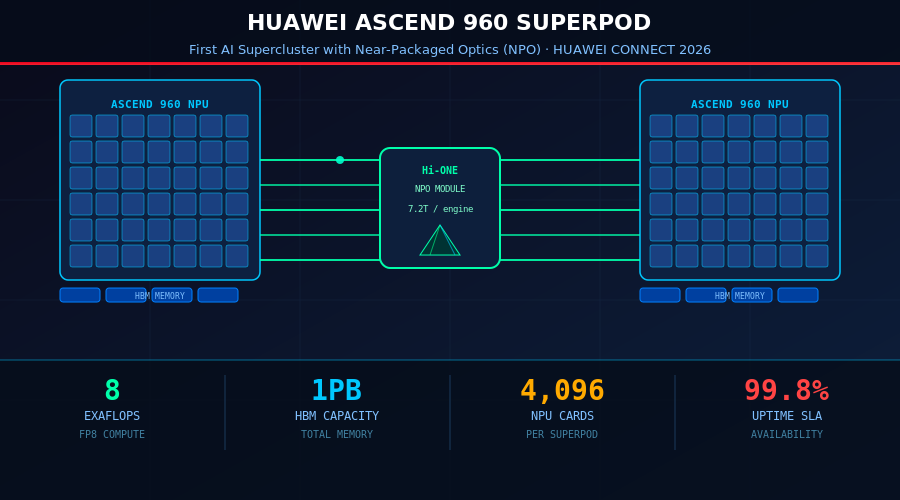
At HUAWEI CONNECT 2026 in Shanghai today, Huawei unveiled what it is calling a generational leap in AI infrastructure: the Ascend 960 SuperPoD, a supercomputer cluster the company claims is the industry’s first to deploy Near-Packaged Optics (NPO) as its interconnect backbone. The announcement lands squarely in Nvidia’s territory — and analysts are taking notice.
What Is the Ascend 960 SuperPoD?
The Ascend 960 SuperPoD is Huawei’s answer to the relentless demand for AI training compute. At its peak configuration, the system houses 4,096 NPU cards and delivers 8 exaflops of FP8 computing power alongside 1 petabyte of HBM memory capacity. To put that in perspective, 8 exaflops is eight quintillion floating-point operations per second — the kind of raw power needed to train the next generation of frontier AI models.
But the headline spec isn’t the chip count or the exaflops figure. It is the networking architecture underneath it all.
Near-Packaged Optics: The Secret Ingredient
Traditionally, large-scale AI clusters connect their accelerators with hundreds of thousands of individual optical transceivers — modules that convert electrical signals to light for high-speed transmission across fabric networks. Those modules are expensive, power-hungry, and can fail. A cluster of this scale would typically require around 48,000 800G optical modules just for the interconnect layer.
Huawei has ripped that architecture out entirely. In its place sits Hi-ONE, the company’s proprietary Near-Packaged Optics module. NPO places the optical engine directly beside the compute silicon rather than at the end of a copper trace — shortening signal paths, slashing power overhead, and dramatically improving reliability.
The Ascend 960 SuperPoD uses only 5,500 Hi-ONE modules to replace those 48,000 legacy transceivers. The result: power consumption drops by more than 550 kilowatts per cluster, system uptime doubles, and the cluster achieves 99.8% measured availability. Each Hi-ONE module delivers 7.2 terabits per second of bandwidth, and Huawei’s UnifiedBus Interconnect technology allows a single SuperPoD to address up to 4,000 processors simultaneously in a flat fabric topology.
Why This Architecture Matters for AI Training
AI training at frontier scale is not bound solely by raw compute. It is increasingly bound by memory bandwidth and inter-chip communication latency. When a model’s parameter count runs into the hundreds of billions, the ability to shuffle activations and gradients between chips quickly — and without burning watts on the interconnect — can determine whether a training run is economically viable.
Huawei’s approach mirrors a trend already underway at Nvidia, whose NVLink technology has similarly prioritized tight chip-to-chip bandwidth. But NPO offers a different trade-off: rather than the proprietary, high-density silicon photonics of NVLink, Huawei’s Hi-ONE modules can be integrated into existing rack and chassis designs, potentially making upgrades less disruptive for data center operators.
The 99.8% availability figure is also significant for enterprise buyers. At exaflops scale, a single hardware failure can halt a multi-day training job and waste thousands of GPU-hours of compute. By reducing the component count in the optical layer by nearly nine-to-one, Huawei has engineered fewer physical points of failure into the system.
The Geopolitical Backdrop
No Huawei AI hardware announcement exists in a political vacuum. The company remains on the US Entity List, meaning American companies cannot supply it with the most advanced chips or chip-making equipment without an export license. That restriction has pushed Huawei to develop its Ascend line of NPUs domestically, using SMIC’s mature-node processes rather than TSMC’s leading-edge nodes.
That constraint has historically placed Huawei’s AI chips behind Nvidia’s in raw per-chip performance. The Ascend 960 SuperPoD appears to be Huawei’s deliberate response: if you cannot win the single-chip benchmark race, engineer the system so that the fabric, the memory subsystem, and the cluster management layer become the competitive moat instead.
Chinese cloud providers, state-backed research institutes, and enterprise AI labs operating inside China cannot access Nvidia’s H100 or B200 chips under US export controls. For that market, Huawei’s Ascend ecosystem is the de facto alternative — and the Ascend 960 SuperPoD is its most credible entry yet.
Timeline and Availability
Huawei confirmed that two variants are on the roadmap. The Ascend 960DT is tracking three quarters ahead of its original schedule and is expected to be ready in the first quarter of 2027. The Ascend 960PR, which likely targets inference-optimized workloads given the PR designation, is one quarter ahead of schedule and is slated for the third quarter of 2027.
That cadence suggests Huawei plans to have production-grade hardware in the field well before the end of next year — fast by the standards of custom silicon programs of this complexity.
The Bigger Picture
The Ascend 960 SuperPoD is more than a hardware announcement. It signals that Huawei’s AI chip ambitions have matured past the single-accelerator benchmark game and into full-system competition. The introduction of NPO as a differentiator echoes how Nvidia reframed its own competitive position years ago: from selling GPUs to selling the CUDA ecosystem and then the full DGX SuperPOD stack.
Whether Huawei can replicate that kind of platform lock-in outside China remains an open question. Its software stack — CANN and the MindSpore framework — lacks the decade of developer momentum that CUDA has accumulated. Attracting model developers to optimize for Ascend will be a slow process even if the hardware delivers on its specifications.
But hardware matters first, and today Huawei put serious hardware on the table. For the growing portion of global AI compute that sits outside Nvidia’s commercial reach, the Ascend 960 SuperPoD is a compelling infrastructure bet — and a clear sign that the race to build the world’s most powerful AI clusters has at least two credible contestants.
*Sources: Digitimes, Huawei Central, InsideAI.news, SaudiShopper, CoinReporter, AllWeatherFinance*


