As AI systems have moved from science fiction into the daily rhythms of work, finance, and communication, the technology is no longer an abstract concern. For hundreds of millions of workers around the world, it is a present-tense question: Will this technology take my job? According to a landmark study released September 17, 2026, by the Pew Research Center, the answer most people believe is yes — and that fear is only growing.
The survey, which polled 42,151 adults across 37 countries between February and June 2026, paints a portrait of a world caught between fascination and dread. In 34 of the 37 countries surveyed, more people believe AI will lead to fewer jobs over the next 20 years than those who think it will create more. The data arrives at a moment when AI capabilities have expanded dramatically — from large language models writing code and legal briefs to autonomous agents handling complex business workflows — and public awareness of those capabilities has never been higher.
The Paradox of Prosperity and Fear
Perhaps the most counterintuitive finding in the report is that fear of AI-driven job loss is most pronounced in wealthy nations, not poorer ones.
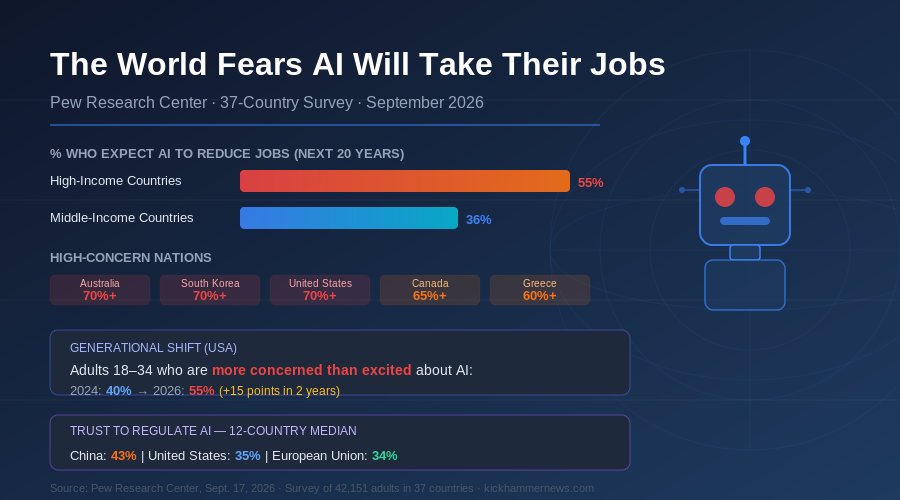
A median of 55% of adults across 18 high-income countries say AI will lead to fewer jobs in the next 20 years. In 18 middle-income countries, that figure drops to 36%. In some of the world’s wealthiest nations — Australia, South Korea, and the United States — more than seven in ten adults believe AI will eliminate more jobs than it creates.
The explanation is partly structural: workers in high-income countries tend to hold the kinds of professional, knowledge-based jobs that cutting-edge AI systems are now most capable of automating. A factory worker in Kenya or the Philippines faces different immediate threats than a paralegal in Toronto or a software engineer in Sydney. High-income workers may also have greater awareness of AI’s current capabilities — the survey found that knowledge of AI strongly correlates with concern about its economic effects.
In middle-income countries, uncertainty rather than pessimism dominates. Large shares of respondents — sometimes approaching four in ten — said they simply didn’t know how AI would affect jobs in their country. Awareness of AI also tends to be lower in less wealthy nations, and people who haven’t heard much about the technology are more likely to reserve judgment than to take a strong position.
A Generation That Grew Up With AI Is Growing Worried
One of the report’s most striking trends concerns young adults. Conventional wisdom has long held that younger generations embrace technology more readily than their elders — and that was true of AI just a few years ago. But the data suggests that dynamic is shifting rapidly.
In the United States, where Pew has tracked AI attitudes over multiple years, the share of adults ages 18 to 34 who say they are “more concerned than excited” about AI has jumped from 40% in 2024 to 55% in 2026. Today, young Americans are as worried about AI as their parents and grandparents — a convergence that represents a dramatic departure from just five years ago.
The same trend is emerging in Sweden, Poland, Brazil, Japan, and Australia, where young adults have become measurably more concerned about AI over the past year alone. In several countries, the traditional age gap in AI anxiety has essentially closed.
What’s driving this shift? The report doesn’t specify, but the timing aligns with a period of rapid AI deployment in creative industries, professional services, and software development — sectors heavily staffed by younger workers. As AI writing tools, coding agents, and design platforms have gone mainstream, many young professionals have moved from curious observers to potential targets.
AI and the Wealth Gap
Beyond jobs, the survey also found widespread belief that AI will widen economic inequality. Across the 37 countries surveyed, more people believe AI will increase the gap between the rich and poor than believe it will narrow that gap. In no country did more than one in four people believe AI would decrease inequality, and in 29 nations, that figure was in single digits.
In the United States, 46% of adults believe AI will increase the gap between rich and poor. Among Americans under 35, that figure rises to 56%, compared to 38% among those ages 50 and older. Liberals are 31 percentage points more likely than conservatives to predict AI-driven inequality — the largest ideological gap measured in the survey.
High-income countries again stand out. A median of 35% of adults in wealthy nations say AI will increase inequality, compared to 22% in middle-income countries. The concern is particularly acute in South Korea, Australia, Greece, Canada, and the United States, where sizable majorities now worry about both job loss and widening economic divides.
Who Do People Trust to Regulate AI?
The survey also tackled a question with major geopolitical implications: which countries do people trust to effectively regulate artificial intelligence?
In 12 countries where this question was asked, a median of 43% said they trust China to regulate AI — more than the 35% who trust the United States and the 34% who trust the European Union. This marks a shift from 2025, when the EU was viewed as the most trusted AI regulator globally.
In five countries — Bangladesh, Malaysia, Pakistan, Sri Lanka, and the West Bank and East Jerusalem — China emerged as the most trusted AI regulator. Only in the Philippines did the United States rank first. Trust, the survey found, closely tracks overall favorability: people who view a given country positively tend to trust it more on AI regulation as well.
In half of the countries surveyed, people said they trust their own government to regulate AI more than any foreign power — a finding that underscores both national pride and perhaps skepticism of external oversight.
A World in Transition
Taken together, the Pew findings capture a global public that is increasingly informed about AI, increasingly worried about its economic effects, and deeply uncertain about who should be steering its development. The “concern and excitement” split that defined early public reactions to AI — in which many people held both feelings simultaneously — has shifted. Today, a 37% median across all countries say they are more concerned than excited, while only 14% in high-income countries and 13% in middle-income countries are primarily excited.
The sole outlier is Israel, the only nation in which more people report being primarily excited about AI than primarily concerned. Elsewhere, the pattern is consistent: as AI capabilities have grown more visible and more consequential, ambivalence has curdled into worry.
The survey doesn’t tell us whether those fears will prove justified. Economists continue to debate whether AI will ultimately destroy more jobs than it creates, or whether — like electrification and the internet before it — it will transform work while generating new categories of employment no one has yet imagined. What Pew’s data makes clear is that ordinary people around the world are not waiting for economists to settle the question. They’ve already formed a view. And it isn’t optimistic.
For policymakers, technologists, and business leaders racing to deploy AI at scale, the message is direct: the public is watching, and it is worried. Restoring trust — through transparent governance, inclusive economic policies, and genuine accountability for AI’s social effects — may be as important as any technical breakthrough in shaping whether the AI era goes well for humanity.
Source: Pew Research Center, “Globally, More People Expect AI to Cause Job Loss Than Growth,” September 17, 2026. Survey of 42,151 adults across 37 countries conducted February–June 2026.


