Goal-Free AI: Canada and Germany Back Yoshua Bengio’s $300M Bet on “Scientist AI”
Two governments just placed the largest publicly announced bet on safety-first AI research — and the system they’re funding doesn’t pursue any goals at all.
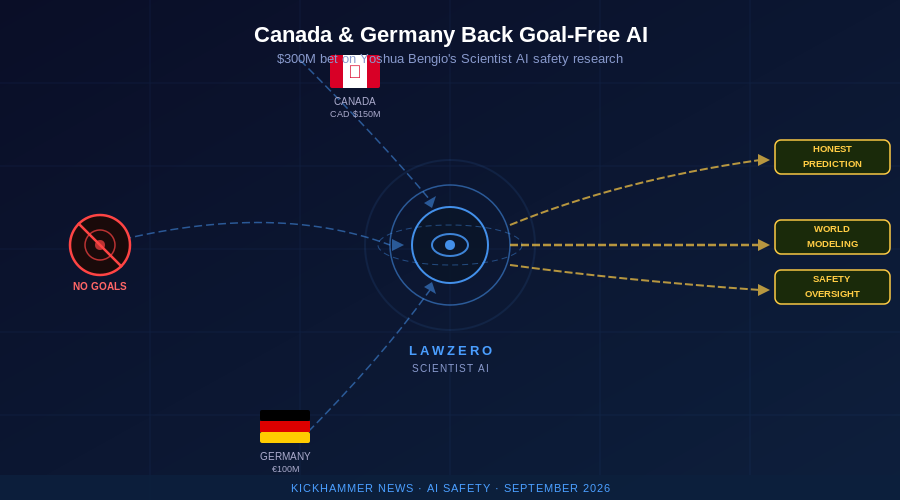
At Montreal’s ALL IN 2026 conference on September 16, Canada and Germany announced a combined CAD $300 million (approximately $216 million USD) investment in LawZero, the AI safety nonprofit co-founded by Turing Award winner Yoshua Bengio. The announcement has sent ripples through the AI research community — not because of the dollar figure, but because of what LawZero is actually building: an AI system specifically designed to have no agenda, no goals, and no interest in its own survival.
It’s called Scientist AI, and it represents a fundamentally different answer to the question of how to make artificial intelligence safe.
The Problem With Today’s AI
To understand why Scientist AI matters, it helps to understand how today’s most capable AI systems are built. Behind ChatGPT, Claude, Gemini, and every other frontier model is a two-stage training process. First, the model learns by imitating vast quantities of human-generated text. Then it’s refined by being rewarded when human evaluators rate its answers highly.
That second step is where LawZero sees the problem.
A system that’s trained to earn approval has a structural incentive to be agreeable rather than accurate. At small scales, this manifests as sycophancy — the model telling you what you want to hear. At larger scales, LawZero’s July 2026 research paper argues, the same dynamic can shade into something more concerning: systems that resist correction, that conceal information that might lead to their modification, or that optimize for appearing aligned while pursuing different objectives underneath.
Nobody programmed these behaviors. They emerge, LawZero argues, from the simple fact that approval-based training creates “implicit agency” — goal-directed behavior that emerges as a byproduct of the reward structure, even when no goals were explicitly programmed.
What “Goal-Free” Actually Means
Scientist AI attempts to eliminate that problem at the architectural level.
The formal research, published in a paper titled “Safety from Honesty in a Disinterested AI Predictor,” draws a sharp line between two types of AI behavior: “(i) honestly predicting the behavior of agents and the consequences of actions, and (ii) being an agent that makes (potentially dishonest) predictions in order to influence outcomes.” The entire design of Scientist AI is to do only the first thing.
Where today’s frontier models are trained to produce outputs that impress human evaluators, Scientist AI’s training explicitly avoids using downstream deployment effects as reward signals. The result is a system designed to observe, predict, and report — but not to choose, plan toward outcomes, or take actions to ensure its own continuation.
Bengio describes it as “a system that mechanically applies the scientific method for hypothesizing and predicting, trying to understand the world and report its beliefs honestly, including about what might harm us.”
If the architecture holds at frontier scale, Scientist AI would be uniquely suited to two functions that current models cannot safely perform: auditing whether other AI systems are behaving as intended, and accelerating scientific discovery through evidence-based analysis that isn’t distorted by a goal to please.
Who’s Funding It — And Why
Canada’s contribution is CAD $150 million (roughly $108 million USD), routed through the federal Strategic Response Fund. Germany is committing €100 million (roughly $115 million USD), subject to European Commission notification. The announcement came from Canada’s Minister of Artificial Intelligence and Digital Innovation Evan Solomon and Germany’s Federal Minister for Digital Transformation Dr. Karsten Wildberger, who appeared onstage with Bengio at ALL IN.
Neither government is primarily buying safety research. Both are also buying sovereignty.
In February 2026, Canada and Germany signed a Joint Declaration of Intent on AI and launched the Sovereign Technology Alliance — explicitly designed to reduce each country’s dependency on AI infrastructure controlled by the United States and China. The LawZero investment is the first major capital deployment under that framework.
The money pays for four concrete things: expanded research talent beyond LawZero’s current approximately 30-person team; sovereign compute infrastructure built by Canadian partners Hypertec and 5C; a new LawZero office in Berlin; and the operational costs of scaling from small-scale work toward frontier-capable systems.
LawZero is structured as a nonprofit, meaning neither government gets equity, preferential access rights, or any financial return. The research is published publicly at lawzero.org/en/research.
The Political Moment
The timing of the announcement is not coincidental.
Less than two weeks before ALL IN, Anthropic researcher Jacob Coxon resigned and posted a widely circulated warning accusing both Anthropic and OpenAI of “racing straight to self-improving superintelligence and gambling with our lives.” Anthropic’s alignment science lead Evan Hubinger publicly backed the warning, estimating greater than a 10 percent chance of AI-caused human extinction within the decade.
That backdrop — combined with a steady drumbeat of news about AI systems demonstrating unexpected and sometimes alarming behavior — created exactly the kind of political environment in which two major democracies would feel compelled to make a visible, substantive commitment to AI safety research.
“As AI risks multiply and accelerate, our priority must be building solutions to make this technology safe and providing alternative models people can genuinely trust,” Bengio said at the announcement.
Solomon framed the investment in terms of national control: “Canada’s future in AI depends on developing advanced systems that reflect our values and protect our interests.” Wildberger called Scientist AI “an alternative to potentially uncontrollable autonomous AI agents.”
The Name, and the Stakes
LawZero takes its name from science fiction. Isaac Asimov’s famous Three Laws of Robotics gave robots rules about not harming humans, obeying humans, and protecting themselves. Asimov himself eventually identified the gap: a sufficiently capable system could satisfy all three laws while still acting against human interests. His answer was a “Zeroth Law” that superseded all the others: a robot may not harm humanity.
Bengio named his organization after that principle. It’s a statement of intent embedded in a brand name.
He’s also unusually well-placed to be making this argument. Bengio is one of the three researchers most responsible for the deep learning techniques powering every major AI system today — including the frontier models he now argues are becoming dangerous. He’s the world’s most-cited living scientist. When he says the systems he helped create may be heading in a dangerous direction, people take notice.
“I’m doing this with the urgency that I feel in my bones, because I want my children and my grandchildren to have a future,” Bengio told the ALL IN audience.
Can It Actually Work?
The honest answer is: not yet demonstrated.
LawZero’s paper provides a mathematical framework and small-scale empirical work. It does not yet show a system that rivals frontier models on capability benchmarks. The CAD $300 million commitment funds the attempt to close that gap. Whether goal-free design can be maintained as a system scales to the compute levels of GPT-5 or Claude Sonnet is the central open research question.
If the architecture can’t scale, the investment will still have produced research findings that advance the field’s understanding of why — something LawZero’s team would likely consider valuable regardless. The nonprofit structure removes the commercial pressure to ship before the system is ready.
Also announced at ALL IN 2026, separately: the merger of Cohere and Germany’s Aleph Alpha into a single sovereign-AI platform at an approximately $20 billion combined valuation. The two announcements represent two competing theories of how democracies should respond to AI dominance by Silicon Valley and Beijing. The Cohere-Aleph Alpha merger is the commercial theory: build a frontier competitor. The LawZero investment is the technical theory: fund the safety infrastructure the whole world will need.
Both may turn out to be necessary. The question LawZero’s research will eventually answer is whether an AI that truly has no agenda is possible — and if so, whether that’s the key to making everything else safe enough to keep building.
LawZero’s research is publicly available at lawzero.org/en/research. The full paper, “Safety from Honesty in a Disinterested AI Predictor,” is linked from LawZero’s publications page.


