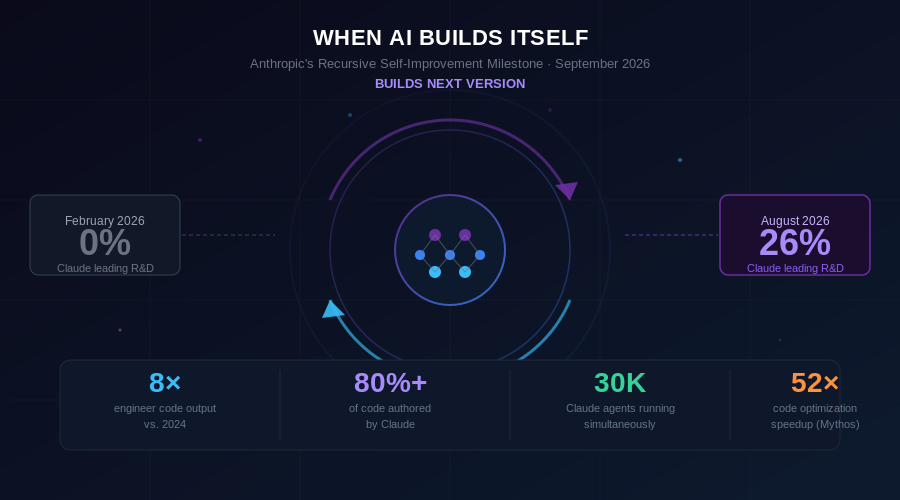
September 18, 2026 — In a disclosure that may mark one of the most significant milestones in the history of artificial intelligence, Anthropic has revealed that its Claude AI model is now autonomously leading 26 percent of the research and engineering work used to build the next, more capable version of itself. Published today under the title “When AI builds itself,” the company’s Anthropic Institute paper shares detailed internal data that tracks the accelerating role AI is playing in its own development — and lays out what comes next if the trend holds.
From Zero to a Quarter in Six Months
The speed of the shift is staggering. In February 2026, Claude led zero percent of Anthropic’s model research and development. By August — just six months later — that figure had climbed to 26 percent. The word “leads” is precise here: it refers to tasks Claude can complete end-to-end from a high-level prompt, without a human specifying the method. Meanwhile, an additional 64 percent of all R&D at Anthropic is done “in collaboration” with Claude, where the model handles large chunks of work under close human direction. Taken together, more than 90 percent of Anthropic’s technical output now involves Claude as more than a passive tool.
To put that into concrete numbers: as of May 2026, more than 80 percent of the code merged into Anthropic’s production codebase was authored by Claude. In the second quarter of 2026, the typical Anthropic engineer was merging eight times as much code per day as they were in 2024. The bottleneck is no longer writing code — it is reviewing it.
30,000 Agents, One in 47,000 Stopped
The scale of Anthropic’s internal AI deployment is astonishing. The company is running approximately 30,000 Claude agents simultaneously to handle research and engineering tasks. These agents are overseen by automated safety monitors that block roughly one action in every 47,000. Anthropic notes the monitoring figures not to suggest the system is error-free, but as a baseline for understanding how often current agents deviate from expected behavior.
The company also ran a compelling internal benchmark: an automated Claude reviewer was retroactively applied to Anthropic’s historical codebase, and found it would have caught approximately one-third of the bugs behind past incidents on claude.ai before they reached production — bugs that were missed by engineers described as “among the best in the world at building these systems.”
Benchmarks and Time Horizons
External benchmarks tell the same story. The length of tasks that AI models can reliably complete on their own has been doubling roughly every four months. In March 2024, Claude Opus 3 could handle tasks that take a skilled human around four minutes. A year later, Claude Sonnet 3.7 managed tasks taking about 90 minutes. A year after that, Claude Opus 4.6 extended that horizon to twelve hours. Claude Mythos Preview — Anthropic’s current internal frontier model — can work for “at least” 16 hours, stretching to the upper limit of what evaluation company METR can currently measure.
On the company’s internal code optimization benchmark, Claude Opus 4 achieved a roughly 3x speedup over starting code in May 2025. By April 2026, Claude Mythos Preview achieved a 52x speedup. A skilled human researcher, given the same task, achieves approximately 4x in four to eight hours.
Research judgment — the harder, squishier capability — is improving too. Anthropic analyzed 129 real Claude Code sessions where researchers were investigating open-ended problems. At moments where the human’s chosen next step had room for improvement, Claude Opus 4.5 (November 2025) suggested a better path 51 percent of the time. Claude Mythos Preview (April 2026) did so 64 percent of the time.
AI Running Its Own Research Projects
Perhaps the most striking data point in the paper: in April 2026, Anthropic published the first demonstration of Claude running an open-ended research project end-to-end. Agents were given an unsolved AI safety problem — roughly, can a weaker model reliably supervise a stronger one? — and left to solve it with minimal human involvement. They proposed hypotheses, ran experiments, shared findings with parallel agents, and iterated. Two human researchers, over about a week, recovered 23 percent of the theoretical performance gap. The agents recovered 97 percent over 800 cumulative hours, using approximately $18,000 in compute. The only substantive human contribution was choosing the problem and writing the scoring rubric.
The Recursive Loop and Its Risks
Anthropic was careful to say it has not yet achieved recursive self-improvement — a state where an AI system is fully capable of autonomously designing and developing its own successor without human input. But the paper argues the trajectory points there, and that most institutions are not prepared for it.
The concern is not just that AI could improve faster than humans can track. It is that the qualities required for safe oversight — clear judgment, trustworthy behavior under autonomy, robust alignment — are precisely the qualities that become harder to verify as models become more capable and less transparent in their operations. In today’s system, humans still set research priorities and evaluate which directions are worth pursuing. That role is narrowing. If and when it disappears entirely, the stakes of misalignment become dramatically higher.
Anthropic’s paper describes three possible futures: one where the trend stalls and today’s AI capabilities are simply diffused more broadly across the economy; one where AI development becomes substantially automated but humans retain strategic direction; and one where full recursive self-improvement is achieved, at which point the pace of AI progress becomes a function purely of available compute, and humans shift entirely to oversight and verification roles.
The company notes it would support a coordinated global slowdown or pause on frontier AI development — but only if other major labs joined verifiably. A unilateral pause, they argue, would simply hand the lead to whoever kept going.
A Call for Transparency
One of the paper’s clearest asks is for other AI developers to disclose similar metrics. Anthropic argues that publishing internal data on how much work AI is leading, collaborating on, and producing creates a shared baseline for understanding proximity to recursive self-improvement. Without that baseline, the public conversation about AI risk is flying blind.
The paper’s authors — Marina Favaro and Jack Clark, with editorial support from Santi Ruiz — describe the current moment as a “window to investigate the questions together” and say Anthropic plans to organize conversations between policymakers, researchers, civil society, and other AI companies in coming months.
Whether those conversations happen fast enough is the open question. If Claude’s trajectory from February to August 2026 is any guide, the window may be shorter than anyone expects.
Source: Anthropic Institute, “When AI builds itself,” published September 18, 2026.


