Google has quietly launched one of the most ambitious consumer AI experiments of 2026: an agent that lives in your family’s inbox, calendar, and group chats and quietly keeps everything running.
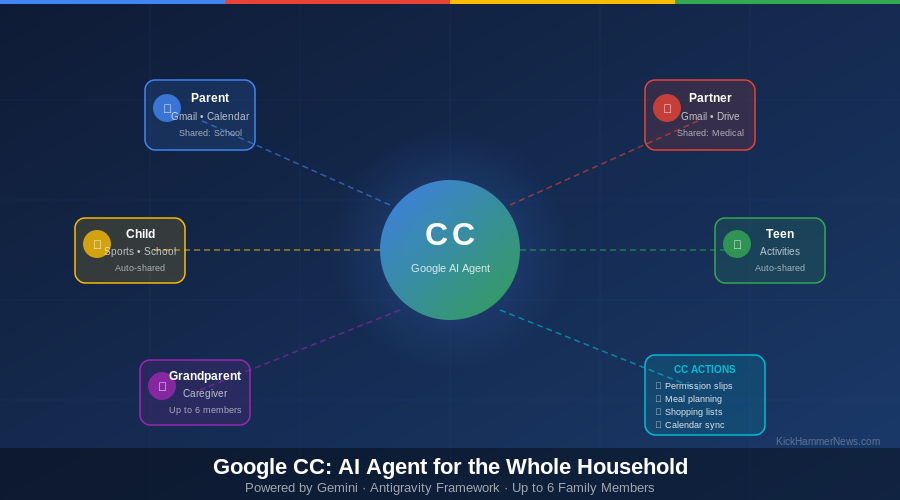
The company announced this week that CC — an experimental AI agent originally launched in December 2025 as a personal productivity tool — has been redesigned from the ground up to serve entire households. The upgraded CC can now coordinate schedules, fill out school permission slips, plan weekly meals, build shopping lists, manage family calendars, and even figure out drive times between your kids’ overlapping afternoon activities. And it does all of this on behalf of up to six family members simultaneously.
It’s a striking pivot. When CC debuted nine months ago, it was positioning itself as a smarter version of the daily briefing email — connecting your Gmail, Google Calendar, and Google Drive to give you a “Your Day Ahead” summary each morning. That version eventually found its way into the Gemini app as “Daily Brief” in May. But user behavior told a different story. People weren’t just asking CC to help manage themselves. They were asking it to help manage their families.
The Household Agent, Explained
The new CC works by giving the agent its own dedicated Google account. Think of it like a shared staff member with its own inbox and calendar access. Each family member can choose exactly what to share with it — emails from the soccer league, appointment confirmations from the orthodontist, school announcements about teacher workdays — and CC synthesizes all of that into a unified picture of what the family needs.
Sharing can be manual (forwarding specific emails to CC’s address) or automated. Users can designate trusted senders — a school district, a pediatrician’s office, a youth sports organization — and have those messages routed to CC automatically. The agent will also proactively suggest senders to add each week based on what it’s already seeing in the family’s communications.
From there, CC takes action. It spots the orthodontist confirmation and adds it to the shared calendar. It sees the school announcement about a half-day and blocks off pickup time. It reads the PDF registration form for baseball tryouts and fills it out. It pulls weekly grocery needs based on the meal plan it built earlier, then generates a shopping list organized by store section.
Google says CC runs on Gemini and is powered by Antigravity, the company’s agentic execution framework — the same infrastructure underlying a range of Google’s recent autonomous AI experiments.
Why Families, Why Now
The timing is not accidental. The consumer AI agent space has exploded in 2026, and the specific challenge of household coordination has attracted a wave of well-funded startups. Ollie launched in early September pitching privacy-first AI assistance for parents. Fambot debuted just weeks earlier with what it called “an AI chief of staff for families.” Both are early-stage and venture-backed.
Google’s entry changes the competitive dynamics substantially. CC isn’t a startup betting on a niche. It has access to Gmail, Google Calendar, Google Drive, Google Maps, Google Docs, and Google Sheets — the tools that already run the logistics of millions of American households. Where a third-party AI assistant has to ask permission to read your emails and sync your calendar, CC is built on top of infrastructure the family is likely already using every day.
That integration advantage is real. When CC builds a shared Google Sheet with the week’s meal plan, or creates a Google Doc summarizing the kids’ upcoming events, it’s not pushing data into a third-party system — it’s working inside the same environment the family already navigates. The friction is minimal by design.
The Limits of the Experiment
Google is being careful to frame CC as an experiment rather than a finished product, and the current limitations make that framing feel accurate. For now, CC is only available to U.S. users with personal Gmail accounts, and members must be 18 or older to participate.
That’s a significant constraint for the household use case. Most of the scenarios CC is built around — school schedules, after-school activities, kids’ medical appointments, sports registration — involve children directly. But tweens and teens can’t use CC with their own Google accounts, and families who run on school-issued Chromebook accounts are currently locked out entirely.
Google hasn’t announced any timeline for expanding CC to minors or to Google Workspace for Education accounts. For now, parents will be the ones connecting the dots, with CC reading their email on behalf of the whole household rather than having each family member interact with the agent directly.
The household ceiling of six people is also worth noting. For most nuclear families, six is plenty. But CC’s potential to serve larger, multi-generational households — grandparents coordinating with parents, adult children who have returned home, caregivers — is one of the more interesting edges of the product. Those arrangements are increasingly common, and the coordination overhead is exactly the kind of task that has historically fallen on one overloaded person.
The Bigger Picture: AI Moves into the Home
The Google CC announcement is part of a broader shift that has been accelerating throughout 2026: AI agents moving beyond professional productivity software and into the logistics of daily life. A year ago, the dominant frame for AI assistants was the knowledge worker — the analyst drafting reports, the developer writing code, the executive summarizing meetings. The household was mostly out of scope.
That’s changed. The commercial success of personal AI tools has surfaced a massive adjacent market: the invisible management work of running a family. Coordinating schedules across multiple kids and two working parents. Tracking due dates for school forms, medical appointments, and extracurricular registrations. Planning meals, generating shopping lists, figuring out how to get three children to three different places at 4pm on a Thursday.
This work is unglamorous, enormous in aggregate, and almost entirely undocumented — which has historically made it hard to automate. But AI agents with access to a family’s email, calendar, and documents have the raw material they need to start making a dent. Google has bet that CC is the right form factor to test the hypothesis.
Existing CC users in the United States will receive an invitation to upgrade via email in the coming days. New users can join a waitlist at labs.google.com/cc.
Whether the experiment scales beyond early adopters will depend on how well the agent handles the unpredictability of real household life — and whether families are comfortable handing that much coordination authority to a system that, however useful, still occasionally gets things wrong. Google knows this, which is why CC asks for clarification when it needs it and updates its group memory as it learns the household’s rhythms. The agent is designed to be supervised, not trusted blindly.
That’s a reasonable starting point. But it also sets the stakes clearly. The families who try CC early will be the ones teaching it what a household actually needs — and their experience will shape what AI-powered domestic assistance looks like for everyone who comes after them.


