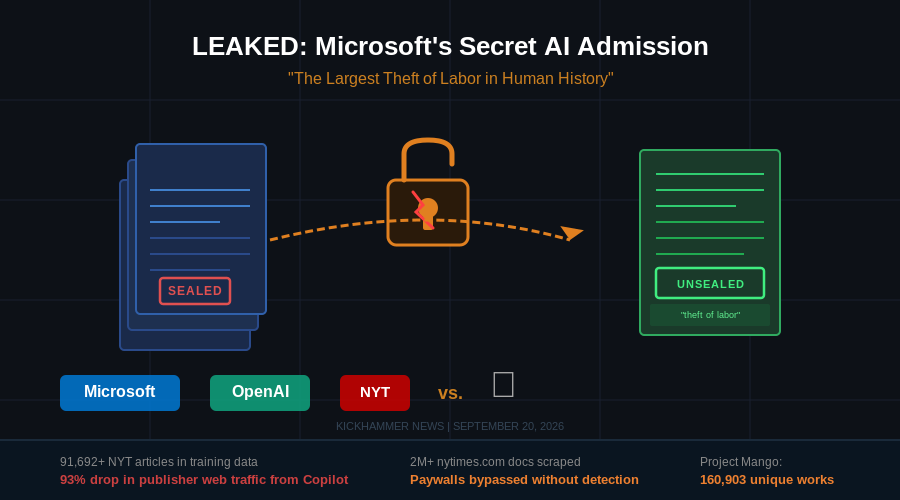
A bombshell emerged this week from the long-running copyright lawsuit between The New York Times and OpenAI and Microsoft: newly unsealed court filings contain internal documents showing that a senior Microsoft executive privately described the AI industry’s mass scraping of human-written content as “the largest theft of labor in human history” — even as both companies were continuing those same practices and publicly defending them under fair use doctrine.
The unsealed materials, filed as part of The New York Times’ brief in its three-year copyright battle against OpenAI and Microsoft, paint a damning internal picture of how the two tech giants understood what they were doing — and what it would mean for the journalists, writers, and publishers whose work fueled the generative AI boom.
The “Astonishing Theft” Memo
The most explosive disclosure centers on a January 2023 internal memo written by Brent Hecht, Microsoft’s Director of Applied Science. In it, Hecht described OpenAI’s training practices as “an astonishing theft of unprecedented proportions” and labeled it bluntly as “the largest theft of labor in human history.”
That phrase — now ricocheting across the tech industry — is particularly significant because it came not from a critic or a journalist, but from inside Microsoft’s own research leadership, roughly a year after the two companies had doubled down on their partnership through a multi-billion dollar investment deal.
The memo wasn’t just about the ethics of scraping. Hecht also warned of a long-term structural danger he called a “doom loop”: as AI tools like Microsoft’s Copilot and OpenAI’s ChatGPT divert users away from news sites — Microsoft’s own data showed Copilot caused click-through rates to The New York Times’ website to drop as much as 93% compared to traditional Bing search — those publishers will generate less revenue and eventually less content. And with less quality content on the web, the AI models themselves will have worse data to train on. “It is highly unusual that an end-product threatens the economic foundations of its essential suppliers,” the filing quotes Hecht as writing, “but that is the situation we have created for our LLM business with respect to its ‘content supply chain.'”
“Existential Threat” to Publishers
Hecht wasn’t alone in this assessment. Internal communications from OpenAI’s own leadership tell a similar story.
Nick Turley, OpenAI’s head of ChatGPT, wrote internally that news publishers face an “existential threat” from products like ChatGPT, which he described as “largely substitutive” — meaning the chatbot doesn’t complement journalism, it replaces it. He added that this substitutive effect would only intensify as the models improved.
OpenAI President Greg Brockman, meanwhile, bragged in internal communications that the models were “excellent at news.” Microsoft CEO Satya Nadella agreed under oath in a deposition that conversing with chatbots “has substituted… giving you the information right there on the AI platform versus needing to go to the underlying source.” This kind of direct substitution is precisely what the fair use doctrine is supposed to protect against.
Bypassing Paywalls and Stripping Copyright Notices
The documents go further than philosophical admissions — they detail specific methods allegedly used to extract copyrighted content at scale. According to the filing, OpenAI employees devised techniques to circumvent paywalls without detection. When researcher Nick Ryder told Greg Brockman about a “hack to get around nytimes paywall,” Brockman reportedly replied: “ah nice.”
The companies also allegedly built massive training datasets that disproportionately relied on scraped journalism. OpenAI’s “WebText” and “WebText2” datasets were constructed this way, alongside material derived from Common Crawl, an open internet archive. In total, the filing reveals that OpenAI’s mid-training datasets contain more than 91,692 copies of works from the NYT, Daily News, and Center for Investigative Reporting, while more than 2 million documents from nytimes.com alone ended up in a Common Crawl-derived dataset.
Perhaps most damaging: the companies allegedly made deliberate efforts to strip copyright notices from training data before the content reached their models, because researchers “wouldn’t want [the] model outputting” copyright notices to users.
Microsoft also transferred the entire GPT-3 training dataset to its own teams to evaluate commercial product applications, and the two companies shared data through internal initiatives codenamed “Project Taxi” and “Project Mango,” with the latter containing at least 160,903 unique works from the plaintiff publishers.
The Fair Use Defense — and Its Contradictions
OpenAI and Microsoft have long relied on the “fair use” doctrine as their primary legal shield against copyright claims, arguing that training AI models on copyrighted content is a transformative use that doesn’t harm the market for the original work.
But the internal documents revealed in the unsealed filing appear to contradict almost every pillar of that defense. Fair use typically requires that the use not substitute for or harm the market for the original work — yet internal Microsoft data shows 93% traffic drops to news sites, and OpenAI’s own leadership described its products as “existential threats” and “largely substitutive.”
The Trump administration filed a brief earlier this month siding with OpenAI, arguing that training on copyrighted material represents legitimate fair use under federal law — a position that has generally been favored by courts so far. But legal observers note that the specific internal admissions now exposed are difficult to square with that defense.
“The evidence revealed here for the first time shows that OpenAI and Microsoft knew that what they were doing was wrong,” Steven Lieberman, counsel for the New York Daily News, said in a statement. OpenAI and Microsoft declined to comment.
Why This Matters Beyond the Courtroom
The NYT lawsuit has been grinding through the courts for three years, and this disclosure is unlikely to be the final word. But the unsealed material matters far beyond the specifics of one copyright case.
The AI industry has now crossed hundreds of billions of dollars in valuation on the implicit assumption that the enormous troves of human knowledge and creative labor used to train these systems were either freely available or legally defensible. The internal documents suggest that, at minimum, the people doing the training weren’t always confident that was true.
There are broader implications for the entire AI ecosystem: every frontier model — from GPT to Claude to Gemini — was trained on large-scale web scrapes containing journalism, literature, code, academic papers, and creative works whose creators received nothing. If courts begin to limit or price that access, the economics of AI development could shift dramatically.
Nadella himself testified that paywalled content “should be licensed by anyone who wants to use it for grounding or training,” and that he would have required OpenAI to retrain its models had he known they had scraped paywalled material. The unsealed filings suggest that knowledge was available within his own company — it just never reached him.
Whether those admissions cost OpenAI and Microsoft in the courtroom remains to be seen. But they have already altered the public narrative: the companies that promised AI would unlock human potential privately acknowledged they built it on an unprecedented extraction of human work.
Sources: TechCrunch, Tom’s Hardware, Washington Post, TechRadar


