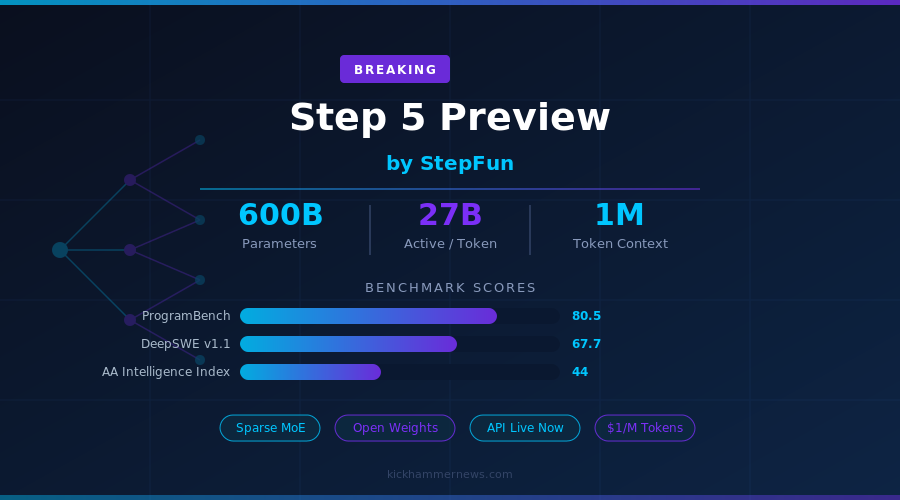
China’s AI laboratory StepFun dropped one of the most technically ambitious model launches of 2026 today, unveiling Step 5 Preview — a 600-billion-parameter sparse Mixture-of-Experts model that opens API access immediately and promises to release its full weights to the public on October 15. The announcement lands at a moment when the global AI industry is watching closely to see whether any challenger can crack the dominance of frontier proprietary models like GPT-6 Astra, and Step 5 Preview makes a serious bid for that conversation.
What Is Step 5 Preview?
Step 5 Preview is StepFun’s new flagship model, purpose-built for agentic workloads: long-horizon tasks where an AI must plan, reason, search, execute code, and synthesize results across hundreds of steps before delivering a final answer. The model targets software engineering, professional knowledge work, and — with unusual specificity for a lab announcement — financial analysis.
The architecture is a sparse Mixture-of-Experts design, meaning the model has 600 billion total parameters but only activates roughly 27 billion of them per token during inference. This is the same efficiency trick used by models like Mixtral and DeepSeek, but at a dramatically larger scale. Critically, StepFun chose to go narrow and deep rather than wide and shallow: Step 5 Preview uses a 92-layer transformer stack, which the company argues gives inference longer “information paths” for the kind of implicit multi-hop reasoning that agentic pipelines demand — where an AI is ingesting tool returns, search snippets, and code execution outputs all at once.
The context window is one million tokens — enough to hold roughly 750,000 words, or several book-length documents — and the model accepts both text and image inputs natively.
Benchmark Performance
On the Artificial Analysis Intelligence Index, an industry-standard composite benchmark, Step 5 Preview scores 44, placing it well above the median of 24 for reasoning models in a comparable price tier. That score puts it among the top three open-source AI models globally as of this writing, according to Artificial Analysis rankings.
On specific agentic coding benchmarks, the numbers are illuminating:
- ProgramBench: 80.5
- DeepSWE v1.1 (software engineering): 67.7
- StepCodeBench: 49.0
- Terminal-Bench 4.0: 33.3%
These aren’t just impressive on paper. Software engineering benchmarks like DeepSWE v1.1 score models on their ability to resolve real GitHub issues — a task that requires understanding large codebases, writing patches, and running tests. A 67.7 on that benchmark represents genuinely useful capability for development teams looking to automate engineering work.
Throughput is also a practical strength: Step 5 Preview generates output at 99.8 tokens per second with a time-to-first-token of 2.96 seconds, which the Artificial Analysis benchmark team notes is “better than average” for reasoning models at this price point.
Pricing That Disrupts the Market
StepFun is charging $1.00 per million input tokens and $2.70 per million output tokens via its API — pricing that sharply undercuts comparable frontier models. For context, OpenAI’s comparable models in this tier have historically charged multiples of that figure. The pricing makes Step 5 Preview immediately interesting for enterprises building high-volume agentic pipelines where inference costs compound quickly.
The cost advantage becomes even more striking if you factor in the forthcoming open-weight release on October 15. Organizations that can deploy on their own infrastructure will effectively pay only hardware and energy costs — a massive reduction for anyone running at scale, and a complete elimination of per-token API fees for those with the resources to self-host a 600B-parameter model.
The Open Weights Story
The decision to release full weights alongside an API is not new territory — Meta, Mistral, and others have pursued similar dual-track strategies — but it remains a significant market signal. For many enterprises, particularly in regulated industries like finance and healthcare, keeping data on-premises is a non-negotiable requirement. Open weights satisfy that requirement while also enabling fine-tuning, distillation, and custom deployment configurations that closed-source APIs simply cannot offer.
October 15 is only weeks away. When those weights land, the research community will begin probing Step 5 Preview’s internals: examining its expert routing patterns, stress-testing its long-context fidelity, and building fine-tuned versions specialized for everything from legal document review to autonomous laboratory pipelines. That kind of community scrutiny accelerates both improvement and trust in ways that proprietary systems rarely achieve.
Why Finance, Specifically?
StepFun’s emphasis on finance is worth examining. The financial sector has been among the most aggressive early adopters of AI for knowledge work, and it presents a distinctive challenge: documents are extremely long (earnings filings, prospectuses, regulatory disclosures), reasoning must be precise (small numerical errors have large consequences), and the domain is highly specialized (financial terminology is not universal knowledge).
A one-million-token context window is directly relevant here. A single SEC Form 10-K for a major corporation can run to 200+ pages. Asking a model to synthesize information across multiple quarterly reports, compare them to analyst consensus estimates, and identify anomalies is exactly the kind of task that has historically broken smaller-context models. Step 5 Preview appears engineered with this workload in mind.
Where Does This Leave the Frontier?
The launch of Step 5 Preview is the latest chapter in an accelerating story about the globalization of frontier AI development. For much of 2023 and 2024, there was a clear US-centric hierarchy: OpenAI and Anthropic at the top, with international labs trailing by meaningful margins. That gap has closed substantially.
Chinese labs — including DeepSeek, Zhipu AI, and now StepFun — have demonstrated a consistent ability to match or exceed Western models on specific capability benchmarks while frequently undercutting on price. The combination of competitive performance and dramatically lower API costs represents a structural challenge for US-based providers that goes beyond any single model release.
Step 5 Preview also arrives as the industry broadly shifts toward agentic architectures. Models that were benchmarked a year ago on single-turn question-answering or coding completion are now being evaluated on whether they can complete multi-day software engineering projects with minimal human intervention. The leaderboards are changing, and Step 5 Preview appears designed specifically for the new leaderboards.
What to Watch Next
The API is live today at StepFun’s platform. The model weights release on October 15. Between now and then, expect third-party benchmarks to surface quickly — particularly from the Hugging Face Open LLM Leaderboard community and independent evaluators like Artificial Analysis.
The key questions that will determine Step 5 Preview’s real-world impact: How does it perform on private enterprise data versus public benchmarks? How reliably does the one-million-token context actually sustain coherent reasoning across that full length? And can the open-weight community leverage the model’s architecture for fine-tuning that closes remaining gaps with proprietary frontier models?
The answers will arrive fast. In the current AI landscape, a weeks-long evaluation period after a major release is practically geological time. By mid-October, when the weights drop, the community’s verdict on Step 5 Preview will likely already be forming.
For now, StepFun has made a statement: the frontier is not a closed club, and the race to build the best agentic AI is very much a global one.


