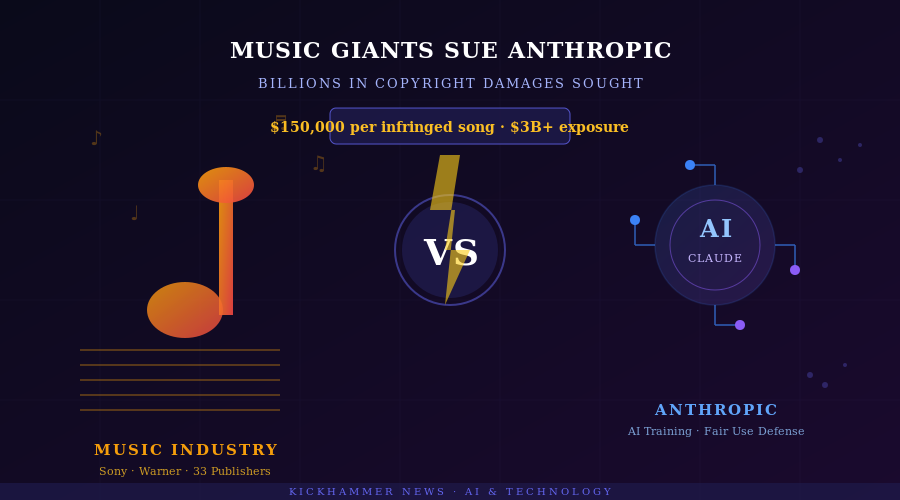
When Sony Music Publishing and Warner Chappell Music filed a 48-page complaint against Anthropic on August 29, 2026, they didn’t mince words. The lawsuit describes what they call “one of the largest and most blatant ongoing thefts of intellectual property in history” — a brazen campaign in which the AI startup allegedly pirated the lyrics and compositions of tens of thousands of songs to power Claude, its flagship AI model.
The stakes are astronomical. With damages potentially reaching $150,000 per infringed copyright and up to $25,000 for each instance of copyright management information being stripped, the combined exposure could easily exceed billions of dollars. But the implications run deeper than any dollar figure. The case is poised to become a defining legal reckoning for the entire AI industry.
What the Publishers Are Claiming
The complaint, filed jointly by 35 publishers including the music arms of Sony and Warner, alleges that Anthropic systematically scraped lyrics and sheet music from pirated book repositories and online databases to train successive versions of Claude. The publishers argue this was not an inadvertent oversight or a gray-area interpretation of fair use — it was a deliberate, industrialized data grab.
Named in the complaint are some of the most iconic songs in modern music history: the Beatles’ “I Am the Walrus,” Leonard Cohen’s “Hallelujah,” Mariah Carey’s “All I Want for Christmas Is You,” Taylor Swift’s “Paper Rings” and “Cruel Summer,” Survivor’s “Eye of the Tiger,” Mark Ronson and Bruno Mars’ “Uptown Funk,” and Marvin Gaye and Tammi Terrell’s “Ain’t No Mountain High Enough,” among hundreds of others.
The publishers contend that Claude can reproduce these lyrics near-verbatim on demand — demonstrating that the copyrighted material was not simply processed and discarded during training, but is embedded in the model’s learned parameters. The lawsuit also alleges that Anthropic stripped copyright management information from training data, a separate violation of the Digital Millennium Copyright Act that triggers the $25,000 statutory penalty per instance.
A Pattern of Litigation
For Anthropic, this is not the first time it has faced the music industry in court. In January 2026, a coalition of music publishers — separate from the Sony/Warner group — filed a $3 billion lawsuit over more than 20,000 works. That case is still winding through the courts.
And before the music publishers, there were the authors. In what became the largest copyright settlement in U.S. history, Anthropic agreed in September 2025 to pay $1.5 billion to a class of authors and publishers whose books were used to train Claude. A federal judge in San Francisco approved the settlement in July 2026. That deal, while landmark, did not resolve the music industry’s claims.
Anthropic has responded to the new lawsuit in characteristic fashion. A spokesperson called it “the third lawsuit from the same lawyers, recycling allegations from cases already before the courts,” and said the company would defend itself “robustly,” maintaining that AI training constitutes fair use of copyrighted material under U.S. law.
The Fair Use Battlefield
At the heart of every AI copyright case is the same contested legal question: does using copyrighted content to train a machine-learning model constitute fair use?
Anthropic and its peers — OpenAI, Google DeepMind, Meta — have consistently argued that training an AI is a transformative process analogous to how a human author might read thousands of books to develop their own voice. The model, they argue, does not reproduce the source material; it learns statistical patterns from it.
Publishers and rights holders counter that this analogy breaks down when the output — whether lyrics, prose, or code — can closely mirror the originals. If Claude can produce a plausible rendering of “Hallelujah” on demand, they say, the fair use defense strains credulity.
No definitive appellate ruling has settled the matter in the United States. The Sony/Warner case, given its scale and the prominence of the works involved, has the potential to produce one. Legal scholars expect the case to move aggressively, with both sides eager for a precedent-setting outcome.
Why This Moment Matters
The timing of this lawsuit is not coincidental. The AI industry has undergone a seismic shift over the past year. Frontier models are no longer curiosities — they are commercial workhorses generating billions in annual revenue. Anthropic reportedly achieved a $2 trillion valuation milestone in September 2026, up from $900 billion just months earlier. The company is no longer a scrappy research lab; it is a major technology enterprise.
That financial success has made AI companies more attractive targets for litigation. Plaintiffs’ lawyers and rights holders alike have grown increasingly skeptical that voluntary licensing arrangements will materialize without legal pressure. Several studios, publishers, and now music companies have concluded that the courtroom is the most effective negotiating table.
Meanwhile, the music industry itself is facing its own AI-driven disruption. AI tools capable of generating original-sounding music, cloning artists’ voices, and even composing in the style of specific musicians have proliferated in 2025 and 2026. For industry executives, the Sony/Warner lawsuit against Anthropic is not just about past harm — it is a bid to establish legal guardrails before AI-generated music fully reshapes the business.
The Broader Industry Reckoning
Anthropic is not alone in the crosshairs. OpenAI faces multiple ongoing copyright suits from publishers and news organizations. Meta is defending its Llama models against claims that they were trained on pirated books. Google’s use of YouTube transcripts and web content to train Gemini has drawn scrutiny.
But the Sony/Warner case stands apart in several respects. The 35-publisher coalition is the broadest music industry front assembled against any AI company. The songs named are not obscure — they are among the most recognized compositions in popular culture. And the legal theory is more specific than some prior cases: the publishers have presented evidence, in the form of Claude’s own outputs, that the model can reproduce copyrighted material in ways that go beyond mere stylistic influence.
For the AI industry writ large, the implications of a plaintiff victory would be profound. Courts could require retroactive licensing fees for training data, mandate that companies disclose training datasets, or even restrict AI companies from training on certain categories of copyrighted work without explicit permission. Any of these outcomes would significantly alter the economics and operational practices of AI development.
What Comes Next
The case is currently in its early stages. Anthropic has not yet formally responded to the amended complaint in federal court. Legal observers expect both sides to engage in extensive discovery, with publishers seeking access to Anthropic’s training datasets, internal communications, and internal documentation about data sourcing decisions.
A trial, if one occurs, is likely years away. In the meantime, the court of public opinion is also in session. Each new lawsuit, each detailed complaint naming beloved songs, makes the abstract question of AI copyright more viscerally concrete for consumers, lawmakers, and regulators.
Anthropic may ultimately prevail on the fair use question. But with 35 publishers, tens of thousands of songs, and a potential damages figure measured in the billions, the company faces a long, expensive fight — and the music industry has made clear it intends to play every note.


