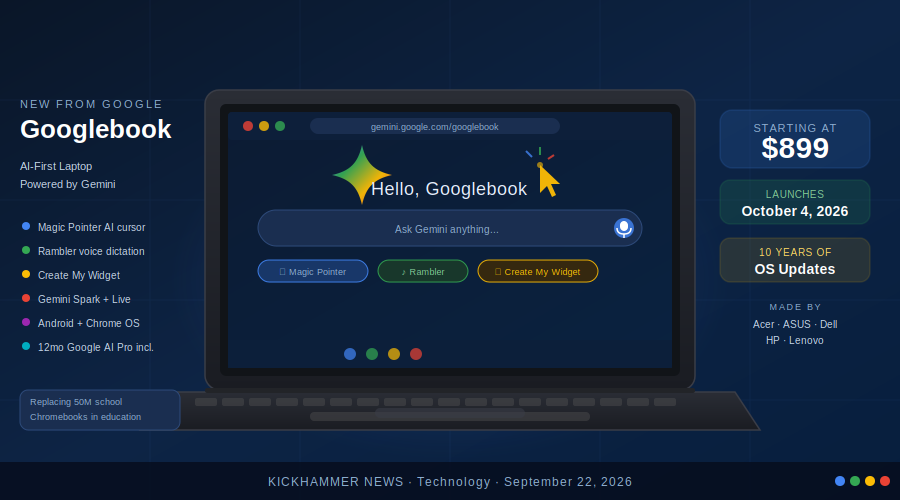
Google officially unveiled its Googlebook lineup on September 21, 2026, opening preorders for a new class of Android-powered laptops built from the ground up around Gemini AI — and asking consumers to spend up to $899 for the privilege.
The Googlebook is not a Chromebook refresh. It’s a clean break. Where Chromebooks were defined by what they didn’t do — no Windows apps, limited offline capability, browser-first everything — the Googlebook is defined by what its AI can do on your behalf. That distinction is Google’s biggest gamble in consumer hardware in years, and it goes on sale in the United States on October 4.
What Exactly Is a Googlebook?
At its core, the Googlebook runs Android OS with a full desktop Chrome browser layered on top, drawing on ChromeOS architecture but moving decisively toward Android’s broader application ecosystem. It’s a laptop that runs your phone’s apps at your desk — and does more with them thanks to Gemini.
Google is not manufacturing the Googlebook itself. Instead, it has certified hardware partners — Acer, ASUS, Dell, HP, and Lenovo — to build devices to its specifications. Starting configurations begin at $899. Buyers get processors from Intel or Qualcomm, each featuring dedicated neural processing units (NPUs) designed to run AI workloads locally. Display options reach up to 2.8K OLED resolution. Battery life is rated at up to 14 hours. The chassis materials span aluminum, magnesium alloy, and carbon fiber. Haptic glass trackpads and backlit keyboards round out a premium-feeling package.
Every Googlebook ships with 12 months of Google AI Pro — a subscription that includes 5TB of cloud storage, Gemini Advanced, and access to a suite of premium apps. Buyers also receive three months of both YouTube Premium and Adobe Photoshop. OS updates are guaranteed for up to 10 years, a commitment significantly longer than most Windows or Android devices on the market today.
The AI Features That Justify the Price Tag
The headline hardware sells the box, but the Googlebook’s differentiation lives in three software features that Google spent considerable stage time demonstrating.
Magic Pointer is perhaps the most ambitious of the three. Described as a multimodal AI cursor, Magic Pointer activates on user command — a deliberate wiggle of the trackpad — and then goes to work understanding whatever is on screen. Highlight a complex paragraph and it can summarize or restructure it. Point at a confusing email and it can identify whether the message looks like spam. Select multiple disconnected images and it can synthesize them without requiring an upload to a third-party service. Google emphasized that Magic Pointer remains dormant unless explicitly invoked, a privacy-first design choice given how powerful ambient screen-reading AI would otherwise feel.
Rambler targets the gap between the speed of human thought and the slow friction of typing. It’s an advanced voice dictation system that doesn’t just transcribe — it interprets. “Messy, rambling brain dumps” are transformed into organized text, with action items pulled into structured bullet points and even contextual emoji suggested. Crucially, Rambler supports multilingual mid-sentence input, making it immediately useful for bilingual users who naturally switch between languages in the same thought.
Create My Widget is for the builders who never learned to code. Describe what you want — a custom productivity widget, a real-time currency converter, a reading-time tracker — and Gemini builds it. For users who want to go further, the Googlebook ships with access to Google Antigravity and a full Linux terminal, enabling real software development on the same device.
Beyond these three flagship features, the Googlebook integrates Gemini Live for real-time conversational AI assistance and Gemini Spark, which can process complex background tasks even when the laptop’s lid is closed. The device also ties deeply into Android phone integration, allowing seamless handoff and cross-device continuity that Google’s hardware ecosystem has been building toward for years.
The Education Endgame
The most revealing strategic signal in Google’s Googlebook announcement wasn’t about adult consumers — it was about classrooms. Google has made clear it intends the Googlebook to eventually replace Chromebooks in the education market. That’s not a small ambition. Chromebooks currently power approximately 50 million student devices in schools across the United States alone.
The Googlebook’s 10-year update commitment is aimed directly at school district IT procurement cycles, where devices need predictable longevity and minimal maintenance. If Google can replicate the Chromebook’s institutional foothold with a Gemini-powered successor, it secures not just hardware revenue but an entire generation of users growing up with Google’s AI as their primary computing interface.
A Crowded but Opportunistic Market
The Googlebook enters a laptop market that Microsoft has spent the last two years trying to define with its Copilot+ PC initiative. Those Windows machines also center AI co-processors and on-device processing, but they run on Microsoft’s ecosystem and depend on Windows as their foundation. Google is betting that Android’s maturity as a mobile operating system — and Gemini’s integration depth — gives the Googlebook a more cohesive AI experience than Microsoft’s patchwork approach.
Apple, meanwhile, remains conspicuously absent from the AI laptop race, with its MacBook line receiving incremental Silicon updates but no dedicated AI-first product positioning comparable to what Google announced this week.
The $899 Question
Will consumers buy a new laptop specifically for AI? That’s the question underlying every aspect of the Googlebook launch. The $899 starting price puts it firmly in the mid-to-high consumer range — more than most Chromebooks, competitive with entry-level Windows machines, and well below a MacBook Pro. The value proposition leans heavily on the included AI Pro subscription and the promise that Gemini will meaningfully change how work gets done.
For early adopters already embedded in Google’s ecosystem — Gmail, Google Drive, Google Calendar — the Googlebook’s AI features represent a genuine upgrade in how those services can interact with each other and with the user’s daily workflow. For everyone else, the question is whether Gemini is compelling enough to change habits, not just hardware.
Preorders are open now at the Google Store, Best Buy, and participating retailers. The international rollout begins October 5, one day after the U.S. launch.
Google’s bet: that AI is no longer a feature inside a laptop, but the reason to buy one.


