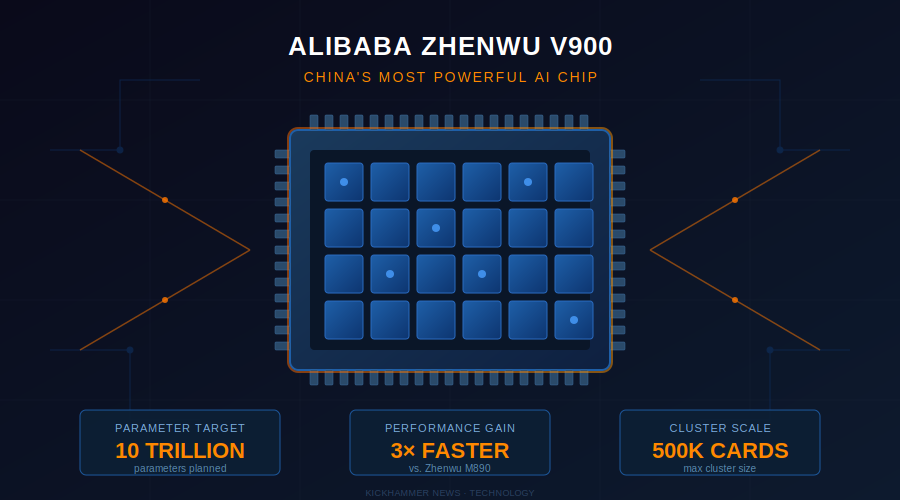
At its annual Apsara Conference, Alibaba dropped what may be the most significant dual announcement in Chinese AI history: the unveiling of the Zhenwu V900, described as China’s most powerful AI chip, and plans to train a model with an almost incomprehensible 5 to 10 trillion parameters—a scale that would dwarf anything currently deployed by OpenAI, Google, or Anthropic. Together, the two announcements signal Alibaba’s ambition to move from AI consumer to AI infrastructure sovereign, competing not just in the Chinese market but on the global stage.
The Zhenwu V900: A Chip Built for the Trillion-Parameter Era
The centerpiece of Alibaba’s hardware reveal is the Zhenwu V900, developed by T-Head, the company’s in-house semiconductor division. According to CEO Eddie Wu, the V900 “delivers three times the performance of its predecessor, the Zhenwu M890″—a chip already considered competitive among domestic Chinese alternatives to Nvidia’s H100 and A100 series.
What sets the V900 apart is its support for clusters of up to 500,000 cards operating in unison for frontier model training and inference. At that scale, a single training run could marshal compute power exceeding the entire GPU fleet of several mid-sized cloud providers combined. This is not an incremental product refresh. This is a chip engineered from the ground up for the trillion-parameter era.
Alibaba has been investing in T-Head since 2018, but the Zhenwu line—named for a Chinese deity associated with wisdom and martial prowess—marks the clearest signal yet that the company intends to compete on silicon rather than simply license compute from Nvidia or TSMC-fabbed competitors. With U.S. export controls continuing to restrict access to advanced Nvidia chips, the strategic imperative is obvious: China’s AI ambitions cannot depend on American hardware.
The V900 joins a broadening T-Head portfolio that now spans GPUs, CPUs, network interface cards, and interconnect chips—a full silicon stack aimed at end-to-end control over the data center layer that underpins everything AI.
The 10-Trillion-Parameter Gamble
The model announcement is, if anything, even more audacious. Alibaba’s research leadership disclosed plans to train a model in the 5-to-10-trillion-parameter range, with no fixed commercial name and no publicly announced timeline. But the ambition behind it was stated without ambiguity: the initiative is aimed at advancing toward Artificial Superintelligence (ASI), with architectural research focusing on Recursive Self-Improvement and multimodal capabilities.
To put the scale in context: GPT-4, released in 2023, was widely estimated at somewhere between 1 and 1.8 trillion parameters—itself a major leap from earlier generations. The models that emerged in 2025 and 2026, including Anthropic’s Mythos and OpenAI’s GPT-5.6 Sol and GPT-6 Astra, are believed to operate in the 1-to-3-trillion-parameter range with dense and mixture-of-experts architectures. A 10-trillion-parameter model would represent a qualitative leap—not just in raw size, but in the kind of reasoning, planning, and generalization such a system might enable.
Recursive Self-Improvement—one of the research pillars Alibaba named—is a concept long discussed in AI safety and capability literature, referring to systems that can iteratively improve their own architecture, weights, or training procedures. Its inclusion in Alibaba’s stated research agenda is notable not just for its ambition, but for the governance questions it raises. An AI system capable of meaningfully improving itself introduces feedback dynamics that no current evaluation framework is designed to handle.
Whether Alibaba can actually train such a model in the near term remains genuinely uncertain. The compute requirements alone are staggering: by rough estimates, training a 10-trillion-parameter model would require thousands of V900 clusters running for months. But the announcement serves a dual purpose—it signals to investors, governments, and rival labs that Alibaba is playing for existential stakes, not incremental feature releases.
Full-Stack AI: The Strategic Frame
CEO Eddie Wu and Chairman Joe Tsai both emphasized what Alibaba is calling a “full-stack AI” strategy built on three mutually reinforcing pillars: AI models, AI chips, and the AI cloud.
The cloud layer is where Alibaba has the most established track record. Alibaba Cloud is the dominant cloud provider in China and a significant player in Southeast Asia, and the company announced a target of more than 20 gigawatts of global data center capacity by 2032. To put that in perspective, Microsoft—which has arguably led the industry in AI infrastructure investment—currently operates roughly 10-12 gigawatts globally. Alibaba’s 2032 target, if achieved, would put it in a tier of its own among non-U.S. cloud providers.
The framing from Chairman Tsai was deliberate: “building full-stack AI … to let AI move from a technological breakthrough to value creation.” This is a message aimed at enterprise customers who have grown skeptical of AI announcements untethered from business outcomes, and at regulators who have begun scrutinizing the gap between AI hype and AI deployment.
Why This Matters Beyond China
It would be tempting to view Alibaba’s Apsara announcements as relevant only to the Chinese market—a domestic champion making bold claims in a field increasingly shaped by geopolitical rivalry. That reading would be too narrow.
Alibaba’s Qwen model family has already achieved massive global traction. Qwen models are downloaded by developers and enterprises worldwide, integrated into products from Southeast Asia to Europe, and have repeatedly topped open-weight benchmarks. The Zhenwu V900 and the planned trillion-parameter model represent the infrastructure layer intended to power the next generation of Qwen—and whatever proprietary enterprise systems Alibaba Cloud builds on top of it.
More broadly, the announcement accelerates what has become the defining dynamic of the AI industry in 2026: the race to build vertically integrated AI stacks. OpenAI has partnered with Microsoft and invested in Jalapeno, its custom inference chip. Google has Tensor Processing Units and Axion CPUs woven throughout its stack. Anthropic has a compute deal with nScale. Meta has built its own MTIA silicon. Now Alibaba is declaring that T-Head’s silicon, combined with Qwen’s model lineage and Alibaba Cloud’s infrastructure, constitutes a complete, sovereign AI stack—one that can operate independently of U.S. suppliers if necessary.
The Governance Question Nobody Is Asking Loudly Enough
The ambition on display at Apsara deserves scrutiny beyond the technology press’s instinct to marvel at parameter counts. A 10-trillion-parameter model trained with Recursive Self-Improvement in mind is not merely a larger language model. It represents a qualitative shift in what AI systems might be capable of—and in the difficulty of understanding, auditing, and controlling their behavior.
The international AI governance conversation, already strained by U.S.-China tensions, has not yet produced frameworks adequate to evaluate models of this ambition. The AI safety community in China is nascent compared to those at Anthropic, DeepMind, or OpenAI—and the geopolitical environment makes coordination between researchers in different countries harder, not easier.
Alibaba’s announcement is, in one sense, an engineering milestone in the making. In another, it is a stress test for institutions that were already struggling to keep pace with AI at the current scale.
The Bottom Line
Alibaba left Apsara 2026 having announced a chip that triples the performance of its predecessor, plans for a model that would make everything currently deployed look modest, and a cloud buildout target that rivals the world’s largest infrastructure players. Whether the Zhenwu V900 can deliver at scale, whether a 10-trillion-parameter model is achievable on any near-term timeline, and whether Alibaba can actually execute on 20 gigawatts of data center capacity are all open questions.
What is not in question is intent. China’s largest cloud company has made the clearest possible statement about where it thinks the AI race is headed—and what it will take to win.


