Microsoft used its European Ignite 2026 event in Paris to drop one of the clearest signals yet about where the company is placing its chips for the remainder of the decade: fully autonomous AI agents, deeply embedded in every layer of the enterprise stack. The message from the Palais des Congrès was unambiguous. “AI agents are no longer a preview feature,” Microsoft CEO Satya Nadella told attendees. “They are the product.”
That single line effectively marks the close of the Copilot-as-assistant era and the opening of a new chapter — one where AI doesn’t just suggest actions, it takes them.
From Assistant to Autonomous Actor
For most of the past two years, Microsoft’s AI story has centred on Copilot as a productivity multiplier: a brilliant assistant sitting alongside Office 365, Teams, and Windows, ready to summarise documents, draft emails, and answer questions. Useful? Undeniably. Transformative? Organisations have been slower to agree.
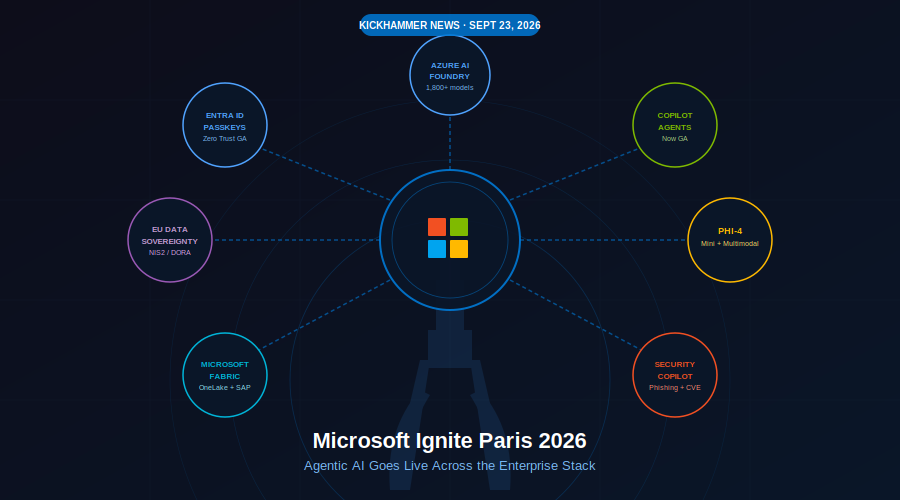
At Ignite Paris, Microsoft pivoted hard. Copilot Agents — task-specific autonomous systems that can handle email triage, document processing, meeting scheduling, and multi-step workflow execution — have moved out of preview and into general availability across Microsoft 365 commercial plans. These aren’t chat interfaces. They are background processes that monitor inboxes, classify incoming requests, trigger workflows in Power Automate, and close tickets in ServiceNow — all without a human approving each individual step.
The distinction matters enormously for enterprise IT leaders who have been cautious about handing AI systems real operational authority. Microsoft spent significant time at the conference addressing governance, explaining that Purview’s AI Hub will now track every Copilot interaction, log data access, and surface anomalies — attempting to give compliance teams visibility over what agents are doing and on whose behalf.
Azure AI Foundry: One Platform to Rule Them All
Microsoft also used Paris to reposition Azure AI Foundry as the definitive enterprise AI development environment. Previously, organisations trying to build custom AI solutions on Azure had to navigate a fragmented landscape of services — Azure OpenAI, Azure Machine Learning, Azure AI Studio — each with overlapping capabilities and separate billing structures.
AI Foundry consolidates all of this into a single unified workspace. It currently provides access to more than 1,800 models, including the full OpenAI GPT family, Meta’s Llama series, Mistral, and Microsoft’s own Phi models. Crucially, it bundles prompt orchestration, safety evaluations, content moderation pipelines, and role-based access controls under one roof.
For large enterprises building internal AI applications — customer service automation, contract review, supply chain intelligence — AI Foundry is Microsoft’s answer to the question of where to start. Whether it genuinely simplifies what has been a notoriously complex developer experience remains to be proven in production, but the consolidation is long overdue.
Phi-4: Small Models for Big Problems
Among the most practically significant announcements was the release of the Phi-4 model family. Microsoft introduced two variants: Phi-4 Mini, designed for on-device inference on Windows AI PCs and mobile devices, and Phi-4 Multimodal, optimised for understanding documents, images, and mixed-format inputs.
The Phi models have consistently punched above their weight class in benchmarks, delivering near-GPT-4 performance on targeted tasks at a fraction of the compute cost. Phi-4 Mini running on a device with a neural processing unit means organisations can automate local document analysis and form completion without data ever leaving the endpoint — a significant selling point for sectors like healthcare, legal, and financial services where cloud data transfer is a regulatory minefield.
Phi-4 Multimodal addresses a gap that has frustrated document-heavy industries for years: the inability to reason across mixed-format files where text, tables, charts, and scanned images coexist in a single PDF. Early demonstrations at Ignite showed the model accurately extracting structured data from invoices with handwritten annotations — precisely the kind of real-world messiness that has made document AI a notoriously hard problem.
Security Rearchitected After CrowdStrike
The CrowdStrike incident of 2024, in which a faulty kernel-level driver update cascaded into a global Windows outage affecting an estimated 8.5 million machines, has visibly reshaped Microsoft’s thinking about third-party security software. At Ignite Paris, the company confirmed that new controlled access layers for security vendors are now being enforced across Windows.
The approach mirrors Apple’s model for macOS: security vendors get rich telemetry and event data through sanctioned APIs, but no longer have direct access to kernel memory. Microsoft positioned this as a structural improvement to Windows resilience, though the security community has noted that it simultaneously tightens Microsoft’s competitive position vis-à-vis independent endpoint security vendors who relied on kernel access to differentiate their products.
Security Copilot also received an upgrade, with new specialised agents for phishing email triage and vulnerability prioritisation. The phishing agent can classify and quarantine suspicious messages across an entire Microsoft 365 tenant, escalate high-confidence threats to human analysts, and generate incident reports — all autonomously. Microsoft claims early customers in financial services are seeing an 80 percent reduction in analyst time spent on first-pass phishing review.
Identity, Access, and the End of Passwords
Passkey authentication for Microsoft Entra ID reached general availability at Ignite, alongside Entra ID token protection — a mechanism that cryptographically binds authentication tokens to specific devices, neutralising a category of credential theft attack that has been responsible for several high-profile enterprise breaches in the past 18 months.
Entra Private Access, Microsoft’s Zero Trust Network Access offering, also moved to GA. It replaces traditional VPN infrastructure with identity-aware, per-application connectivity — a significant shift for organisations still running legacy hub-and-spoke network architectures that were designed for a world where most users sat inside a corporate perimeter.
Data Sovereignty and the European Moment
The Paris venue was not accidental. With European regulators tightening requirements under NIS2 and DORA, and several member states actively migrating government workloads away from US cloud providers, Microsoft arrived in France with a pointed message: we can meet your sovereignty requirements.
The Microsoft Cloud for Sovereignty tier received a significant expansion at Ignite, with new EU data residency guarantees, NIS2 and DORA compliance documentation, and expanded confidential computing coverage across European Azure regions. Microsoft also announced that its French data centre expansion is proceeding ahead of schedule, adding capacity in the Paris and Marseille regions.
Whether this is enough to stem the tide of European public sector defections to open-source alternatives and EU-domiciled cloud providers remains an open question. Germany’s recent mandate for federal agencies to migrate to open-source document formats, and France’s own autumn deadline for government Linux migration, suggest the pressure on Microsoft in Europe is structural rather than episodic.
The Stakes
Microsoft enters the final quarter of 2026 with genuine momentum in AI — Azure’s cloud infrastructure revenue doubled year-on-year in the most recent quarter, with AI services accounting for a significant portion of that growth. The transition from assistant to agent is the bet that the next doubling will come from autonomous enterprise workflows rather than individual productivity tools.
That bet is not without risk. Enterprises that feel burned by preview features that never delivered, compliance teams alarmed by AI agents acting without human approval, and regulators in Brussels who are watching every move Microsoft makes in the agentic space — all of these forces will shape how quickly the vision laid out in Paris translates into contracted ARR.
But the direction of travel is now unmistakable. Microsoft is not building AI into its products. It is building its products into AI.