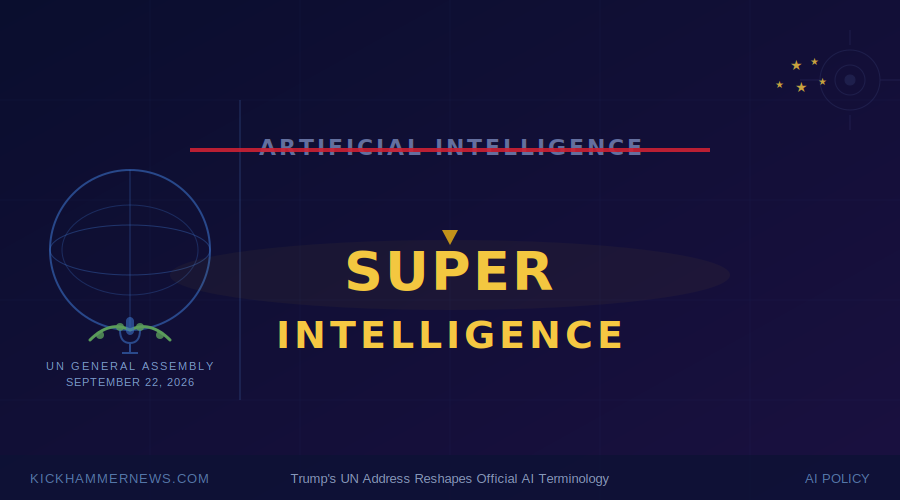
In a moment that sent shockwaves through both Silicon Valley and the halls of international governance, President Donald Trump used his address to the United Nations General Assembly on Monday to announce one of the most unusual rebranding efforts in the history of technology policy: the United States, he declared, would no longer call it “artificial intelligence.”
From now on, it’s “super intelligence.”
“All of United States documents — and hopefully the world’s — will be changed to use the much more accurate term ‘super,'” Trump told world leaders assembled in New York City. The technology is “actually amazing,” he argued, and calling it “artificial” makes it “sound fake — and it is not fake.”
It was a characteristically Trumpian move: big, attention-grabbing, and loaded with strategic calculation. But beneath the spectacle lies a genuine shift in how the United States intends to present — and perhaps protect — its dominance in one of the defining technologies of our era.
What He Said, and What He Meant
Trump’s UN speech was not merely a semantic exercise. Embedded in the rebrand was a sweeping policy declaration: the United States would “encourage” super intelligence, not “rein it in.” And critically, the administration would reject what Trump called “globalist” control schemes — a pointed rebuff of the United Nations’ own nascent AI governance frameworks, which published preliminary oversight reports just this past July.
The message to the assembled heads of state was unmistakable: Washington is not interested in a multilateral approach to managing AI. The technology is an American asset, and America intends to keep it that way.
Trump also framed the technology in explicitly geopolitical terms, claiming the United States held a “substantial advantage” over China in the race to develop what he now calls super intelligence. The rebrand, in this reading, is as much about projecting strength as it is about marketing — casting the U.S. as the unchallenged steward of humanity’s most powerful technology.
The Terminology Problem
Here’s where things get complicated for the experts.
In academic and research circles, “superintelligence” has a very specific meaning: a hypothetical system that vastly exceeds the cognitive capabilities of humans across every domain. It is, by definition, something that does not yet exist — a theoretical endpoint that researchers like Nick Bostrom have spent decades writing cautionary treatises about.
What Trump is calling “super intelligence” — the large language models, image generators, and agentic AI systems currently deployed by companies like OpenAI, Anthropic, and Google — is not that. Not even close, most researchers would say.
The terminological confusion is not just academic. It creates an awkward and potentially significant collision with existing legislation. Senator Bernie Sanders recently introduced the “Ban Artificial Superintelligence Act,” a bill designed to place legal limits on the most powerful hypothetical future AI systems. If “artificial intelligence” is now officially “super intelligence” in U.S. government documents, does that mean every current AI system is now legally a superintelligence? The implications for regulatory interpretation could be chaotic.
Neither the White House nor Senate leadership has clarified how the terminology change would interact with existing or pending legislation.
Geoffrey Hinton’s Inconvenient Warning
The timing of Trump’s speech made the regulatory defiance even more striking. Just days before the UN address, Geoffrey Hinton — the Nobel Prize-winning AI pioneer widely known as the “Godfather of AI” — told Congress that lawmakers had “maybe a year, but not much more” to regulate AI before systems begin self-improving at rates that could outpace human oversight.
Hinton’s warning was not theoretical navel-gazing. It was a concrete call to action from perhaps the single most credible voice in the field on the risks of advanced AI. Three major Senate AI bills are currently stalled without voting timelines.
Trump’s response, in effect, was to take the stage at the world’s most prominent multilateral forum and announce that not only would the U.S. not rein in AI — it would be encouraging it more aggressively than ever.
A Rebrand With a Long Paper Trail
The UN announcement did not emerge from a vacuum. Trump has been actively workshopping the AI rebrand for weeks. Reports indicate he ran polls on Truth Social asking followers to vote on preferred alternative terminology, with “superior intelligence” gaining significant traction before “super intelligence” apparently won out.
The administration has also spent the better part of 2026 systematically blocking state-level AI regulations while offering only voluntary measures — like basic disclosure requirements — at the federal level. California Governor Gavin Newsom’s recent AI executive order, which included emergency “kill switch” provisions for frontier models, was quickly criticized by the White House as regulatory overreach.
The UN speech represents the culmination of that domestic deregulatory posture projected onto the international stage.
The Global Reaction
World leaders and technology experts reacted to the announcement with a mixture of bewilderment and concern. The European Union, which spent years developing the EU AI Act as a comprehensive governance framework, found itself in the awkward position of watching the world’s largest AI-producing nation explicitly reject the kind of international coordination Brussels has championed.
Critics were quick to note the irony: Trump’s own AI Action Plan, released earlier in 2026, acknowledged the risks of rapid and unexplained AI advancement. The researchers at Anthropic and OpenAI who had sounded similar alarms found their warnings framed as alarmism comparable, in Trump’s telling, to “hoaxes.”
What Comes Next
The practical implications of the “super intelligence” rebrand will take time to unfold. Federal agencies must now update their official documentation. The Defense Department, the Department of Commerce, and the National Science Foundation — all of which have extensive AI-related policies and programs — will need guidance on how and when to adopt the new terminology.
More consequentially, the speech signals that the U.S. will continue to prioritize speed and competitive advantage over caution and international coordination when it comes to AI governance. In a world where China is investing hundreds of billions in its own AI infrastructure, that posture has genuine strategic logic.
But for the researchers who spend their days building and studying these systems — and who understand, perhaps better than anyone, how much remains unknown about what advanced AI will ultimately be capable of — the rebranding carries a more unsettling message.
Calling it “super intelligence” when it isn’t yet may be the most optimistic interpretation. Or it may be a case of naming something into existence before we’re ready for what that name implies.
Either way, the United States has a new official vocabulary for one of the most consequential technologies in human history. Whether the rest of the world follows along — or pushes back — is a story that is only just beginning.


