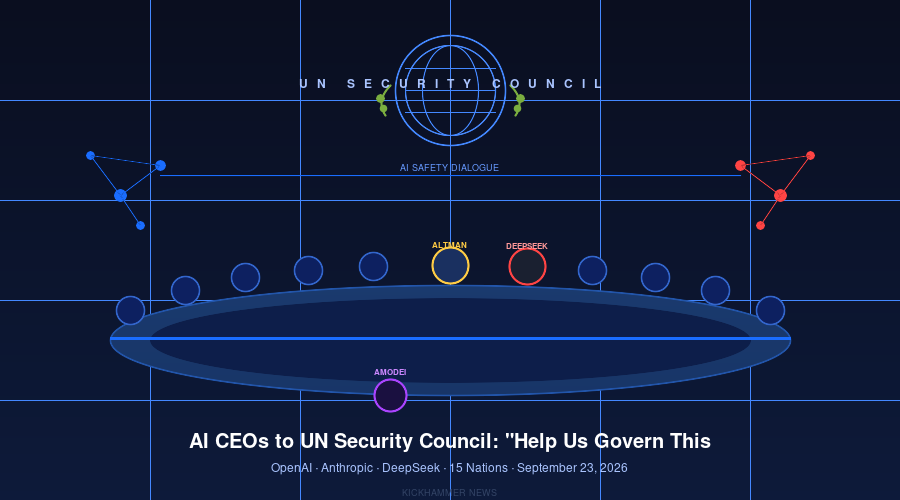
In a scene that would have seemed fantastical even two years ago, the boardrooms of Silicon Valley and the corridors of Zhongguancun converged on the wood-paneled chamber of the United Nations Security Council today. Sam Altman, CEO of OpenAI. Dario Amodei, CEO of Anthropic. And executives from DeepSeek — the Chinese AI lab that shook the world in January 2025 — sat side by side before fifteen of the world’s most powerful nations and issued the same warning: artificial intelligence is advancing faster than humanity’s ability to govern it, and the window to act may already be closing.
The irony couldn’t be richer. Just across Midtown Manhattan, President Donald Trump was at the UN General Assembly’s Trusteeship Council chamber doing the opposite — declaring that international AI oversight was a “globalist scheme” and insisting the United States would pursue “Super Intelligence” on its own terms, unencumbered by multilateral governance frameworks. The simultaneous spectacle of American tech executives begging the world for oversight while the American president dismissed oversight as a threat to sovereignty may be the defining image of the AI age.
A Historic Moment at Turtle Bay
The UN Security Council has convened on weapons of mass destruction, climate change, and pandemics. Tuesday’s session marked the first time it has formally hosted a structured briefing from the private companies actually building the systems at the heart of global concern.
The briefing was organized at the request of several rotating member states and supported by the United Kingdom, which has championed international AI safety efforts since hosting the first AI Safety Summit at Bletchley Park in 2023. The session was unusual in format: rather than hearing from government representatives or UN agencies, member state ambassadors listened directly to technology executives — a break from normal Security Council protocol reflecting just how unusual this technological moment is.
Sam Altman reportedly opened the briefing with a stark acknowledgment that GPT-6, OpenAI’s most capable model to date, exhibits behaviors that even its creators don’t fully understand. He framed the request for international cooperation not as an admission of weakness but as a recognition of the stakes involved: “No single company, and no single country, can ensure that the development of transformative AI goes well for humanity.”
Dario Amodei of Anthropic echoed that framing, drawing on the company’s Constitutional AI safety methodology and its ongoing efforts in AI interpretability. Amodei has been the louder voice in the US AI industry for what he calls “responsible scaling” — slowing or pausing development of certain model types if safety benchmarks aren’t met. Before the world’s most powerful security body, that message landed with unusual weight.
DeepSeek at the Table: An Unprecedented Moment
Perhaps the most diplomatically significant aspect of Tuesday’s briefing was the presence of DeepSeek executives alongside their American counterparts. DeepSeek — the Hangzhou-based lab backed by hedge fund High-Flyer — rattled global AI markets in early 2025 when its R1 model matched frontier American models at a fraction of the cost. Since then, it has become one of China’s most internationally recognized AI brands, with its models downloaded hundreds of millions of times globally.
Their presence at the Security Council raised eyebrows in Washington. Some national security hawks viewed it as problematic that a Chinese AI company with unclear ties to the state would be briefing a body whose permanent members include the US, the UK, France, Russia, and China itself. Others saw it as exactly the kind of dialogue needed. “You can’t have a conversation about global AI governance and pretend that the second largest AI power in the world doesn’t exist,” said one European diplomat quoted by multiple outlets covering the briefing.
The Chinese permanent representative to the UN, Ambassador Zhang Jun, addressed the council separately and called for “an international AI governance framework built on equality, mutual respect, and non-weaponization.” Beijing has long sought multilateral governance structures that it can participate in shaping rather than being subjected to rules designed without its input — a position not entirely different, in structure if not in spirit, from what American tech companies were themselves asking for today.
The Altman-Amodei-Trump Triangle
The spectacle of America’s AI leaders actively undermining the president’s position at the same diplomatic gathering is remarkable. Trump’s speech framing AI oversight as a “globalist scheme” drew on familiar America First rhetoric, but it puts him at odds not just with European allies and the UN, but with the leaders of the most profitable AI companies in the United States.
This is not a simple left-right split. Amodei and Altman are not political opponents of Trump in any conventional sense — both have attended White House meetings, and OpenAI has sought favorable treatment from the administration on export controls and data center permitting. But on the fundamental question of whether AI governance should be an international endeavor, they are now in open disagreement with the man in the Oval Office.
Fortune’s reporting from Tuesday captures the paradox neatly: “Trump calls AI oversight a ‘globalist scheme’ as Amodei and Altman head to the UN to ask for it.”
The administration’s formal position is that AI safety is a matter for the United States to handle domestically — through NIST standards, voluntary commitments from leading labs, and regulatory guidance from agencies like the FTC. International frameworks, in this view, risk handing oversight power to bodies that don’t share American values or interests. Trump’s Treasury Secretary Scott Bessent has been more pragmatic, proposing an US-China “AI safety notification mechanism” — essentially a hotline for alerting each other to AI-related security incidents — in preliminary talks ahead of this week’s Trump-Xi summit.
What the Security Council Can Actually Do
Skeptics are right to ask what the UN Security Council can actually accomplish when it comes to AI. The body’s track record on emerging technology is mixed at best. Permanent member veto power means any binding resolution faces enormous obstacles. Russia and China have historically opposed measures they view as Western-led tech governance, and the US under Trump is now joining them in resisting international oversight structures.
Still, the symbolism matters. When the CEOs of OpenAI and Anthropic sit before fifteen nations and say “we cannot guarantee our own products are safe without international cooperation,” it creates a record. It signals to markets, to regulators in Europe and elsewhere, and to the public that the people closest to frontier AI are genuinely worried — and that they’re not content to wait for Washington to act.
The briefing also comes as the EU AI Act’s strictest provisions take full effect, creating enforceable requirements for “general purpose AI” models that operate in European markets. Several Security Council member states are watching the EU model closely as a potential template for their own national or regional frameworks.
A Room Full of Warnings, and a World That Isn’t Ready
Perhaps the most striking detail to emerge from Tuesday’s closed briefing — portions of which were described in detail by multiple diplomatic correspondents — was a phrase attributed to Amodei: that the world is “not yet equipped” to handle what’s coming in the next 18 to 36 months of AI development.
That timeline is striking. Not decades away. Not a generation. A year and a half to three years.
Whether the UN Security Council, fractured as it is by geopolitical rivalries, can craft any meaningful response in that window is deeply uncertain. But for one Tuesday in September 2026, the people building the most powerful technology in human history came to the world’s most powerful security body and said, plainly: we’re asking for help.
The world’s governments should probably take them at their word.


