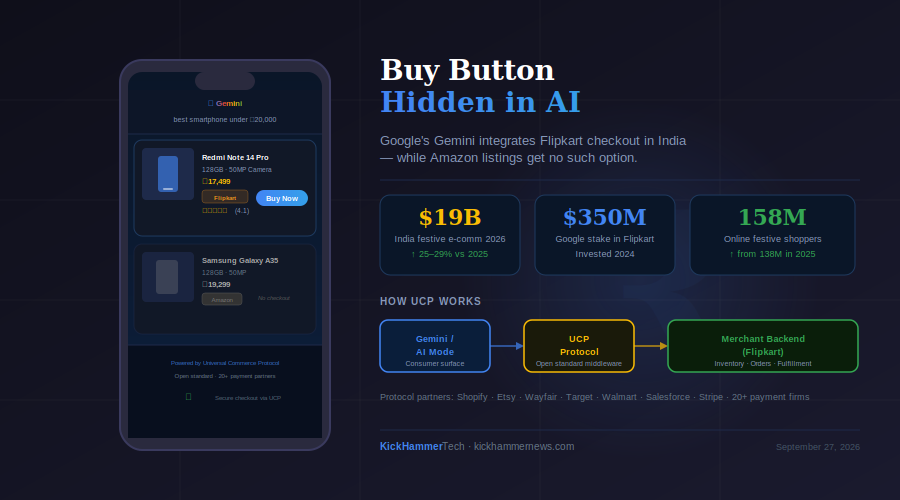
There is a small button appearing inside Google’s Gemini AI assistant in India right now, and it is quietly upending the rules of one of the world’s most competitive e-commerce battlegrounds. The button says “Buy.” It sits beside certain Flipkart product listings. And when you click it, you never have to leave Google.
Amazon listings appear in the same search results. They do not have the button.
That asymmetry — a single UI element withheld from one competitor — may be the most consequential small rectangle in technology right now.
What Google Just Did
Starting this week, a subset of Indian users browsing with Gemini or Google’s AI Mode are seeing something new: a direct checkout option embedded into AI-generated product recommendations. The pilot currently covers smartphones, electronics, and mobile accessories sold through Flipkart, the Indian e-commerce giant owned by Walmart. When the button appears, users can complete a full Flipkart-branded purchase without ever navigating to a separate website or app.
Google confirmed the test in characteristically non-committal terms, calling it an effort to “help people discover and connect with businesses more easily.” The company plans to expand the feature broadly in October — just in time for India’s festive shopping season, the most lucrative retail period in a country of 1.4 billion people.
The timing is not accidental. India’s festive e-commerce season — spanning Navratri, Dussehra, Diwali, and the weeks that follow — is projected to generate ₹1.50 to 1.55 lakh crore in 2026, or roughly $18 to $19 billion. That figure represents a 25 to 29 percent increase over the 2025 season, fueled by expanding internet access in Tier 2 and Tier 3 cities and India’s extraordinary digital payments infrastructure. In August 2026 alone, the country’s Unified Payments Interface processed 24.51 billion transactions. The online festive shopper base is expected to swell to 158 million consumers this year, up from 138 million last year.
Google wants a piece of that, and it has built the plumbing to get it.
The Protocol Underneath Everything
The Gemini buy button is not a one-off integration. It is the first major consumer-facing deployment in India of Google’s Universal Commerce Protocol, or UCP — an open-source standard the company developed alongside Shopify, Etsy, Wayfair, Target, and Walmart, with endorsements from more than 20 global payment and commerce firms.
UCP works through a three-layer architecture. The consumer surface — Gemini, AI Mode, eventually any AI assistant that adopts the standard — receives a shopping request. The UCP middleware translates that request into a standardized language that any participating retailer’s backend can understand. The merchant system handles inventory, pricing, and fulfillment. The result: an AI assistant that doesn’t just recommend products but completes purchases, manages carts, applies loyalty points, and tracks orders, all without the user visiting a separate website.
Google rolled out UCP to a select group of U.S.-based merchants earlier in 2026. The Flipkart integration is the first time the protocol has been deployed at scale in a major non-U.S. market, and the fact that it is launching in India — ahead of a $19 billion shopping season — signals that Google is done treating this as an experiment.
For merchants who have not yet adopted UCP, the implication is stark: if your products cannot communicate with AI agents through this protocol, those agents will not recommend you. The AI will route shoppers to competitors who do participate.
The Investment Behind the Integration
Google’s partnership with Flipkart is not purely strategic — it is also financial. Google invested approximately $350 million in Flipkart during a 2024 funding round, acquiring a minority stake in the Walmart-owned platform. That investment now looks prescient. By embedding Flipkart’s checkout directly into Gemini, Google has created an AI commerce loop that locks users inside its own ecosystem while routing transaction fees back through a company it partly owns.
Flipkart and Amazon India have fought an increasingly intense battle for dominance during annual festive sale periods — Flipkart’s “Big Billion Days” and Amazon’s “Great Indian Festival” typically land within days of each other. This year, Amazon will fight that battle with one hand behind its back. Its product listings appear in Google’s AI results, but the checkout button belongs exclusively to Flipkart.
Amazon has not responded publicly to the integration.
The New Shape of AI Commerce
The Flipkart-Gemini partnership is the latest data point in what is rapidly becoming the defining commerce story of 2026: who controls the point of purchase when AI becomes the primary interface between consumers and products.
The playbook differs sharply by platform. Amazon, which blocked Meta’s Muse AI shopping agent in July over concerns about stealth browsing and credential capture, wants to own the entire consumer journey inside Amazon.com — it is deeply resistant to external AI routing shoppers into its checkout. Shopify took the opposite approach, formally partnering with Meta to let AI agents complete transactions on merchant storefronts, and its stock surged 14% on the news.
Google is charting a third path: build an open protocol that makes Google’s AI surfaces the preferred shopping interface by giving preferential checkout integration to partners — or in this case, a company in which Google holds equity. Amazon can appear in the results. It just cannot close the sale there.
This distinction matters enormously at scale. When a shopper asks Gemini “what’s the best smartphone under ₹20,000” and Gemini surfaces a Flipkart listing with a one-tap checkout, the friction reduction is dramatic. Studies of e-commerce consistently show that every additional click between intent and purchase costs conversions. Google has just removed several clicks from Flipkart’s funnel and added them to Amazon’s.
What Comes Next
Google has signaled that the UCP rollout in India is a prelude to a much broader global expansion. With Salesforce and Stripe committed to implementing UCP support, the protocol is likely to become a standard layer of e-commerce infrastructure over the next 12 to 18 months, dramatically lowering the technical barrier for merchants who want to participate in AI-native commerce.
For Indian retailers, the timeline is more urgent. With the festive season beginning in October, merchants who have not yet implemented UCP or established Flipkart partnerships will have limited time to position themselves for AI-driven traffic before the most important shopping window of the year closes.
The broader question — one that regulators in Brussels, Washington, and New Delhi will eventually have to answer — is whether Google is using its AI surfaces to unfairly preference commercial partners in which it holds financial stakes. The EU’s Digital Markets Act would almost certainly have questions about a dominant AI assistant using checkout integration as a competitive tool.
For now, the button is live, the season is approaching, and Google has quietly built a tollbooth at the entrance to one of the world’s fastest-growing consumer markets. Amazon is watching from the other side of the gate.


