How a content delivery giant quietly became the most important infrastructure partner in AI
When people think about the companies powering artificial intelligence’s rapid ascent, the usual names come to mind: Amazon Web Services, Google Cloud, Microsoft Azure. What almost nobody expected was Akamai.
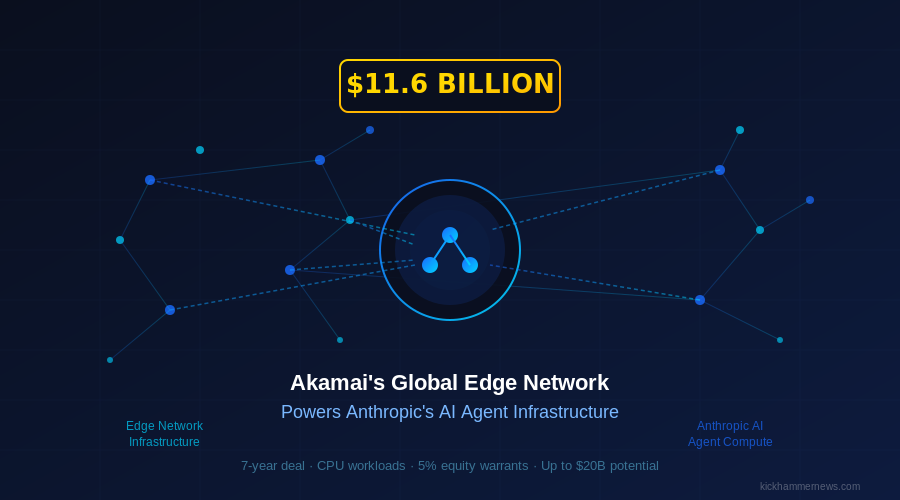
On September 25, 2026, Akamai Technologies — the company whose global network has quietly delivered web content for nearly three decades — announced what its CEO called “the largest contract in Akamai’s history”: an $11.6 billion, seven-year cloud infrastructure deal with Anthropic. With an option to expand by an additional $9 billion, the total potential value of the partnership reaches a staggering $20 billion. The announcement sent Akamai shares surging 17% in a single trading session.
The deal represents something more than a headline number. It signals a fundamental shift in what AI companies actually need to scale — and why the compute wars are no longer just about GPUs.
Not Your Typical AI Infrastructure Story
Almost every AI infrastructure narrative of the past three years has centered on one thing: GPUs. Nvidia’s H100s. Blackwell chips. The race to secure graphics processing units capable of training ever-larger language models. So it came as something of a surprise when Akamai’s announcement made clear that this deal is explicitly about CPUs — general-purpose processors, not the specialized chips that train models.
The reason matters enormously. Anthropic is not buying this compute to train Claude. It’s buying it to run Claude — specifically, the increasingly complex tasks that AI agents perform once deployed. Code execution. Web browsing. File manipulation. API calls. The thousand unglamorous operations that make up an AI agent’s actual working day.
“As AI agents take on more tasks,” Akamai CEO Tom Leighton explained, “the CPU workload demands accelerate.” A language model that simply answers questions needs GPU inference. An agent that writes code, runs it, checks the output, browses documentation, revises the code, and commits it to a repository needs sustained CPU capacity across a globally distributed network. That is precisely what Akamai has built — not in one hyperscale data center, but across thousands of points of presence spanning every inhabited continent.
The deal is, at its core, a bet that AI agents will become ubiquitous workhorses — and that the infrastructure supporting them will look less like a traditional cloud and more like the internet itself.
A Partnership With Skin in the Game
The financial structure of the deal is nearly as unusual as the pairing itself. Alongside the seven-year “take-or-pay” commitment — meaning Anthropic owes the money regardless of usage fluctuations — Akamai issued Anthropic a warrant granting it the right to acquire up to 5% of Akamai’s outstanding shares, approximately 7.7 million on an as-converted basis, at an exercise price of $111.33 per share.
The vesting schedule is tied directly to the commercial relationship. Approximately 2% vests with the initial $11.6 billion commitment. The remaining 3% unlocks incrementally — roughly one percentage point for each additional $3 billion Anthropic commits — as the relationship expands toward that $20 billion ceiling.
This is an inversion of the “circular AI deal” structure that became common in 2024 and 2025, where compute suppliers like Amazon, Google, and Microsoft invested billions in AI companies while simultaneously selling them cloud services. In those arrangements, the money moved in a circle: an AI lab received an investment from a cloud provider and used much of it to buy compute from that same provider.
The Akamai arrangement reverses the equity direction. Anthropic is not the recipient of investment; it is the strategic anchor customer whose commitment is valuable enough that Akamai is essentially giving Anthropic an ownership stake as a relationship sweetener — and an incentive to keep spending. A similar structure appeared in OpenAI’s arrangement with AMD, but applying it to Akamai signals that unconventional warrant structures are becoming a standard tool in the AI infrastructure negotiating playbook.
Akamai’s Transformation, Measured in Billions
For Akamai, the deal represents an aggressive acceleration of a multi-year identity shift. The company spent the 1990s and 2000s perfecting content delivery — the technology that ensures a webpage loads quickly whether its visitor is in Boston or Bangalore. It spent the 2010s expanding into security and edge computing. Now, in the mid-2020s, it is betting that its distributed global footprint can become the preferred substrate for AI agent workloads.
The Anthropic deal is Akamai’s largest single contract ever, but it is not its only 2026 cloud commitment. Combined with approximately $2.8 billion in other cloud contracts signed this year, Akamai’s year-to-date signed contract value reaches roughly $14.4 billion. The company also expanded an existing arrangement with Anthropic that dated to May 2026, when the two companies announced a $1.8 billion deal — meaning the new agreement is six times larger than the one struck just four months ago.
To support the commitment, Akamai is planning $5.5 billion in capital expenditures through 2028, including $1.7 billion in accelerated spending in the fourth quarter of 2026 alone to secure critical supply chain components, particularly memory. The company projects no revenue from the deal in 2026, between $150 million and $300 million in the second half of 2027, and an annualized run rate of approximately $1.7 billion by the end of 2028.
Anthropic’s Insatiable Compute Appetite
For Anthropic, the Akamai deal is the latest chapter in what analysts have begun calling the company’s “compute gobbling streak.” In the past eighteen months, Anthropic has secured major infrastructure commitments from Amazon Web Services, Google Cloud, Microsoft Azure, and AMD, in addition to now Akamai. Each arrangement has been significant. Taken together, they paint a picture of a company that believes the constraint on AI capability is not model architecture or training methodology but raw infrastructure at planetary scale.
The logic is straightforward, even if the dollar amounts are breathtaking. Claude is no longer primarily a chatbot. It is increasingly deployed as the backbone of autonomous workflows: engineering agents that review and write code, research agents that synthesize scientific literature, operations agents that manage logistics chains. Each of those use cases requires not just a single inference call but sustained, reliable compute — the kind that needs to be distributed, redundant, and available everywhere.
Akamai, with its thousands of edge nodes planted in internet exchange points and carrier facilities around the world, offers something that hyperscale cloud providers cannot easily replicate: genuine geographic distribution without the latency of routing workloads back to centralized data centers. For AI agents that need to interact with local systems, local data, and local regulations, that edge infrastructure may prove more valuable than raw GPU clusters.
What It Means for the Industry
The Akamai-Anthropic deal is a signal flare for the broader infrastructure market. GPU capacity remains essential for model training, but the frontier of competitive advantage is shifting toward the distributed CPU infrastructure that will actually run AI agents in production.
Companies like Cloudflare, Fastly, and traditional telcos are watching closely. If Akamai’s gamble pays off — if AI agent workloads become a sustained, growing source of cloud revenue — every company with a distributed network will have to decide whether to make a comparable bet. The question is whether Akamai has moved early enough to establish a durable position, or whether the hyperscale cloud providers will build comparable edge capabilities before the market matures.
For now, Akamai’s stock market response provides a verdict. A 17% single-day gain on an $11.6 billion deal announcement is not mere enthusiasm. It is the market repricing what distributed infrastructure is worth in an age of AI agents — and concluding that the answer is considerably more than anyone had previously assumed.
The internet’s backbone, it turns out, was already in exactly the right place.


