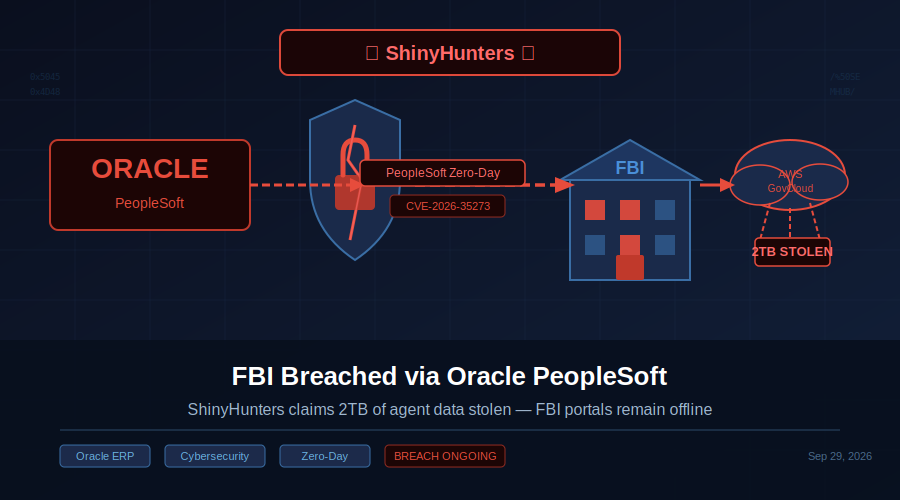
The notorious ShinyHunters hacking group has escalated its ongoing Oracle PeopleSoft exploitation campaign to a staggering new level, claiming a successful breach of the Federal Bureau of Investigation that has left the agency’s job-application portals offline for more than a week. The group says it extracted approximately two terabytes of sensitive data — including personal information on tens of thousands of active FBI agents, prospective employees, and their immediate family members — through an unpatched vulnerability in Oracle’s flagship human-resources platform. If confirmed, the attack represents one of the most audacious breaches of a U.S. law-enforcement agency in recent memory and raises urgent questions about the security posture of Oracle PeopleSoft deployments across government and critical infrastructure.
The Breach: What Happened
According to statements published by ShinyHunters and corroborated by independent cybersecurity researchers, the group exploited a zero-day remote code execution vulnerability in Oracle PeopleSoft — the enterprise resource-planning suite widely deployed by universities, healthcare organizations, and government agencies to manage HR, finance, and student records. After gaining a foothold on an Oracle PeopleSoft server used by the FBI to manage job applications and background-check workflows, the attackers pivoted laterally into Amazon Web Services GovCloud infrastructure where the agency stores operational data.
The compromised systems allegedly include FBIJobs (the agency’s public-facing careers portal), FBI BEAST (the background-check processing system), FBI MedLink (a medical records database for agents and applicants), FBI BICS (an investigative-information repository), and several internal HR platforms. ShinyHunters claimed the extracted cache contains names, home addresses, phone numbers, Social Security numbers, medical records including prescriptions and diagnoses, and — perhaps most alarmingly — data revealing which FBI agents work in sensitive or classified units.
Both public FBI careers portals, apply.fbijobs.gov and fbijobs.gov/special-agents, remain offline as of September 28, 2026, with prospective applicants unable to submit or track applications.
The Oracle PeopleSoft Vulnerability
The technical heart of this incident is a PeopleSoft vulnerability that security researchers have linked to CVE-2026-35273, a critical flaw the same group weaponized against university HR systems in June 2026. In that earlier campaign, ShinyHunters compromised records at dozens of higher-education institutions before Oracle pushed an emergency patch. The group’s latest claims suggest they developed a bypass for web-application firewall defenses by URL-encoding characters in their exploit payloads — requesting “/%50SEMHUB/” instead of “/PSEMHUB/” to evade signature-based detection.
Security firm Vectra AI, which analyzed indicators of compromise shared by ShinyHunters, noted that organizations that deployed firewall rules following the June 2026 attacks without applying Oracle’s emergency patch remained functionally unprotected. “This is a textbook demonstration of why perimeter controls are not a substitute for patch management,” said Vectra’s threat-intelligence lead. “The attackers simply re-encoded their payload and walked through a door that was never properly shut.”
Oracle had not issued a public statement specifically addressing the FBI incident at the time of publication. The company’s standard guidance following the June 2026 university campaign was to apply Critical Patch Update advisory remediation and to upgrade PeopleSoft PeopleTools to the latest supported release.
Motivation: Retaliation, Not Ransom
In an unusual twist, ShinyHunters has explicitly stated the FBI breach was not financially motivated. The group — which has historically monetized stolen data on criminal forums — says the operation was carried out in direct retaliation for an FBI public-service announcement warning organizations about ShinyHunters’ Canvas LMS attack campaigns, which the group characterized as “substantial false allegations.”
Rather than demanding payment for the data, ShinyHunters has threatened to release the full dataset publicly unless the FBI retracts the advisory and corrects what the group frames as misrepresentations. This ideologically motivated posture makes the situation more difficult for law enforcement and incident responders: there is no conventional ransomware negotiation pathway, and the threat of broad data disclosure to harm agents’ operational security is ongoing.
Two individuals with alleged ties to ShinyHunters were arrested by UK law-enforcement authorities in a coordinated operation on September 22, 2026 — the same day the FBI breach was first publicly disclosed. That timing led some researchers to speculate the disclosure was intended to demonstrate the group’s continued operational capability even after the arrests.
The FBI’s Response
The Bureau has confirmed it is “actively and aggressively investigating this matter” but has been cautious about confirming specifics, noting the “point of breach is still undetermined — whether a third-party or the FBI’s enterprise.” That carefully worded statement leaves open the possibility that a third-party vendor or contractor managing PeopleSoft infrastructure, rather than the FBI’s own internal network, was the initial point of compromise.
The FBI’s careers portals were taken offline as a precautionary measure. Federal cybersecurity agency CISA has been notified and is supporting the investigation alongside FBI Cyber Division personnel and outside digital-forensics contractors.
Broader Implications for Oracle PeopleSoft Deployments
The FBI breach is the highest-profile incident yet in what security researchers now describe as a sustained and widening campaign against Oracle PeopleSoft deployments in government and regulated industries. The platform is used by hundreds of federal, state, and local government entities to manage personnel records, benefits, payroll, and background-check data — exactly the kinds of sensitive datasets that hostile nation-state actors and extortion-motivated criminal groups prize most.
Analysts point to several systemic vulnerabilities in how government agencies manage enterprise-software patching. Procurement cycles, change-control processes, and the operational complexity of upgrading a heavily customized PeopleSoft instance can delay security patches by months or even years beyond Oracle’s recommended application timelines. In environments where the HR system is directly integrated with AWS GovCloud or other cloud infrastructure, an unpatched PeopleSoft vulnerability can quickly become a springboard into broader cloud environments.
“The pivot from PeopleSoft to GovCloud is the part that should worry every CISO running Oracle in a hybrid government environment,” said one federal security architect who requested anonymity because they were not authorized to speak publicly. “PeopleSoft was never designed to be the outermost security perimeter. When it becomes one by default, you have a problem.”
What Organizations Must Do Now
With Oracle’s next Critical Security Patch Update scheduled for October 2026, security teams managing PeopleSoft deployments should not wait. Immediate actions recommended by multiple cybersecurity firms include auditing all PeopleSoft-facing firewall and WAF rules to ensure they are not serving as the sole mitigation for unpatched CVEs; applying all available Oracle emergency patches for PeopleSoft PeopleTools and application modules, particularly those addressing the CVE-2026-35273 family; reviewing network-segmentation policies to ensure PeopleSoft servers cannot directly reach cloud control planes or sensitive downstream systems; and enabling enhanced logging on PeopleSoft integration broker endpoints to detect anomalous URL-encoded request patterns.
Organizations should also review Oracle’s July and August 2026 Critical Security Patch Update advisories for any PeopleSoft-specific entries and confirm current patch levels against Oracle’s support matrix.
The Escalating PeopleSoft Threat Landscape
ShinyHunters’ campaign against PeopleSoft represents a concerning evolution in ransomware and extortion tactics. What began as financially motivated data theft against universities has transformed into a geopolitically charged confrontation with a federal law-enforcement agency, demonstrating that well-resourced criminal groups are increasingly willing to escalate conflict with authorities rather than retreat when exposed. For Oracle, whose PeopleSoft platform serves as critical HR infrastructure across the public sector, the incident is likely to accelerate customer pressure for more frequent out-of-band security patches and clearer breach-notification guidance.
The outcome of the FBI investigation — and whether ShinyHunters follows through on its threat to release the stolen data — will shape enterprise risk assessments for Oracle PeopleSoft for the foreseeable future. In the meantime, every organization running the platform should treat the current threat environment as a five-alarm fire rather than a scheduled maintenance item.


