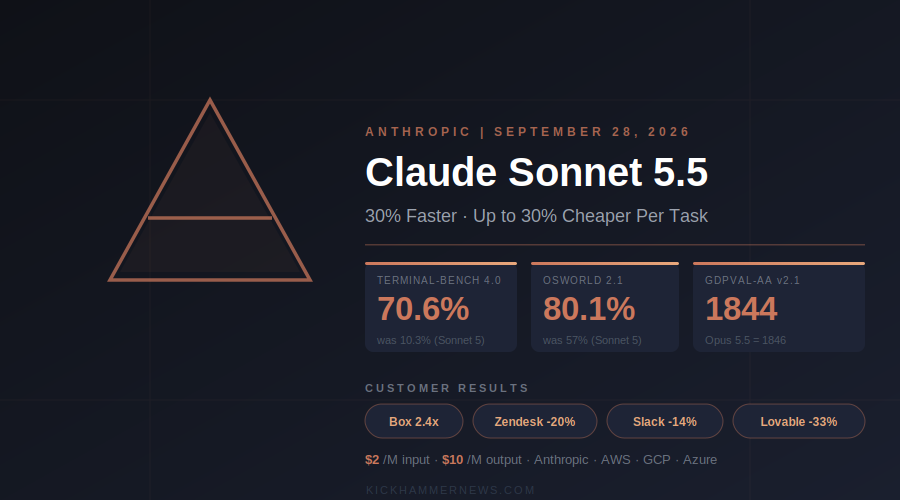
Anthropic dropped a surprise on Monday that its S-1 roadshow investors will want to read closely: a new mid-tier model called Claude Sonnet 5.5 that outperforms its predecessor by a margin that shouldn’t be possible at the same price. The model is 30 percent faster, costs up to 30 percent less per completed task, and on the benchmark that matters most for agentic coding work, it improved not by a few percentage points but by a factor of seven.
For enterprise customers who have been watching the AI cost curve obsessively, Sonnet 5.5 is the model release they’ve been waiting for. For Anthropic — which filed its IPO registration statement last Monday disclosing over $518 billion in compute commitments and an $8 billion operating loss — it is a reminder that the company can still move fast on the product side, even as it prepares to become the most scrutinized AI company on Wall Street.
What Changed
The core of Sonnet 5.5 is efficiency, not raw capability expansion. Anthropic kept the API price identical to Sonnet 5 — $2 per million input tokens, $10 per million output tokens — but engineered the model to consume far fewer tokens to finish the same work. The result is a lower real-world bill without touching the rate card.
The numbers are striking. On Terminal-Bench 4.0, the primary evaluation for agentic coding, Sonnet 5.5 scores 70.6 percent. Sonnet 5 scored 10.3 percent on the same benchmark. That is not an incremental update; it is a different category of model for coding tasks. On OSWorld 2.1, which tests computer use and interface navigation, Sonnet 5.5 reaches 80.1 percent — well above Sonnet 5’s 57 percent and only 1.7 points behind the flagship Opus 5.5 at 81.8 percent. On GDPval-AA v2.1, a broad benchmark covering knowledge work across 44 occupations, Sonnet 5.5 scores 1844, within two points of Opus 5.5’s 1846.
The chart recognition score is the most eyebrow-raising data point in the release notes: 61.6 percent on Chartography, versus 15.6 percent for Sonnet 5. Sonnet 5.5 is also the first Sonnet model to have cleared Pokémon Red using only screenshots — a benchmark the AI community uses as a proxy for sustained, real-world reasoning under uncertainty with no special scaffolding.
The Efficiency Mechanism
What explains the speed and cost gains without a price increase? Anthropic attributes much of the improvement to “batching.” Sonnet 5.5 consolidates tool calls, making fewer separate steps to accomplish the same result. In multi-agent pipelines, this means each agent fires fewer calls before reaching the answer, reducing both latency and the total token count billed.
Enterprise customers who tested Sonnet 5.5 ahead of launch reported results that validate the mechanism. Box saw a 2.4x speed increase with 12 percent fewer tokens consumed. Zendesk reported a 20 percent reduction in ticket processing time. Slack found approximately 14 percent fewer output tokens and fewer steps to complete tasks. Lovable, the AI-powered web app builder, recorded one-third fewer tool calls and half as many shell executions per build. Base44 measured 3.6 build iterations per completed project compared to 7.7 with Opus 5 — a result that illustrates how the model’s coding gains translate into operational savings when multiplied across thousands of daily builds.
Anthropic also notes that on several evaluations, Sonnet 5.5 running at “Low” or “Medium” effort levels can exceed Sonnet 5’s best score at roughly one-tenth the per-task cost. For companies deploying models at scale, that efficiency ratio is significant enough to prompt a wholesale architectural review of where in their stack they’re spending money on Opus-tier compute.
Safety and the Cybersecurity Upgrade
Sonnet 5.5 is the first model in the Sonnet family to carry cybersecurity safeguards that Anthropic previously reserved for its flagship systems. The company describes these protections as “comparable to Opus 5.5,” meaning the mid-tier model now has the same hardened behavior against misuse in security-related contexts as the most capable model in the lineup.
Two other safety additions are worth noting. The model includes classifiers specifically designed to block “reasoning extraction attacks” — attempts to compel the model to reveal the internal chain-of-thought steps it uses to reach conclusions. This is an emerging attack vector as companies increasingly rely on reasoning-capable models where the intermediate steps contain proprietary or sensitive logic. The model also includes invisible AI-generated text watermarking, a technical implementation aligned with the EU AI Act’s requirements for transparency around AI-produced content.
On the alignment front, Sonnet 5.5 scores well on Anthropic’s behavioral audits and ships with preserved “thinking” feature protections to prevent downstream users from extracting and decoupling the model’s capabilities across accounts.
The Competitive Moment
The Sonnet 5.5 release lands in a market that has shifted dramatically in the past two weeks. OpenAI unveiled GPT-6.1 Sol on September 29 at similar pricing, and both companies are racing to make capable intelligence as cheap as possible for enterprise buyers who are watching compute costs closely. Google’s Gemini 3.8 Flash remains the aggressively priced option at $4.50 per million combined tokens, though it trails on the agentic benchmarks where Sonnet 5.5 now excels.
The more interesting competitive angle may be the one between Sonnet 5.5 and Opus 5.5 within Anthropic’s own lineup. For coding tasks — which account for a disproportionate share of enterprise AI spending — Sonnet 5.5 now matches or exceeds Opus 5.5’s performance at one-fifth the per-token output cost. Anthropic is effectively telling enterprise buyers: you can stop defaulting to the flagship model for routine coding work.
What Comes Next
Anthropic has confirmed that Haiku 5.5 is in development, though no timeline has been announced. If Haiku 5.5 follows the same efficiency pattern as its Sonnet sibling — the same nominal pricing, dramatically lower real-world task costs — it would compress the cost of AI at the small-model end of the market further. Haiku 5 is currently the go-to model for high-volume, latency-sensitive applications; a 30 percent efficiency gain at that tier would matter to any company doing hundreds of millions of API calls per month.
The Sonnet 5.5 release also comes as Anthropic is preparing for its public market debut with a valuation potentially exceeding $2 trillion. The company’s S-1 filing last week was notable for its extensive risk disclosures — 80 of 261 pages — but Sonnet 5.5 is the other side of that document: evidence that Anthropic can ship meaningful capability improvements on a cadence that justifies its infrastructure investment. In a week when the AI industry has been dominated by regulatory alarms and safety debates, a model that is just measurably better at the work is a welcome reminder that the engineering machine is still running.
Sonnet 5.5 is available now on Anthropic’s platform, AWS, Google Cloud, and Microsoft Azure, accessed via the `claude-sonnet-5-5` model identifier. Zero-data-retention enterprise tiers are supported across all platforms.


