Enterprise data integration has long been one of the most painful, expensive, and fragile parts of running a large organization. Moving data from SAP’s flagship ERP systems into analytics platforms has historically required armies of consultants, months of pipeline engineering, and perpetual maintenance cycles. At Microsoft Ignite 2026 in Paris, one announcement buried in a dense slate of AI news may quietly dismantle this entire industry: Microsoft Fabric now mirrors SAP HANA and S/4HANA data without requiring any ETL at all.
The ETL Tax That Every Enterprise Pays
To understand why this matters, consider what enterprises currently endure. SAP HANA — the in-memory database underpinning SAP S/4HANA and scores of legacy SAP Business Suite deployments — is one of the most widely adopted ERP platforms on the planet. Fortune 500 companies rely on it for finance, supply chain, procurement, and HR. But getting that data into a modern analytics platform like Microsoft Fabric, Databricks, or Snowflake has always required ETL: extract, transform, load.
ETL pipelines are not merely technical plumbing. They are expensive engineering projects that require specialized SAP expertise, careful schema mapping, incremental load logic, and constant monitoring. A mid-sized enterprise might spend hundreds of thousands of dollars per year maintaining the connections between its SAP systems and its analytics environment. Integration middleware vendors — Informatica, Boomi, MuleSoft, and SAP’s own Data Services — have built entire businesses around solving this problem.
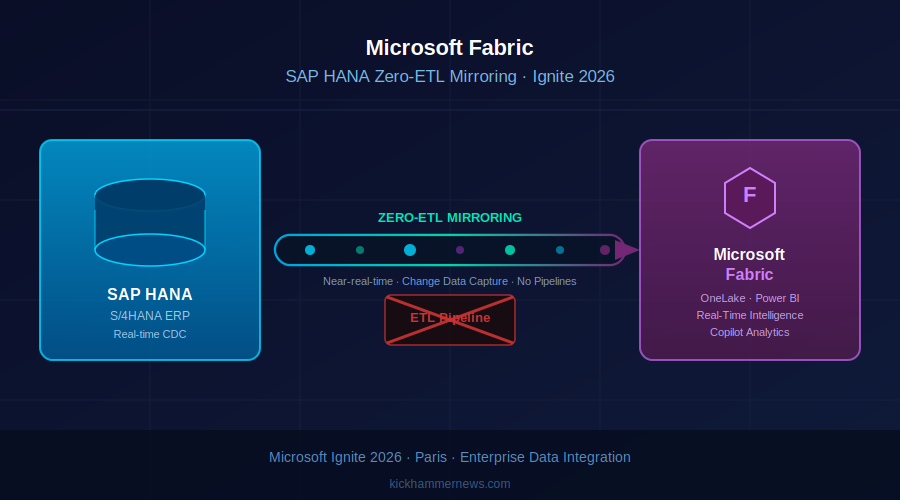
Microsoft has now announced that Fabric can mirror SAP HANA directly into OneLake, the unified data lake underlying the entire Fabric platform, without any ETL layer in between.
What Zero-ETL Mirroring Actually Means
Zero-ETL mirroring, as Microsoft has implemented it across several systems including Azure SQL and now SAP HANA, uses near-real-time change data capture (CDC) at the database level. Rather than periodically extracting data snapshots and loading them into a target system, mirroring continuously replicates changes as they happen in the source — inserts, updates, and deletes — with minimal latency.
For SAP HANA, this is particularly significant. The data in an S/4HANA system isn’t just rows in a table; it reflects complex business entities like material documents, financial postings, and sales orders that span dozens of normalized tables. Microsoft’s Fabric integration is designed to surface this as queryable Delta tables in OneLake, making SAP data available to Fabric’s full stack: Real-Time Intelligence, Power BI, Fabric Notebooks, and the new Copilot-powered data engineering features that also reached general availability at Ignite 2026.
Microsoft’s Real-Time Intelligence service — also announced as generally available at the conference — gives analysts the ability to run streaming KQL queries over mirrored data as it arrives. Combined with SAP HANA mirroring, this means a financial controller could see a sales order close in S/4HANA and have it reflected in a Power BI dashboard within seconds, not the hours or overnight delays that characterize traditional ETL cycles.
The Competitive Implications for SAP and Snowflake
This announcement lands at a delicate moment for the enterprise data landscape. SAP has been aggressively pushing customers toward its own analytics layer — SAP Analytics Cloud and Datasphere — and has a clear commercial interest in keeping its customers’ data within the SAP ecosystem. Zero-ETL Fabric mirroring directly counters that by making it trivially easy to route S/4HANA data to Microsoft’s competing analytics platform.
Snowflake, which has developed its own SAP partnership and offers connectors for SAP data, faces a similar competitive pressure. Microsoft’s tight integration between Fabric and SAP HANA removes a key reason enterprises might choose a neutral data warehouse platform when a Microsoft-native alternative can now pull the same data with no integration overhead.
Databricks has pursued a similar zero-ETL strategy through its own mirroring partnerships with databases like MySQL, PostgreSQL, and more recently Salesforce. Microsoft’s SAP HANA announcement extends the competitive front to the most critical ERP data sources that large enterprises hold.
Governance and Security in the New Architecture
One legitimate concern with zero-ETL mirroring at the ERP layer is security and governance. SAP systems often contain the most sensitive financial and operational data in an organization. Moving this into a general-purpose data lake raises questions about access controls, data residency, and audit trails.
Microsoft addressed this at Ignite with Purview AI Hub, a new governance dashboard that tracks data flows across Fabric environments. Purview’s data loss prevention policies — historically focused on documents and emails — now extend to AI prompts and agent interactions as well. For enterprises subject to SOX, GDPR, or sector-specific data regulations, being able to trace exactly which SAP data fields are being accessed by which Fabric workloads, and by which AI agents, is not just useful but required.
Microsoft also announced that Confidential Computing is now generally available across European Azure regions, with Confidential Containers on AKS and confidential AI inference in Azure AI Foundry. For European enterprises subject to the EU Data Boundary and growing digital sovereignty requirements, this positions Fabric’s SAP mirroring as a governance-compliant solution, not just a technical convenience.
The Broader Fabric Momentum
SAP HANA mirroring doesn’t exist in isolation. At Ignite 2026, Microsoft also announced that Fabric’s Real-Time Intelligence platform has reached general availability, completing the platform’s core services after the initial Fabric preview launched in 2023. OneLake now features automatic data lineage tracking through the OneLake Catalog, meaning every mirrored SAP record can be traced from its source through every transformation and downstream consumption.
The Fabric Copilot for data engineering is another piece of the picture: a natural language interface for building and modifying data pipelines, running SQL queries, and debugging Spark jobs. Combined with zero-ETL mirroring from SAP HANA, the vision Microsoft is articulating is one where a business analyst can describe a business question, have Fabric automatically mirror the relevant SAP data into OneLake, and get an answer without writing a single line of SQL or ETL code.
GitHub Copilot Workspace also reached general availability at Ignite 2026, which has indirect relevance for SAP integrations: the autonomous coding environment can now read repository context, plan and implement changes across files, and open pull requests with full descriptions. For enterprises that do need custom SAP integration code — ABAP programs, custom BAPIs, or integration middleware — Copilot Workspace represents a significant productivity accelerator.
What Enterprises Should Do Now
For IT leaders and enterprise architects, the SAP HANA zero-ETL mirroring announcement warrants immediate attention. If your organization is running S/4HANA or SAP HANA and currently maintaining custom ETL pipelines to feed data warehouses or analytics platforms, you now have a Microsoft-native path to eliminate that overhead.
The migration calculus is not trivial. Existing ETL pipelines often carry years of business logic, data quality rules, and transformations that are not simple to replicate at the database level. But for organizations starting new analytics initiatives, or those already standardizing on Microsoft Fabric, the case for bypassing ETL entirely is now very strong.
Microsoft has published preview documentation for the SAP HANA mirroring connector in Fabric, though general availability timelines have not been specified beyond Ignite’s announcement. Enterprises should begin evaluating the feature in preview environments and engaging their Microsoft account teams to understand roadmap commitments.
The Quiet Revolution in Enterprise Data
The headline narrative at Ignite 2026 was AI agents — Copilot Agents moving to general availability, agent-to-agent orchestration in Copilot Studio, and Azure AI Foundry consolidating the company’s machine learning infrastructure. But beneath the AI narrative, Microsoft quietly announced the most significant enterprise data integration move in years.
Zero-ETL SAP HANA mirroring into Microsoft Fabric represents a fundamental shift in how enterprises will connect their operational backbone to their analytics infrastructure. It removes the integration tax, accelerates time-to-insight, and hands Microsoft a powerful competitive tool in the battle for enterprise data platform dominance. For SAP customers already deep in the Microsoft ecosystem — and there are tens of thousands of them — the path of least resistance just got considerably shorter.
The ETL industry has survived many disruptions. But zero-ETL mirroring directly from the world’s most widely deployed enterprise ERP platform, landing in the cloud’s most tightly integrated analytics stack, may be a harder challenge to survive than most.