There is a joke in the semiconductor industry that the hardest part of building a chip isn’t the physics — it’s the paperwork. A modern system-on-chip contains billions of transistors arranged in layers of staggering complexity, governed by thousands of timing constraints, power rules, verification checks, and design-rule violations that must each be resolved before a single wafer is cut. A single advanced chip takes two to three years to design. A shortage of experienced engineers has made this bottleneck worse.
On October 1, 2026, OpenAI and Synopsys announced they intend to change that.
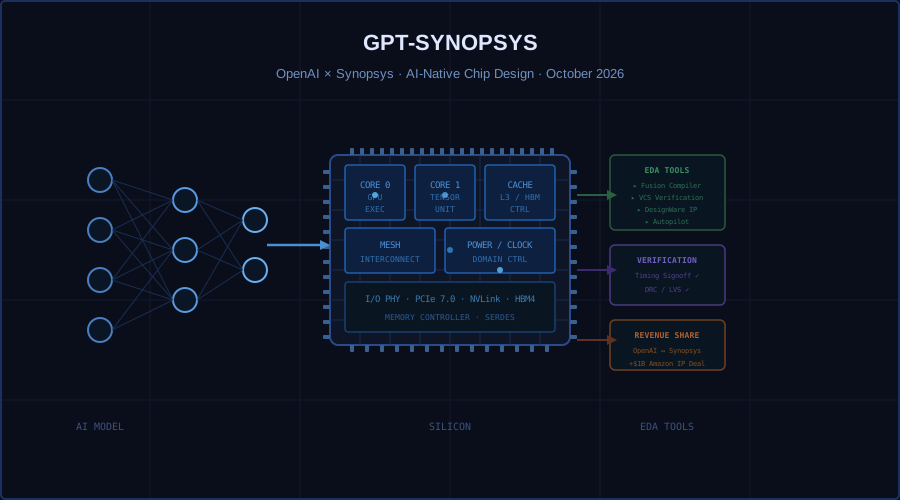
The two companies unveiled GPT-Synopsys, a specialized artificial intelligence model built not to chat about chip design, but to actually do it — operating Synopsys’ electronic design automation tools, interpreting results, implementing changes, and iterating toward verified engineering objectives with a degree of autonomy previously unimaginable for software that costs lives in data centers and cars.
The announcement arrived the same day Synopsys disclosed a separate blockbuster deal: a multi-year silicon intellectual property licensing agreement with Amazon valued at more than $1 billion. Synopsys stock jumped 7%, and Deutsche Bank raised its price target from $590 to $640. By any measure, it was the company’s biggest day in years. And the story it tells about AI’s expanding ambitions is more significant than any single stock move suggests.
What GPT-Synopsys Actually Does
To understand why this matters, it helps to understand what Synopsys does. Founded in 1986, the company makes the software that chip engineers use to design semiconductors — the kind of tools behind every Nvidia GPU, every Apple M-series chip, every Qualcomm Snapdragon. Its products include Fusion Compiler, DesignWare, VCS, and Formality, among dozens of others. Synopsys EDA software is as fundamental to the semiconductor industry as AutoCAD is to architecture.
For decades, these tools required seasoned engineers to operate. A front-end designer might spend years learning to optimize RTL code for timing closure. A place-and-route specialist might spend a career learning how to efficiently pack billions of transistors onto silicon. This institutional knowledge is hard to hire and even harder to scale.
GPT-Synopsys is designed to encode that expertise in an AI model.
Rather than merely acting as a conversational assistant layered over existing tools, the model operates Synopsys software directly. An engineer sets a design objective — minimize power consumption, close timing at a given frequency, improve performance-per-area — and GPT-Synopsys runs the tools, reads the output, determines what changes to make, and iterates until it converges on a solution. A human engineer reviews the result before it is implemented.
“We structured this so it wouldn’t displace our core business,” Synopsys CEO Sassine Ghazi said. “It’s intended to be an additional source of revenue.”
OpenAI co-founder Greg Brockman framed the ambition more expansively. “This is a path to better chips and better AI,” he said — an observation that carries a self-reinforcing logic: better chips accelerate AI development, and AI accelerates chip design. If the partnership works as intended, it closes a feedback loop that has historically been gated by human engineering capacity.
The Architecture: Determinism as a Safety Net
One of the more notable design choices in GPT-Synopsys is what it is deliberately not allowed to do. The model does not produce chip layouts or netlists directly. Instead, it operates within the loop of deterministic EDA tools that verify every output before it proceeds. When GPT-Synopsys determines that a particular placement strategy will improve timing, it asks Synopsys’ verification engine to confirm. Only verified outputs advance.
This is a direct response to the failure mode that has plagued AI-generated code: hallucination. An AI that invents plausible-looking chip layouts without verifying them against real physics and electrical rules could produce designs that fail in silicon. Synopsys has built its business on signoff-quality verification, and the GPT-Synopsys architecture preserves that guarantee.
“Verification at the highest level of accuracy, which we call final signoff, is essential,” Ghazi said.
The commercial structure reflects this division of responsibility. OpenAI pays Synopsys a subscription fee to train GPT-Synopsys on its tool interfaces. When customers use the finished product — delivered as a bundle of OpenAI-hosted compute, the specialized model, and Synopsys software licenses — revenue is shared based on demonstrated improvements to design efficiency. If GPT-Synopsys cuts two months off a design cycle, the economics are favorable for everyone involved.
Customer data privacy is built in: chip designs are among the most sensitive intellectual property in the technology industry, and Synopsys was explicit that customer design data will not be used to train the model. All data is encrypted at rest and in transit, with configurable retention and audit controls. Early engagements with leading semiconductor customers are already underway.
The Amazon Deal: A $1 Billion Bet on Custom Silicon
The Synopsys-Amazon announcement arrived alongside the OpenAI partnership and is, in some ways, its mirror image. Where the OpenAI deal is about AI making chip design faster, the Amazon deal is about custom silicon being designed specifically to run AI faster.
The agreement, valued at more than $1 billion over multiple years, licenses Synopsys silicon intellectual property and EDA tooling for Amazon’s in-house chip programs: Trainium (AI training and inference), Graviton (general-purpose cloud computing), and Nitro (networking, security, and storage). Amazon is described as “the lead customer for this new category of IP,” structured around application-optimized silicon rather than general-purpose processor designs.
The deal also flows in the other direction: Synopsys will use Amazon’s cloud infrastructure — EC2, Amazon Bedrock, and related services — for its own internal product development. It is the kind of interlocking commercial relationship that has become standard in the AI infrastructure era, where compute, software, and silicon are increasingly sold as bundled systems rather than independent products.
The two deals together paint a clear picture of Synopsys’ strategic position: the company sits at the center of a future where AI designs chips, and where those chips are increasingly custom-built to run AI. That position is now supported by the two most prominent AI companies in the world.
The Broader Stakes: A $100 Billion Industry at Inflection
The semiconductor EDA market is large but overlooked. Synopsys and its chief competitor Cadence together generate roughly $10 billion in annual revenue and represent a near-duopoly in the tools required to design every advanced chip in existence. Their software is, in a real sense, the foundation of the global semiconductor industry — but they operate far from the consumer-facing headlines that follow Nvidia, AMD, and Intel.
GPT-Synopsys changes that positioning. It is one of the first credible demonstrations that AI can operate complex professional software autonomously, not as a coding assistant or a search interface, but as an expert operator of industrial tools with real verification standards.
The competitive implications extend beyond Synopsys. Cadence, the main EDA rival, has its own AI ambitions and has been developing Cadence Cerebrus, an AI tool for chip implementation. NVIDIA acquired Synopsys competitor Ansys in 2024 for $35 billion, partly to compete in physical simulation for chip and system design. The market knows AI will reshape EDA; the question has been who would move first with a frontier model partner. OpenAI and Synopsys have now answered it.
Deutsche Bank’s revised forecast tells the financial story plainly. With the Amazon deal adding a new revenue stream and GPT-Synopsys positioned as a new commercial offering, the firm now expects 15% revenue growth for Synopsys in fiscal 2027 — well above the 11.19% consensus — with $11.15 billion in revenue and adjusted operating margins of 44%.
What This Means for Engineers
The instinctive reaction to “AI that designs chips” is anxiety about displacement. But the engineers closest to the problem tend to read it differently.
Chip design at the frontier has become genuinely inhuman in its complexity. A leading-edge system-on-chip might have over 100 billion transistors, with timing constraints that must be met across billions of signal paths and thermal characteristics that vary with every revision. The shortage of engineers capable of working at this level is a real constraint on the pace of chip development — and, by extension, on the pace of AI development itself.
If GPT-Synopsys can handle the mechanical iteration — running tools, reading results, adjusting parameters — and hand verified outputs back to engineers for review and judgment, the result is not fewer engineers but more productive ones. The analogy is not to an assembly line automation that eliminates a job, but to a surgical assistant that handles instrument management so a surgeon can focus on the procedure.
Greg Brockman’s phrase keeps resonating: “better chips and better AI.” The loop is closing. The tools that build the hardware that runs the software are now being built, in part, by the software.
Somewhere in a semiconductor lab right now, GPT-Synopsys is running a place-and-route iteration on a design no human has reviewed yet. It is reading the timing report, deciding what to change, and asking the verification engine whether the modification holds. It will do this thousands of times tonight.
The engineer never sleeps anymore.


