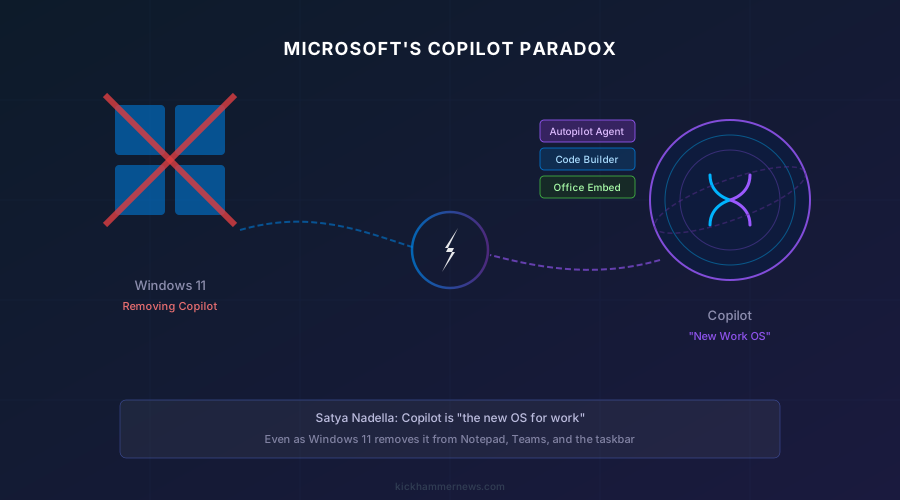
Last week, Satya Nadella dropped a statement that cut through the noise of a hundred AI product announcements: “We’re building Copilot as a new OS for work that spans every model, every form factor, and every task.” It was the kind of sweeping vision statement that Microsoft CEOs are famous for — ambitious, abstract, and designed to be quoted on earnings calls for years to come.
There is just one problem. At almost exactly the same moment, the rest of Microsoft was quietly taking Copilot out of Windows 11. Gone from Notepad. Stripped from the Snipping Tool. Retired from Teams. Removed from the Windows shell in ways that just months ago would have been unthinkable. The “Copilot+ PC” hardware brand — once plastered across every new Surface device — has been quietly shelved. The company is, as one industry analyst put it, simultaneously doubling down on Copilot and walking it back, depending on which business unit you ask.
This is the defining paradox of Microsoft’s AI strategy heading into the final quarter of 2026, and understanding it requires separating two very different visions of what Copilot was ever supposed to be.
From Feature to Platform to Operating System
When Microsoft first launched Copilot in 2023, it was a chat assistant bolted onto the side of Windows and Office. A button in the taskbar. A pane in Teams. A shortcut key on new laptops. The pitch was simplicity itself: ask questions, get answers, do things faster.
That pitch, as Microsoft now effectively admits, did not work. Customers were confused about which “Copilot” product they were actually using — the consumer app, the Microsoft 365 enterprise tier, the Windows sidebar, or the hardware SKU. Brand dilution set in quickly. By early 2026, the company was publicly acknowledging that Windows 11 had “gone off track” with AI, and internal memos (later confirmed by executives) spoke of removing Copilot features that failed to meet clear productivity benchmarks.
Nadella’s September 26 announcement represents the counteroffensive — not a retreat from AI, but a radical repositioning of where AI lives in Microsoft’s product hierarchy. Rather than being an OS feature, Copilot is now pitched as the OS itself: a unified work environment that contains apps, agents, and automation in one place.
What the New Copilot Actually Is
The announcement outlined four major pillars of the rebuilt platform. Home serves as a personal dashboard, aggregating recent files, upcoming meetings, and pending tasks from across Microsoft 365. Office Integration brings full versions of Word, Excel, and PowerPoint directly into the Copilot interface, creating a single environment for both communication and document work.
The most technically interesting addition is Code — an AI-powered application builder that allows non-developers to create custom business applications, dashboards, and automated workflows using plain English descriptions. Microsoft is positioning this directly against no-code platforms and, implicitly, against the sprawling ecosystem of point solutions that enterprises have accumulated over the past decade.
Most consequentially for enterprise customers, Autopilot introduces what Microsoft is calling an autonomous agent with its own persistent identity inside Microsoft 365. Unlike previous AI features that responded to single prompts, Autopilot monitors communication channels, tracks recurring workflows, and handles repetitive tasks without human initiation. It can, in theory, sit in on a project thread, notice when an action item has gone unaddressed, and take steps to resolve it.
The Logic Behind the Windows Pullback
Understanding why Microsoft is simultaneously removing Copilot from Windows requires recognizing that the two moves serve different constituencies. Windows ships to over a billion devices, including machines in hospitals, factories, and schools where unexpected AI behavior is not just annoying but potentially dangerous. The pressure to make Windows stable, predictable, and IT-administrator-friendly has always existed in tension with the impulse to demonstrate AI capability.
The Copilot integrations that are being removed — AI suggestions in Notepad, smart crop in Snipping Tool, the sidebar chat panel — were consumer-facing features that generated more support tickets than productivity gains. Removing them is a concession to the enterprise customer base that Microsoft can’t afford to alienate.
Meanwhile, the new Copilot-as-OS announcement is aimed squarely at knowledge workers in large organizations who have subscriptions to Microsoft 365 and are measured on output that tools like Autopilot can theoretically improve. These are two different products for two different problems, and the branding confusion of the past two years was precisely that Microsoft treated them as one thing.
The “Copilot+” Branding Collapse
The quietest casualty in this strategic reset is the Copilot+ PC hardware designation. Launched in 2024 with considerable fanfare, the label was meant to identify devices with sufficient on-device AI processing power to run Microsoft’s most advanced features. New Surface models announced this autumn — including machines that technically meet every specification — are shipping without the designation.
Microsoft has said only that it is “going in a different direction” with hardware branding. The move implicitly acknowledges that tying software capability claims to hardware stickers backfired when the software features themselves proved underwhelming. Consumers who purchased premium devices specifically for Copilot+ features were left wondering what they had actually paid extra for.
What Enterprises Should Watch
For IT leaders and procurement teams, this moment represents an opportunity to reset expectations in both directions. The new Copilot platform deserves a genuine evaluation on the merits of its Autopilot and Code capabilities — these are materially different from earlier feature-level integrations, and early enterprise pilots suggest meaningful productivity gains in specific workflow categories.
At the same time, the pattern of rapid repositioning that has defined Microsoft’s AI strategy demands healthy skepticism. The company has now pivoted Copilot’s core identity at least three times in three years: chat assistant, OS feature, and now work operating system. Each pivot has left enterprise agreements, training investments, and change management efforts partially stranded.
The fundamental question heading into Microsoft’s October Windows and Surface event is whether “Copilot as OS” represents a stable strategic destination or simply the next iteration in a continuing search for a product that sticks. Given that Nadella used nearly identical “new OS” language for Windows itself just twelve months ago — to far more skepticism than this week’s announcement attracted — the answer is not yet clear.
What is clear is that the AI computing era has produced a distinctly new kind of company announcement: one where the same organization simultaneously tells the market that its flagship AI brand is being elevated to operating system status and tells its engineering teams to quietly remove that same brand from the operating system they actually ship. Both things are true. The tension between them is where the real story lives.
Sources: Windows Latest, Windows Central, X/@satyanadella