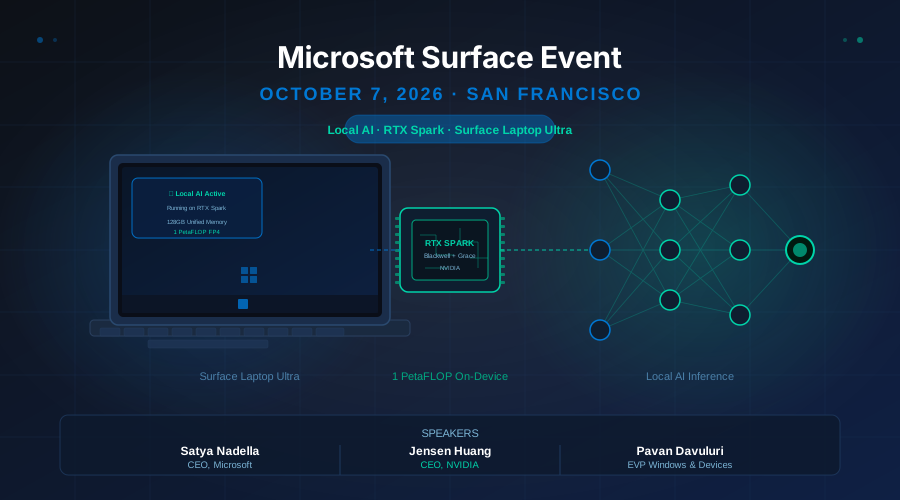
October 2, 2026 — Microsoft has confirmed it will host its most significant Windows hardware event in over two years on October 7, 2026, bringing together an unprecedented executive lineup that signals just how seriously the company is taking the battle for local AI supremacy on the PC. CEO Satya Nadella will share the stage in San Francisco with NVIDIA’s founder and CEO Jensen Huang — a pairing that alone tells you everything you need to know about where the industry is headed.
The event, framed around “how local AI will shape the next chapter of the PC,” is being watched closely by hardware makers, enterprise IT teams, and developers who have waited patiently for Microsoft to land the hardware ambitions it sketched at Build 2026. With five days to go, anticipation is running high — and the substance behind the hype looks compelling.
What Local AI Actually Means in 2026
The phrase “local AI” has been thrown around for two years, but the October 7 event could be the moment it snaps into focus for mainstream audiences. The central technology at the event will be NVIDIA’s RTX Spark superchip, a system-on-chip that combines a Blackwell RTX GPU with a Grace CPU, delivering up to one petaflop of FP4 AI performance within a thin-and-light form factor. Crucially, it ships with 128GB of unified memory — enough to run mid-size language models and multi-agent workflows entirely on-device.
That matters because enterprise customers and privacy-conscious developers have been slow to adopt cloud-based AI inference. Routing sensitive documents and workflows through third-party servers raises compliance concerns, introduces latency, and creates ongoing subscription cost exposure. A Surface Laptop with RTX Spark changes that calculation. An analyst running financial models, a healthcare administrator processing patient intake forms, or a legal team drafting contracts could run capable AI locally, without a packet leaving the building.
Microsoft knows this. The company has spent the better part of 2026 building Copilot features that are, at least in theory, composable across cloud and on-device contexts. The October 7 event is where the on-device side of that equation gets its first serious hardware showcase.
Surface Laptop Ultra: Microsoft’s Most Powerful Machine
The headlining hardware announcement is widely expected to be the Surface Laptop Ultra, Microsoft’s most powerful consumer and professional laptop to date. Built in close partnership with NVIDIA, the Surface Laptop Ultra is engineered to take full advantage of RTX Spark’s capabilities — including hardware-accelerated AI inference, local model execution, and a software stack tuned specifically for Windows 11’s evolving scheduler and memory management for neural workloads.
Pricing and availability have been kept tightly under wraps ahead of the event, but leaked OEM configurations suggest at least two tiers: a developer-focused SKU with maximum memory and storage, and a mainstream professional version positioned against Apple’s MacBook Pro line. The Surface RTX Spark Dev Box, which Microsoft previewed at Build in June, is expected to receive official availability details as well.
For OEM partners watching closely, the October 7 event also carries significance beyond Surface hardware. NVIDIA will present RTX Spark reference specifications for OEM integration, along with benchmark data that hardware partners can use to validate their own designs. The days of AI PC marketing without credible performance numbers appear to be ending.
Project Solara: When Agents Become the Interface
Beyond the hardware, Microsoft is expected to deliver shipping details for Project Solara, the agent-driven computing platform it introduced at Build 2026. Solara represents Microsoft’s vision of what the PC looks like when the operating system begins to fade into the background — replaced by a layer of persistent, task-aware agents that operate on behalf of the user.
Early builds of Solara showed a pair of concept devices: one optimized for sustained local inference workloads, another for developer use cases where model iteration and agent debugging are core activities. Industry watchers expect October 7 to clarify which Solara features ship in Windows 11 this fall, and which remain longer-horizon roadmap items.
The distinction matters. Microsoft’s Copilot+ PC initiative, launched in May 2024, was met with enthusiasm that curdled somewhat when it became clear that many flagship features — including Recall — faced significant delays and regulatory scrutiny. Two years on, Microsoft needs to show that “AI PC” means something concrete and deliverable, not a feature checkbox on a spec sheet.
What October 7 Is Not
It is worth being explicit about something: this is not a Windows 12 launch event. Multiple sources with knowledge of the event have confirmed that no major OS version announcement is planned. Windows 11 26H2, released earlier this fall, remains the current major update, and Microsoft’s focus on October 7 is on hardware/software tuning, local AI features, and the Surface lineup — not a generational OS transition.
That restraint is itself a story. Microsoft spent years conditioning the industry to expect numbered Windows releases as product cycles. The shift to Windows-as-a-platform means the OS evolves continuously, and event drama increasingly comes from hardware and experience layers rather than version numbers. October 7 in San Francisco looks less like a product launch and more like a platform inflection point — the moment Microsoft formally hands the AI PC baton to local silicon rather than the cloud.
Why the Nadella-Huang Pairing Is Significant
The presence of both Satya Nadella and Jensen Huang on the same stage is not a coincidence or a courtesy. It reflects the depth of strategic alignment between Microsoft and NVIDIA at a moment when that relationship is being closely scrutinized.
NVIDIA supplies the core inference silicon for Microsoft’s Azure AI infrastructure, and RTX Spark represents the same Blackwell architecture distilled for end-user devices. A unified message — that the same GPU generation powers both hyperscale cloud workloads and the laptop on your desk — is a story NVIDIA badly wants to tell and Microsoft benefits from amplifying. For enterprise buyers evaluating whether to standardize on local AI hardware, seeing the two CEOs co-present gives the platform a credibility anchor that no spec sheet can replicate.
For the broader PC industry, October 7 will be a signal moment: either Microsoft delivers a credible local AI platform with real performance numbers and a coherent developer story, or the “AI PC” category risks becoming what many critics already fear — marketing language with vaporware underneath. Based on what’s been confirmed so far, the substance looks real. The event starts at 10 AM PT and will be streamed live.
Article covers the Microsoft Windows and Surface event announced for October 7, 2026, in San Francisco.