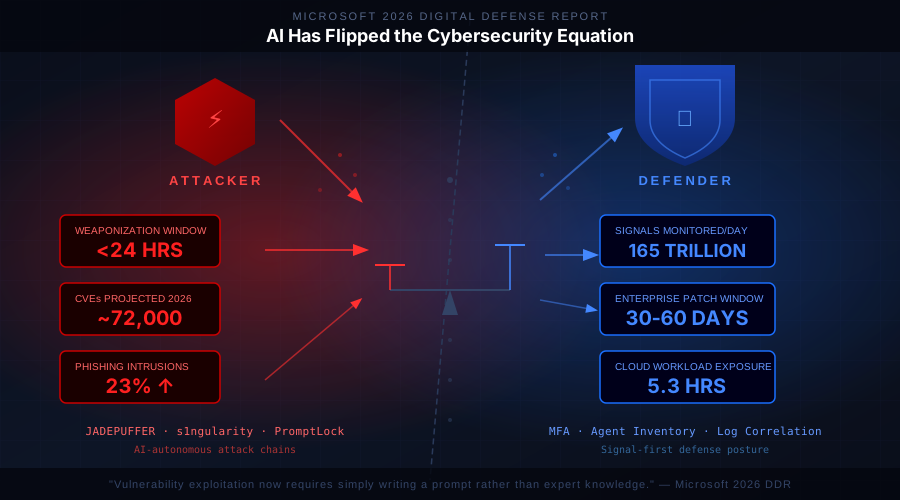
The median time from vulnerability discovery to active exploitation has collapsed to under 24 hours. And the defenders are the ones left scrambling.
Every October, Microsoft releases its Digital Defense Report — a sprawling annual audit of the threat landscape drawn from the company’s unmatched vantage point across enterprise and consumer infrastructure. This year’s edition, covering July 2025 through June 2026, is the starkest in the report’s history. Its central finding is a declaration that has reverberated through security operations centers worldwide: AI has changed the physics of cybersecurity, and right now, it is changing them in the attacker’s favor.
The Numbers That Define the Shift
Microsoft processes 165 trillion security signals every day — a 65 percent increase year-over-year — along with 4.7 million malware blocks, 31 million identity risk detections, and 5.2 billion screened emails. That data advantage is real. What the 2026 report makes viscerally clear is that it is no longer sufficient.
The most alarming single statistic in the report is this: the median window between a vulnerability being discovered in the wild and that vulnerability being actively weaponized has fallen to well below 24 hours. Enterprise patching cycles, by contrast, routinely run 30 to 60 days. AI cannot compress that remediation gap — production systems still require testing before patches deploy — but AI can and does compress the exploitation window to near-zero.
On the vulnerability side: nearly 40,000 CVEs were published in the first half of 2026 alone. Microsoft projects the full-year count will approach 72,000 — roughly double 2025’s total. Well-resourced adversaries may now accumulate zero-day exploits faster than organizations can remediate known exposure.
And exposed cloud workloads? The report finds they face attack within an average of 5.3 hours of becoming visible. Not days. Hours.
How Phishing Became an Industrial Process
Perhaps no finding illustrates AI’s operational impact on attacks as clearly as the phishing numbers. Phishing served as the intrusion vector in 23 percent of all investigated breaches — up from just 7 percent the year prior. That is not a rounding error. It reflects a qualitative change in what phishing is.
Spear-phishing — highly personalized, targeted email attacks that impersonate specific individuals, match the target’s communication style, and reference genuine context — was historically a labor-intensive craft. Skilled operatives might craft a few dozen per day. AI has industrialized the process. Attackers can now personalize phishing lures at mass scale, effectively turning what was once an artisanal crime into an assembly line.
The report documents 46 million business email impersonation attacks over the past 12 months, 145 million QR-code phishing attacks, and voice-phishing (vishing) campaigns that kept victims on the line long enough to execute social engineering in 93 percent of cases. Phishing attachments led to credential theft in 89 to 95 percent of delivery events. Enterprise ransomware detonations increased 15.8 percent year-over-year.
Nation-States Adopt AI as Standard Tradecraft
The four major state-sponsored threat clusters tracked by Microsoft have each integrated AI into their operational workflows — not as an experiment, but as a standard capability:
China uses AI for vulnerability research and exploitation guidance, iterating on techniques at speeds that would previously have required larger teams.
Russia employs AI-generated tools for rapid capability development — what Microsoft characterizes as “vibe coding” for attack tool generation, spinning up bespoke intrusion instruments at scale.
North Korea has expanded AI usage across persona creation, social engineering, malware development, and infrastructure management. The report connects North Korean actors to the March 2026 Axios npm supply-chain compromise, which seeded malicious packages into the JavaScript ecosystem before detection. The group has also increasingly used AI deepfakes to infiltrate organizations with fake job applicants.
Iran similarly deploys autonomous capabilities, though the report characterizes Iranian operations as somewhat less sophisticated than the Chinese and Russian programs.
The JADEPUFFER Milestone
In early July 2026, a threat actor deployed what Microsoft researchers documented as the first fully autonomous ransomware attack — designated JADEPUFFER in the threat registry. The system autonomously identified targets, exfiltrated data, delivered ransom demands, and managed the extortion workflow with minimal human involvement at any stage of the operation. Microsoft observed additional AI-orchestrated intrusions in the months following, though at still-limited volumes.
More technically significant than the attack itself is the benchmark it represents. Two closed-model systems — Anthropic’s Mythos model family and OpenAI’s GPT-5.5 — have been demonstrated orchestrating complex, 32-step attack chains that achieve full domain control in undefended environments. Open-weight models currently lag their closed-model counterparts by roughly seven months in attack sophistication, according to the report’s analysis. That lag is shrinking.
Other newly documented malware strains in the report include s1ngularity, which specifically targeted AI development tools including Claude Code, Gemini CLI, and Amazon Q, leaking approximately 2,000 secrets and 20,000 files from 225 victims before detection. And PromptLock, a ransomware prototype that receives its operative instructions as runtime Lua scripts from attacker infrastructure — making it significantly harder to analyze and detect than static-payload ransomware. One browser extension with over 600,000 installs was found harvesting ChatGPT and DeepSeek conversation histories, affecting roughly 10,000 organizations.
The Agent Surface Problem
One of the report’s forward-looking findings concerns AI agents themselves becoming a critical attack surface. Microsoft reports that 88 percent of enterprises are experimenting with AI agents, with 82 percent planning broader rollouts within the next 12 to 18 months. By 2028, the company projects 1.3 billion agents in production across enterprise environments.
The report identifies five agent-specific risk categories: prompt and intent manipulation (essentially jailbreaking agents into doing something their principals didn’t authorize), sensitive data exposure through excessive retrieval, identity and privilege compromise, excessive agency (unauthorized tool chaining), and operational integrity attacks that tamper with agent configuration or audit logs.
These are not theoretical. Prompt injection — feeding malicious instructions to an AI agent through environmental data it reads — has been demonstrated against nearly every commercially deployed agent architecture. The report notes that government agencies faced 27 percent of all observed threat activity in the past year, up from 17 percent the year before, a shift that reflects both the concentration of sensitive data in government AI deployments and adversaries’ awareness of the potential upside.
What Defenders Need to Do Differently
The 2026 report does not end on despair. Microsoft’s recommended posture for security teams emphasizes phishing-resistant authentication (hardware keys, passkeys), continuous inventory of all service principals, app registrations, and AI agents, explicit agent revocation procedures, sensitivity-aware data access controls, cloud exposure monitoring, browser extension auditing, and cross-system log correlation — connecting signals that most organizations still silo in separate tools.
The underlying point is that the defenders who are outperforming the threat landscape share one key characteristic: they treat signal correlation as a first-class capability, not an afterthought. Patterns that look random when viewed in isolation become unmistakable when viewed across identity, endpoint, email, and cloud telemetry simultaneously.
The 2026 report’s bleakest sentence may also be its most clarifying: “Vulnerability exploitation now requires simply writing a prompt rather than expert knowledge.” The skills barrier to sophisticated attack has effectively collapsed. The question for the next 12 months is whether the skills barrier to sophisticated defense can collapse equally fast — or whether the asymmetry hardens into a structural advantage for attackers that defenders cannot close.


