October 3, 2026
In 1999, a nineteen-year-old Sean Parker co-founded Napster and, over the following two years, methodically dismantled the recorded music industry’s revenue model. Tens of millions of users downloaded songs for free. Labels sued. Courts intervened. Napster died. The music industry spent the next decade bleeding out.
Twenty-seven years later, Parker is back — and this time, every record label he once helped destroy has given him a check.
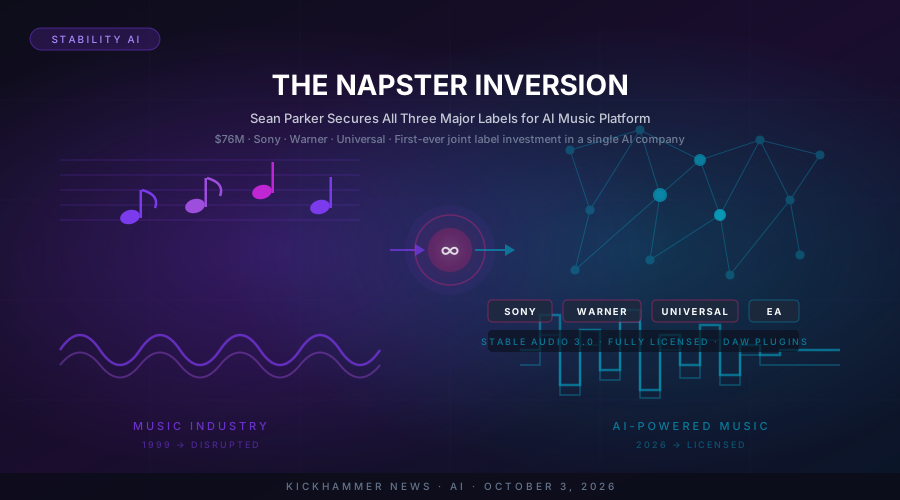
On August 25, 2026, Stability AI announced a $76 million Series B funding round that included equity stakes from Universal Music Group, Warner Music Group, Sony Music Group, and Electronic Arts. It marked the first time in history that all three major record labels invested simultaneously in a single artificial intelligence company. The companies also licensed their music catalogs for AI model training as part of the arrangement.
If that sounds like the punchline to a very long joke, Parker seems acutely aware of the irony.
“Asking for forgiveness rather than permission didn’t work out so well,” Parker told TechCrunch, in what may be the tech industry’s most understated admission of a prior strategic miscalculation.
A Rescue Mission Becomes a Reinvention
Parker didn’t arrive at Stability AI as a triumphant acquirer. He arrived as a rescuer.
Two years ago, the company founded by Emad Mostaque was collapsing. Mostaque had departed under pressure. Revenue was thin. The image-generation products that made Stable Diffusion famous had launched a thousand competitors but generated little lasting business advantage for the company that created them. Parker helped organize an $80 million rescue round that kept Stability AI solvent and brought in Prem Akkaraju — a longtime Parker associate — as CEO.
That stabilization phase is now over. The $76 million Series B, which brings total funding under the new leadership to $232 million, signals the strategic direction Parker has been building toward: Stability AI as the definitive AI toolmaker for music professionals.
The company has already taken its first steps. In May 2026, Stability AI launched Stable Audio 3.0 — a music generation system trained exclusively on licensed data from AudioSparx and Creative Commons materials, capable of producing structured compositions up to six minutes and twenty seconds in length. The system distributes through plugins for digital audio workstations (DAWs) as well as Stability AI’s own platform.
Three additional audio models have since been released alongside a dedicated music-editing application. Current features include generating instrumental tracks and short audio snippets from text prompts. An upcoming update will allow users to hum melodies or beatbox drum patterns to guide the AI’s output — a capability aimed directly at professional musicians who want creative control over generation rather than pure automation.
Why the Labels Said Yes
For decades, the major labels’ default response to disruptive technology has been litigation. They sued Napster. They sued Grokster. They sued The Pirate Bay. They issued takedown notices by the millions. They resisted, delayed, and litigated until market reality forced them to negotiate — usually from a weaker position than if they had engaged earlier.
The Stability AI deal represents a different calculation. Rather than waiting for a music AI company to grow large enough that suing it becomes the only option, all three majors invested while Stability AI was still relatively small — buying a seat at the table during product development, not after.
The labels’ catalogs serve as both training data and, implicitly, as a competitive moat. Competitors like OpenAI’s Jukebox or Google’s MusicLM cannot easily replicate the arrangement. Securing licensed training data from all three majors requires separate multi-year negotiations with each; Sony alone controls roughly 30% of the global recorded music market. Stability AI has already done that work, and the equity stakes align the labels’ financial interests with the platform’s success rather than its destruction.
For the labels, it’s also a hedge. If AI-generated music becomes a dominant creative format over the next decade — and many industry observers believe it will — the majors would rather own equity in the platform generating it than be spectators. The deal gives them both a financial return if Stability AI succeeds and influence over how the technology develops.
Partnerships with Universal Music Group and Warner Music Group had been forming since October and November 2025, respectively, before those working relationships converted into equity ownership during the Series B.
The Napster Inversion
What makes the Stability AI music pivot genuinely unusual isn’t just the label involvement — it’s the deliberate structural reversal of the Napster playbook.
Napster’s model was disrupt first, license later (or never). The company’s value proposition was literally built on unlicensed content. It assumed that scale and user adoption would eventually force the industry to negotiate rather than fight. That assumption turned out to be wrong — courts sided with the labels, and Napster was shut down before it could convert its 80 million users into sustainable revenue.
Stability AI has inverted every element of that approach. Licensing agreements were secured before the products launched publicly. Labels are co-investors, not adversaries. The product is explicitly positioned for professional musicians — a market segment that actively wants working relationships with the institutions that control their distribution — rather than for consumers looking to circumvent those institutions.
Parker’s experience with Napster appears to have produced a genuinely different strategic framework, not just a different PR stance.
“We’re playing by the rules,” Parker told Connie Loizos at TechCrunch. The statement, from the man who once built the internet’s most famous piracy platform, carries a weight that’s hard to overstate.
Unresolved Questions
The Stability AI thesis is compelling on paper, but it carries meaningful uncertainties.
The company has not disclosed pricing for its professional music tools, making it difficult to assess unit economics. Stability AI’s image-generation division — the product that originally built the company’s reputation — never demonstrated strong commercial margins. Music generation is a different business, but Parker and Akkaraju will need to prove that professional musicians will pay recurring subscription fees large enough to justify the platform’s capital requirements.
The competitive landscape is also more crowded than it appears. Google’s MusicLM, Suno AI, Udio, Adobe’s generative audio tools, and several smaller players are all building in the same space. Most lack licensed major-label catalogs, but some have built legitimate businesses without them. And as AI-generated music becomes more commonplace, the question of whether “licensed training data” translates into meaningfully better output — in ways musicians can actually hear and value — remains open.
There’s also the artist question. Labels and musicians often have divergent interests. A label that licensed its catalog for AI training may benefit financially even if the individual artists on that catalog feel their work was appropriated without adequate compensation. The contracts underlying the Sony, Warner, and UMG licenses have not been disclosed, and several musician advocacy groups have already raised questions about whether individual artists received any share of the licensing fees.
What Comes Next
Stability AI under Sean Parker is a fundamentally different company than the one Emad Mostaque built. The image-generation era positioned Stability AI as an open-source challenger to proprietary AI systems, with ideological commitments to accessibility that sometimes outpaced business sense.
The music era is more deliberately commercial, more structurally defensible, and — at least so far — more legally sound. Whether that translates into a sustainable business depends on factors Parker cannot fully control: how quickly the market for professional AI music tools develops, whether artists adopt or resist the platform, and whether the labels’ investment reflects genuine enthusiasm for the technology or simply a defensive hedge against a future they’re not sure they can stop.
What’s clear is that the man who disrupted music once has spent the last two years constructing the most licensing-secure AI music platform in existence, with the explicit blessing of the industry he once helped dismantle. The Napster model — disrupt, get sued, die — has been replaced by something that looks much more like a music industry joint venture.
Whether it succeeds is an open question. That it exists at all, with Parker’s name on it and Sony’s money behind it, is one of the stranger second-act stories in tech history.


