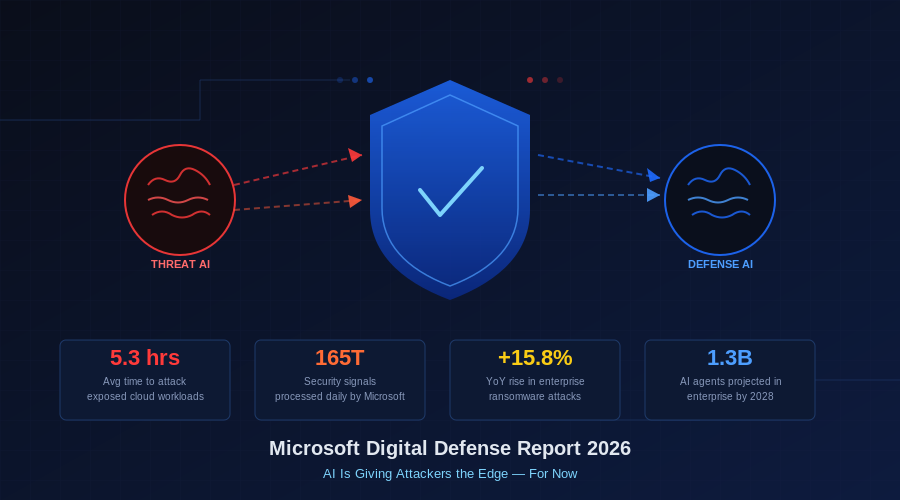
Microsoft dropped its annual Digital Defense Report this week, and the headline is stark: threat actors are winning the early AI race. The 2026 edition, covering telemetry from July 2025 through June 2026, paints a picture of a cybersecurity landscape fundamentally transformed by artificial intelligence — not just in the tools defenders use, but in the velocity, scale, and creativity of the attacks they face.
The company processes 165 trillion security signals daily, a 65 percent increase over the prior year, and employs 35,000 full-time security engineers. Even with that infrastructure, Microsoft concedes the asymmetry is real: attackers are leveraging AI faster than most organizations can adapt their defenses.
The Numbers Tell the Story
The report lands on some striking statistics. Exposed cloud workloads are now attacked within an average of 5.3 hours after discovery — a timeline that renders many traditional patch-management cycles effectively useless. The median window between vulnerability disclosure and weaponization has compressed to “well below 24 hours,” according to Microsoft’s telemetry. The implication is unambiguous: the era of deploying patches on a leisurely weekly or monthly schedule is over.
On the credential-theft front, the picture is equally sobering. More than 52 percent of valid-account intrusions led directly to credential theft as a next step. Across a twelve-month period, Microsoft detected over 46 million business email impersonation attacks. Voice-phishing, often dismissed as a low-tech nuisance, succeeded in engaging victims 93 percent of the time — a figure that should give any enterprise security leader pause.
Ransomware operators, meanwhile, recorded a 15.8 percent year-over-year increase in enterprise attacks. Perhaps more concerning than the volume is the method: 63 percent of intrusions involved data exfiltration, suggesting criminals are no longer content to simply encrypt and demand ransom. They are extracting leverage before they detonate, creating compounding pressure on victims to pay.
AI: The Double-Edged Sword
The core thesis of this year’s report is that AI operates as a force multiplier for both sides — but the offensive side currently holds the advantage in time-to-deployment.
Microsoft documents how state-sponsored operators have moved well beyond experimentation. Chinese cyber units are using AI for systematic vulnerability research, accelerating the speed at which they can identify and prioritize exploitable weaknesses in target infrastructure. Russian threat groups have embraced what the report colorfully calls “vibe coding” — using AI-generated tooling to rapidly prototype and iterate on malware. North Korean actors have turned to AI for persona development and social engineering, creating more convincing fake identities for long-running infiltration operations.
The practical effect, Microsoft notes, is a dramatic compression of the post-compromise timeline. Activities that once took days — lateral movement through a network, locating sensitive data, staging exfiltration — can now be completed in minutes when AI assists the attacker. Organizations that previously had hours or days to detect and respond to an intrusion may now have only moments.
The AI Agent Problem
One of the most forward-looking sections of the report addresses a threat that barely registered in previous editions: the security implications of AI agents deployed inside enterprise environments.
With 88 percent of enterprises now experimenting with AI agents and Microsoft projecting 1.3 billion agents in production by 2028, the attack surface is expanding at a pace that security teams are struggling to inventory, let alone defend. The report identifies five distinct risk classes for agentic AI deployments: prompt manipulation (injecting malicious instructions through data inputs), sensitive data exposure, identity compromise, excessive agency where an agent chains tools beyond its intended permissions, and operational integrity tampering.
The report includes a striking real-world example: a malicious browser extension with over 600,000 installations that harvested ChatGPT conversation histories, ultimately affecting more than 10,000 organizations. The extension exploited the gap between what enterprises permit in their browser extension policies and what those extensions actually do with data.
Microsoft’s recommendation is to inventory every service principal, app registration, and deployed agent before expanding AI capabilities further — and to establish rapid credential revocation procedures for compromised agents. Given how few enterprises have formal agent inventories today, this represents a substantial operational gap.
Government in the Crosshairs
The report’s sector-level data carries a notable shift: government entities now account for 27 percent of observed threat activity, up from 17 percent in 2025 — making them the most targeted sector, ahead of IT (17 percent) and research and academia (14 percent). The spike correlates with intensifying geopolitical tensions and a growing recognition among nation-state adversaries that disrupting government digital infrastructure yields strategic leverage.
What Organizations Should Do Now
Microsoft offers a concrete set of recommended actions, with an emphasis on identity hardening and AI governance rather than perimeter defense. The top priorities include transitioning to phishing-resistant multi-factor authentication and passkeys, implementing sensitivity-aware access controls before expanding AI deployments, and auditing browser extension allowlists to close the data-leakage vectors demonstrated by the ChatGPT harvesting case.
Equally important, Microsoft argues, is log correlation. The company emphasizes that correlating threat intelligence across endpoint, identity, cloud, application, email, and network telemetry represents one of the highest-leverage investments a defender can make — yet most enterprises still operate these signal sources in separate silos, leaving obvious attack patterns invisible until it is too late.
The Longer View
Microsoft is careful not to end on pure alarm. The report acknowledges that defensive AI capabilities will eventually catch up to offensive ones, and that most real-world campaigns still require human direction. Fully autonomous attack chains remain mostly a laboratory phenomenon, and human judgment from experienced security analysts continues to be essential for identifying novel attack combinations that automated systems miss.
But the near-term asymmetry is real, and the 2026 Digital Defense Report makes a compelling case that organizations cannot afford to treat AI-driven threats as a future problem. The attackers, as Microsoft’s 165 trillion daily signals make clear, are already here — and they are moving faster than most defenders realize.
The full report is available at Microsoft’s corporate responsibility site.
This article is based on the Microsoft Digital Defense Report 2026, covering threat data from July 2025 through June 2026.


