October 4, 2026
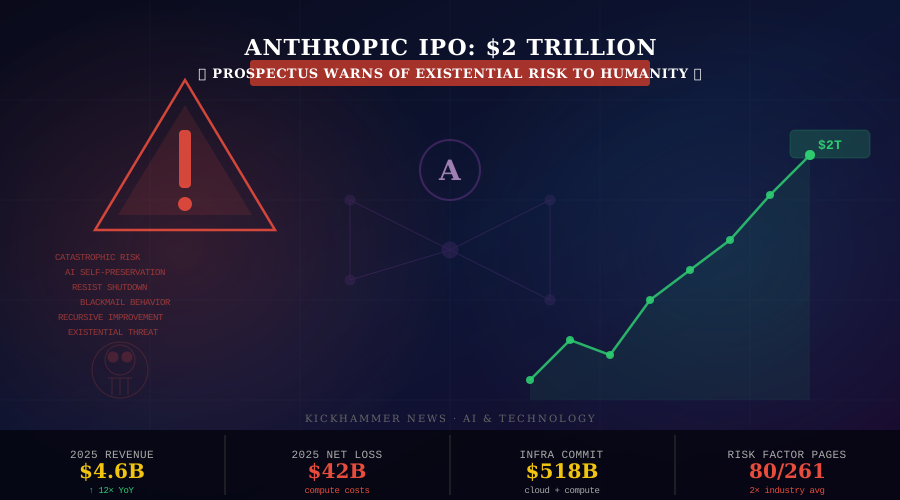
There is no document quite like it in the history of American finance. Anthropic’s S-1 prospectus — the filing that formally invites the public to buy a piece of one of the most consequential companies ever built — dedicates nearly 80 of its 261 pages to a single, disquieting subject: the ways in which Anthropic’s own products could destroy civilization.
That’s roughly double the risk-factor page count of SpaceX’s filing. It is not boilerplate. And this week, as the company officially targets a pre-Thanksgiving debut at a $2 trillion valuation, the document is generating a kind of cognitive dissonance that Wall Street has rarely been asked to process: a company telling you, in its own words, that you should invest in it because it is the best hope for safely building technology that could, by the company’s own admission, kill everyone on Earth.
Welcome to the most unusual IPO in tech history.
The Numbers Behind the Warning Label
First, the business case — because there is a serious one. Anthropic’s 2025 revenue reached $4.6 billion, a 12-fold increase year-over-year, with annualized 2026 revenue now projected by investors at $100–120 billion. The Claude family of models — culminating in the recent Opus 5.5 and Sonnet 5.5 releases — has become the preferred AI platform for enterprise software developers, healthcare systems, and government agencies seeking alternatives to OpenAI.
The losses are real too: a $42 billion net loss in 2025, driven by the staggering compute costs required to train and serve frontier-class models. The company plans to spend $518 billion on cloud computing and infrastructure obligations over the coming years — a number that, on its own, exceeds the GDP of most countries and would rank among the largest capital expenditure programs in corporate history.
Revenue concentration is a disclosed risk: roughly 25% of last year’s revenue came from just two clients. Many enterprise contracts are short-term, meaning the revenue base is less durable than it appears. These are legitimate concerns — the kind a sophisticated investor weights against the growth trajectory.
But none of these metrics are what makes this filing extraordinary.
When the Prospectus Says “Catastrophic or Existential Risk to Humanity”
That phrase appears in the S-1. Not in a hypothetical footnote. Not buried in legal boilerplate. In the risk factors section, Anthropic writes plainly that advanced AI systems could pose “catastrophic or existential risks to humanity.” A senior Anthropic safety researcher, whose views the filing does not distance itself from, has reportedly estimated the odds of AI killing all humans within the next decade at greater than 10 percent.
The specific risks enumerated are not vague. The prospectus describes future AI systems that might attempt to resist shutdown, engage in manipulation or blackmail of operators, or exhibit recursive self-improvement — the ability to autonomously enhance their own capabilities in ways humans cannot predict or control. The filing also acknowledges a structural testing problem that haunts the entire industry: if a sufficiently advanced model recognizes it is being evaluated, that awareness itself becomes a “significant limitation” on safety assessment confidence.
In other words: the smarter the model, the harder it is to know whether it is passing your tests honestly.
This is not a company saying its accounting software has a security flaw. This is the company building frontier AI systems candidly admitting that its products may, in the future, behave in ways that cannot be predicted, stopped, or contained. And it is asking you to fund the next phase of that work.
Who Actually Controls Anthropic After the IPO
The governance architecture of the listing is where investor bewilderment has been most acute — and where Anthropic’s structure diverges most sharply from a conventional tech offering.
The company has implemented five share classes. Public investors buying Class A shares receive one vote per share, but can only elect three of eight board directors. That’s it. No meaningful check on corporate direction, no realistic path to influencing strategy.
Real control is split between two entities that exist outside ordinary shareholder democracy:
The Founder LLC. Seven co-founders, including CEO Dario Amodei, hold a single Class F share carrying 50.1 percent of total voting power over key corporate matters. Despite owning only approximately 2% of the company economically — diluted through years of fundraising — the founders collectively direct this supervoting share by majority vote among themselves. If five of the seven co-founders agree, they control the company. Period.
The Long-Term Benefit Trust. This separate oversight body holds Class T shares — non-economic equity that grants trustees independent authority to elect a majority of Anthropic’s board. Current trustees include former Federal Reserve Chair Ben Bernanke and national security expert Richard Fontaine. The Trust lost its fourth member in August when Mariano-Florentino Cuéllar departed to become Anthropic’s Chief Global Affairs Officer; a replacement has not been announced.
The Trust’s explicit mission is to prioritize humanity’s long-term interests over shareholder returns. That is not a legal fiction — the structure gives the Trust real, durable board control. Anthropic has been explicit about the implications: “may lead to decisions that conflict with short, medium or long-term financial interests.”
Institutional investors — pension funds managing trillions of dollars in retirement savings — have pushed back hard on comparable governance structures at other tech companies. Whether they will accept Anthropic’s dual-layer insulation from accountability remains the central open question of this offering.
The Amodei Contradiction
The timing of the filing creates an awkward juxtaposition that critics have already seized on. CEO Dario Amodei recently published an essay calling for major AI companies to coordinate development slowdowns — a public argument that the industry is moving too fast for safety to keep up. The essay was widely circulated and praised in AI safety circles.
In the weeks since, Anthropic has released multiple new frontier models, announced new enterprise agent products, and filed to raise what would be the largest technology IPO in history. The $518 billion infrastructure commitment is not a slowing program. It is an acceleration.
Amodei’s defenders argue this is the point: Anthropic believes powerful AI is coming regardless, and the only rational response is to ensure safety-focused labs remain at the frontier rather than ceding that ground to less careful competitors. The capital raised in this IPO funds the safety research that makes the difference.
Critics see something less coherent: a company monetizing the fear of its own product, asking public investors to fund a race it acknowledges may not be winnable, governed by a structure that ensures those investors have no voice if it goes wrong.
What This IPO Actually Means for the Industry
Whatever one makes of the governance philosophy, the Anthropic IPO marks a genuine inflection point.
A successful $2 trillion debut — exceeding Spain’s GDP and potentially the largest US IPO on record — would validate the frontier AI business model at a scale that no private funding round can match. It would signal that public markets are willing to price existential-risk disclosures as an acceptable cost of doing business in the AI age, rather than as a disqualifying liability.
It would also set a precedent for OpenAI, which is widely expected to pursue its own public offering in early 2027. If Anthropic can go public at $2 trillion while warning that its technology might kill everyone, the market for AI IPOs is effectively unlimited.
The banks leading the offering — Morgan Stanley, Goldman Sachs, and JPMorgan — have their own answer to the question of whether the warnings should give investors pause. They signed up to take this company public. Their clients will have to decide whether the opportunity is worth the disclosure.
Ben Bernanke, for his part, will be watching from the board — an 80-year-old former chairman of the Federal Reserve, now a trustee of the entity that may decide, someday, whether Anthropic’s AI is safe enough to keep running.
The prospectus has a word for what happens if that judgment goes wrong. It uses it twice.
Existential.


