When Oracle announced Fusion Claw on September 29, 2026, it wasn’t pitching another chatbot overlay for enterprise software. It was unveiling something more structurally ambitious: a governed execution runtime designed to let artificial intelligence run entire business processes — autonomously, accountably, and without constant human handholding.
For the millions of organizations running Oracle Fusion Cloud for finance, HR, supply chain, and sales, Fusion Claw represents a philosophical shift in how enterprise AI should operate. The question is no longer “How can AI help me work?” but “What work can I delegate to AI — and under what authority?”
From Copilot to Autonomous Execution
Enterprise AI has spent the last several years in assistant mode. AI tools suggested next steps, drafted emails, surfaced insights from dashboards. They were helpers. Fusion Claw is Oracle’s bet that the market is ready for something more.
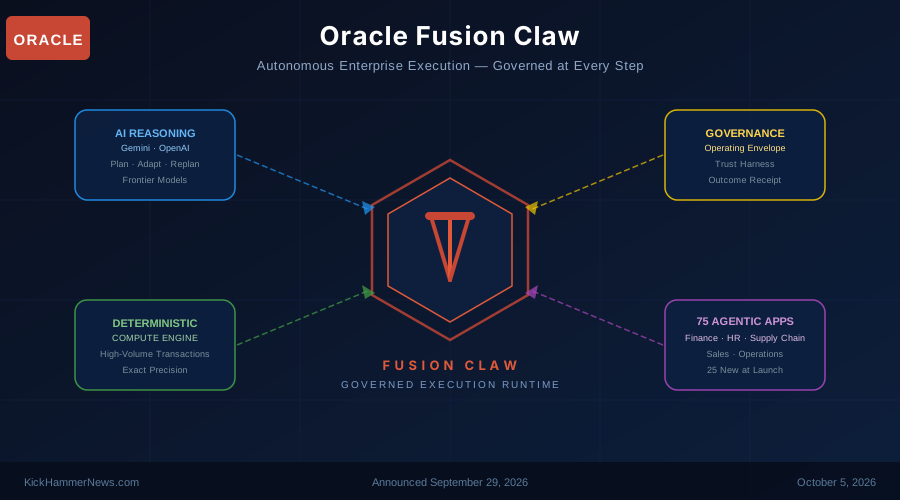
The platform pairs two previously separate worlds: frontier-model AI reasoning and deterministic enterprise computation. On one side, large language models handle planning, judgment, and adaptive replanning when circumstances change. On the other, Oracle’s traditional computational engine handles high-volume transactional work with the precision that financial and regulatory environments demand. Fusion Claw acts as the bridge — deciding which layer takes over at each moment of a process, applying AI where it earns its keep and keeping deterministic logic where certainty is non-negotiable.
This is not a trivial engineering feat. Most enterprise AI deployments struggle precisely because AI models are probabilistic while accounting ledgers, payroll runs, and logistics routes require exact answers. Oracle’s hybrid approach acknowledges that tension rather than papering over it.
The Governance Framework: Three Layers
The most distinctive element of Fusion Claw is its three-tier governance architecture, built to satisfy the compliance and risk demands of regulated industries.
Enterprise Operating Envelope is the first layer — essentially a pre-configured rulebook that encodes an organization’s objectives, policies, permissions, risk thresholds, and decision rights before any agent runs. An agent operating within finance, for instance, might be authorized to reconcile ledger exceptions up to a defined threshold but required to escalate anything above it. The envelope defines what autonomous execution is and is not permitted to do.
Outcome Trust Harness is the runtime enforcement layer. For each individual process execution, it controls which data the agent can access, what actions it can take, and under whose identity it operates. It’s the difference between an agent that has permission to read data and one that has permission to act on it — a distinction that enterprise security teams will immediately recognize as critical.
Outcome Receipt is the audit trail. Every decision made, every transaction executed, every piece of evidence used by the agent gets logged in a structured, human-readable record. For organizations subject to SOX compliance, GDPR data governance, or supply chain due diligence requirements, this is not optional functionality — it’s table stakes.
Together, the three layers address the core objection that has held enterprises back from deploying autonomous AI in production: who is responsible when the AI makes a wrong call? With Outcome Receipts, the answer becomes auditable.
Twenty-Five New Applications Across the Enterprise
Fusion Claw launched with 25 new AI-powered applications, bringing Oracle’s total Fusion Agentic Applications portfolio to 75. They span every major business function.
In finance, the Ledger application uses Claw to reconcile accounting entries, investigate discrepancies, and close exceptions — tasks that traditionally consume entire teams during month-end close. With defined authority limits, the agent can resolve the vast majority of routine exceptions without human intervention, surfacing only the genuinely complex cases.
In supply chain, Shipping Consolidation models timing, capacity, and cost alternatives in real time, optimizing how orders are grouped and routed. As supply chain volatility has become the norm, having an agent that can replan dynamically — within predefined cost and service-level constraints — addresses a pain point that ERP systems have historically been too rigid to solve.
In human resources, Workforce Staffing tackles scheduling, a notoriously labor-intensive HR function. The agent balances employee availability, skill requirements, regulatory constraints, and business demand to propose staffing plans — again, within boundaries the organization explicitly sets.
In sales, Account Territory Growth Plan uses agentic reasoning to optimize coverage, identifying whitespace in territories and recommending adjustments based on pipeline data and customer activity.
The Market Backdrop
Oracle is not operating in a vacuum. The timing of Fusion Claw reflects a broader enterprise AI market inflection point. According to Futurum Research’s first-half 2026 survey of 830 enterprise decision-makers, 62.4% placed autonomous agents in their top three technology priorities — with 17.1% ranking agentic AI as their single most important investment area. Supply chain automation alone ranked in the top three for nearly 60% of respondents.
Oracle holds approximately 11% of the global ERP market by revenue, representing roughly $6.6 billion annually, with a further $2.5 billion in HCM. Its installed base — organizations already deeply integrated with Fusion Cloud’s data models, security architecture, and process workflows — gives it a structural advantage in deploying agentic capabilities that a standalone AI vendor would struggle to replicate. An agent that already knows your chart of accounts, your supplier master data, and your approval hierarchies is a fundamentally different proposition than one that has to be trained from scratch.
Big Four Validation
The launch of Fusion Claw came with a notable signal of enterprise readiness: endorsements from Accenture, Deloitte, KPMG, and PwC. The Big Four’s involvement is not incidental. These firms are the implementation layer through which most large-scale Oracle deployments are executed, and their endorsement reflects a calculated assessment that Fusion Claw will generate substantial professional services revenue — and that they have confidence in its governance model being acceptable to the regulated enterprises they serve.
For CIOs evaluating the platform, that alignment matters. Enterprise software investments of this magnitude are rarely made without knowing that the implementation partner ecosystem is ready to deliver.
Supported AI Models and Cloud Infrastructure
Fusion Claw is not tied to a single AI provider. At launch, the runtime supports Gemini and OpenAI models, with additional models planned. This multi-model architecture reflects Oracle’s positioning as an infrastructure layer rather than an AI vendor — it provides the governance framework and the enterprise data context; customers and partners can select the reasoning model that best fits their requirements and risk profiles.
The platform runs on Oracle Cloud Infrastructure and integrates with Oracle AI Agent Studio for Fusion Applications, which provides ROI measurement tooling and observability dashboards. The observability layer is significant: it allows enterprise IT teams to demonstrate the business value of autonomous execution, building the internal case for expanding agent authority over time.
What It Means for Enterprise IT Teams
For organizations already running Oracle Fusion Cloud, the practical path to Fusion Claw adoption is more straightforward than it might appear. The governance framework rewards the kind of process documentation that mature ERP shops have already invested in. Well-defined approval workflows and documented business rules map directly onto Enterprise Operating Envelopes. Organizations that have done the work to standardize their processes are, in Oracle’s framing, already partially ready.
The Outcome Receipt model also changes the conversation with internal audit and compliance teams. Rather than explaining to auditors how an AI agent made a decision — a historically uncomfortable exercise — finance teams can produce a structured execution log. That auditability may prove to be Fusion Claw’s most compelling enterprise selling point.
The Larger Stakes
Oracle’s move positions Fusion Claw as infrastructure rather than a feature — production-grade software designed to run critical business operations, not a demo environment for experimentation. If it delivers, it shifts the competitive ERP battleground from which vendor has the best analytics dashboards to which vendor has the most trustworthy autonomous execution layer.
SAP, Workday, and Microsoft Dynamics are watching closely. Each has its own agentic roadmap. But Oracle’s combination of a 75-application portfolio, a concrete three-tier governance architecture, and Big Four go-to-market alignment gives it one of the most complete enterprise AI execution stories in the market right now.
Whether Fusion Claw lives up to that ambition will depend on how well the governance framework holds up in production — in the messy, exception-heavy reality of actual enterprise operations, where policies are ambiguous, data is incomplete, and edge cases are the rule rather than the exception. But the architecture Oracle has built suggests it understands what production-ready actually means in regulated environments.
Enterprise AI has been promising autonomous execution for years. Fusion Claw is Oracle’s wager that governance was what was missing all along — and that the ERP installed base is finally ready to find out.