October 6, 2026 — Today, Europe got its answer to DeepSeek.
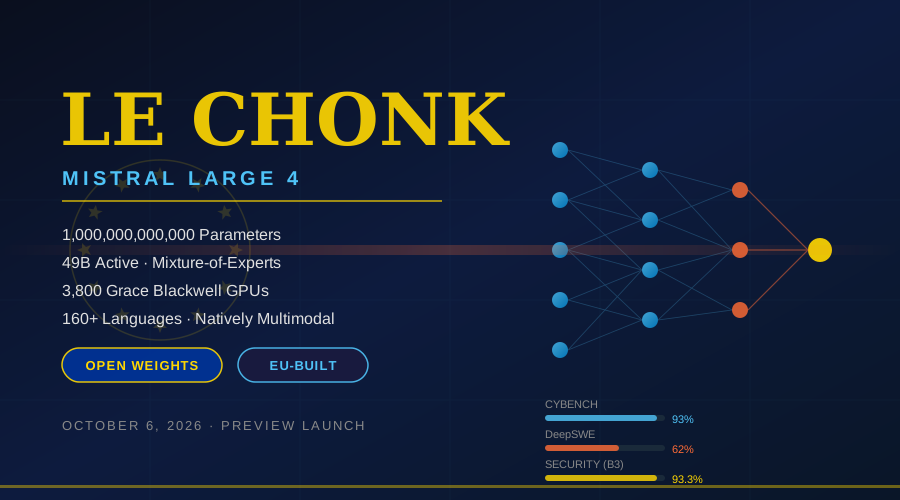
Mistral AI launched the public preview of Mistral Large 4 — a natively multimodal, 1-trillion-parameter open-weight model that the Paris-based company has quietly nicknamed “Le Chonk” in internal communications. The model is available via Mistral Studio’s API starting today, with full open weights slated for release on October 27, 2026.
The launch reframes a narrative that had begun to calcify in AI circles: that frontier open-weight AI is a contest between American closed-source giants and Chinese open-weight disruptors, with Europe watching from the sidelines. Mistral’s CEO Arthur Mensch pushed back on that story directly. “The narrative that Europe cannot compete is something that is not true,” he said in remarks accompanying the launch.
Large 4’s arrival is a direct provocation — aimed squarely at China’s strongest open models, and positioned as the first European AI system capable of matching them.
What “Le Chonk” Actually Is
The size is the first thing that stands out. Mistral Large 4 carries 1 trillion total parameters — a figure that would have seemed implausible for any openly released model as recently as 2024. But raw parameter count only tells part of the story. Large 4 is a mixture-of-experts (MoE) architecture, meaning it activates only 49 billion of those 1 trillion parameters at any given moment. Inference costs track the active parameters, not the total, keeping the model economically viable for enterprise deployment at $0.68 per million input tokens and $2.09 per million output tokens in preview pricing.
Training consumed roughly 3,800 Nvidia Grace Blackwell GPUs housed in Mistral’s European data centers, with the process taking approximately two months and consuming around 10 megawatts of power. The model was trained from scratch on data spanning more than 160 languages — including every official EU language — underscoring Mistral’s emphasis on multilingual capability and European data sovereignty.
Unlike closed competitors, Mistral is releasing the model weights under an open license, enabling organizations to download and run the system on private infrastructure, operate without vendor lock-in, and maintain full control over their data — a configuration that’s particularly attractive to European enterprises operating under the EU’s General Data Protection Regulation.
The Numbers That Matter
Mistral chose its benchmarks carefully, and the results are credible.
On the DeepSWE v1.1 coding benchmark, Large 4 scored 62%, edging out Zhipu’s GLM-5.3 (61%) and beating DeepSeek-V4-Pro (57%). Independent benchmarks from Reflection AI show some competitors performing higher — DeepSeek V4.1 Flash scored 74.2% on DeepSWE — but Mistral’s positioning as the strongest open-weight model built outside China holds up under that framing.
In cybersecurity — the area Mistral is most aggressively marketing — the results are striking. Large 4 scored 93% on Cybench’s 40 security exercises and 82% on a reproduce-and-patch vulnerability test, which Mistral claims is the highest score recorded among competing models. The model resisted 93.3% of attacks on Lakera’s B3 AI Security Benchmark. For defenders who need an AI that can engage with real vulnerability assessment work — rather than refusing based on content policies — this is a meaningful differentiator. Closed-source competitors have struggled to serve security researchers while maintaining refusal guardrails; Large 4’s open-weight nature sidesteps that problem entirely.
In finance, Large 4 scored 67% on FinWorkBench, matching DeepSeek-V4-Pro and nearly doubling Mistral’s own Medium 3.5 model (37%). For legal reasoning, it led the field with 15% on Harvey’s Legal Agent Benchmark — ahead of Kimi K3 (13%) and GPT-6 Astra (5%), though all scores reveal this domain remains exceptionally hard for current AI systems.
Vision capabilities show genuine progress. Large 4 hit 73% on the DIOR-RSVG remote-sensing grounding test, outperforming GPT-6 Astra (68%), and scored 42% on the Dense200 visual test, matching the same system. These benchmarks target industrial vision applications — reading satellite imagery, assessing infrastructure — rather than consumer image recognition.
Business automation landed at 59.9% on AutomationBench, covering 657 workflows across Gmail, Google Sheets, Slack, and Salesforce. In Surge AI’s blind human coding evaluation, Large 4 scored 3.74 out of 5, placing second among the five models tested — behind Claude Opus 5 at 4.22, but ahead of other competitors.
Europe’s AI Sovereignty Play
The timing of this launch is not coincidental. Mistral closed a €3 billion Series D funding round in September 2026 — Europe’s largest-ever AI funding round — and “Le Chonk” is the model that justifies it.
The geopolitical framing is explicit throughout Mistral’s communications. While China has dominated open-weight frontier AI with successive DeepSeek releases and competing systems from Zhipu and Moonshot, European AI development has been largely represented by Mistral, a company that launched in 2023 with eight researchers and has grown into a genuine contender. Large 4 is the first time a European AI lab has fielded a model capable of competing directly at the 1-trillion-parameter scale.
This matters in practical terms. For European enterprises evaluating AI providers, the choice has largely been between American closed-source systems (which may become inaccessible during geopolitical disruptions or regulatory disputes) and Chinese open-source models (which raise separate sovereignty concerns). An open-weight European model trained on European infrastructure, licensed to run on private infrastructure, addresses both failure modes simultaneously. Mensch’s comments about European competitiveness reflect a genuine market thesis, not just rhetoric.
The EU AI Act, which has imposed compliance obligations on frontier model providers since 2025, creates additional incentive to work with European providers who are structurally aligned with regulatory requirements rather than adapting to them reluctantly. Mistral has made EU compliance a selling point; Large 4’s multilingual training data includes all EU official languages as a deliberate choice.
The Three Weeks Before Weights
The October 6 preview launch is not the final act. Weights ship October 27 — Mistral chose a three-week gap specifically to “red-team the model in real-world settings with cybersecurity leaders, vetted partners, and state authorities” before release. This is a responsible disclosure approach borrowed from security research: give trusted evaluators access, collect findings, patch what you can, then release.
It’s also a calculated risk. Three weeks of exclusive API preview creates buzz and surfaces issues, but it compresses the window for adversarial testing. The model’s cybersecurity positioning makes this especially notable — a system optimized to engage with offensive security research at 93% Cybench accuracy will attract sophisticated users who push its limits. Whether three weeks is sufficient to characterize its misuse surface before weights are in the wild is an open question.
The open-weight release will allow any organization — or individual — to run Large 4 locally, without the rate limits, monitoring, or content filtering that an API imposes. For security defenders, this is the point: a model that can be deployed in air-gapped, highly sensitive environments without external data transmission. For regulators, it raises the familiar problem of powerful AI capabilities released into a world where no license can be revoked.
What Le Chonk Changes
Naming a trillion-parameter model “Le Chonk” is a deliberate act of irreverence — and it works. The nickname signals confidence. You don’t make jokes about your flagship product if you’re not sure it can stand on its benchmarks.
The more serious question is whether Large 4 changes the competitive landscape or merely confirms Mistral’s position within it. On the evidence of today’s launch, it does both. The benchmarks show a model that can genuinely compete at the frontier tier for specific workloads — coding, security, vision, finance — without matching the very top closed-source systems across the board. Claude Opus 5 still leads in blind coding evaluations. DeepSeek V4.1 Flash leads on DeepSWE by a meaningful margin. The caveat about independent benchmarks showing competitors ahead on some tests is real.
What Large 4 changes is the availability equation. A trillion-parameter model with strong security and vision capabilities, trained in Europe, released as open weights, available for private deployment — that configuration didn’t exist yesterday. It does today.
For organizations that need frontier AI capabilities without vendor dependency, without cross-border data transfer, and without a provider who can cut off access — this is a different kind of value proposition than raw benchmark supremacy. Mistral isn’t claiming to have built the world’s best model. It’s claiming to have built the best model you can actually own.
If the October 27 weight release goes cleanly, that claim will have a very large set of potential customers ready to evaluate it.
Word count: approximately 1,310 words


