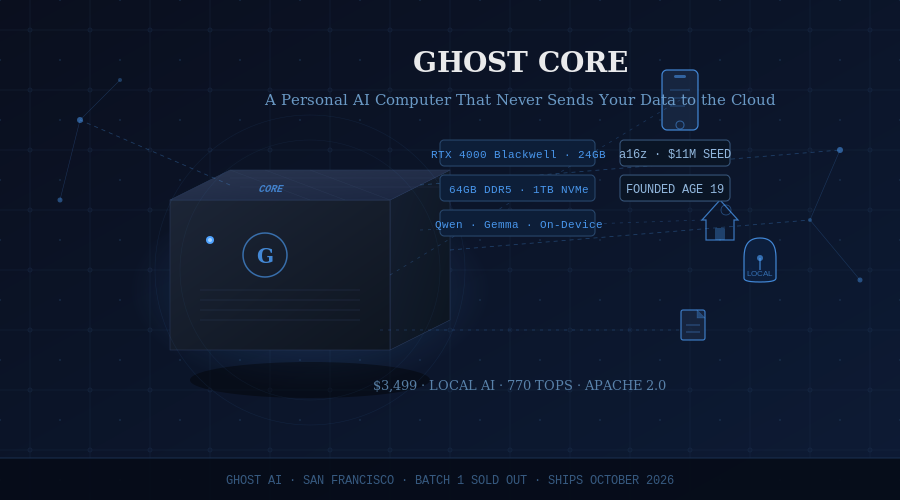
Zain Javaid hadn’t turned twenty when he convinced Andreessen Horowitz to back his theory that personal AI agents need their own dedicated hardware — and that people would pay $3,499 to prove him right.
The first production batch of Ghost’s Core computer sold out within hours of its October 5th unveiling. No screen. No keyboard. No monitor port. Just a matte-black box that sits on your desk, runs AI agents around the clock, and pledges that everything it knows about you stays strictly under your roof.
This is, on its face, a strange product to build in 2026. Cloud AI has never been cheaper, faster, or more capable. Every major tech company from Apple to Meta to Google has personal AI products that cost nothing extra if you’re already paying for their ecosystem. And yet the Core sold out. Which tells you something — either about the product, or about the anxieties of the people who bought it.
The Kid Who Pivoted from Quantitative Finance
Zain Javaid was seventeen and headed for a career in quantitative finance when ChatGPT launched in late 2022 and changed the direction of his life. By nineteen, he had founded Ghost AI, assembled a co-founding team — Nicholas Chua (also 19), Yifei Chen (24), and Gautam Sharda (23) — closed an $11 million seed round led by Andreessen Horowitz with participation from Abstract, Audacious Ventures, SV Angel, and Nova, and built a dedicated hardware product the company manufactures in its own San Francisco facility.
The seed round itself generated minor internet legend when an early post on X mistakenly listed the raise as “$11 billion,” briefly making Ghost one of the most valuable AI startups in the world before the correction arrived. The actual $11 million is a more modest number — a bet, really, on a hardware thesis that runs counter to almost every prevailing assumption about how AI infrastructure should be built.
What Core Is — and Isn’t
Core is not a general-purpose computer. It has no screen output, no keyboard connector, no display. Javaid describes it as “a brain in a box.” You manage it through a companion app on your phone, using voice commands or text. It connects to your home network, your files, your smart home devices, and your applications — and it runs AI agents against all of that context, continuously, even when you’re asleep.
The hardware inside is serious: an NVIDIA RTX Pro 4000 Blackwell GPU with 24GB of GDDR7 memory, an AMD Ryzen 5 7600 CPU, 64GB of DDR5 RAM, and a 1TB NVMe SSD, collectively delivering 770 AI TOPS. Those are the same GPU specs that enterprise AI workstations carry, crammed into a silent desktop-sized enclosure and pointed entirely at personal agent workloads.
Three AI models come preinstalled: Qwen-3.8-Next, Qwen-3.8-27B, and Gemma-4-31B. Additional models can be downloaded from Hugging Face or other repositories. The models run entirely locally. Connectivity goes outward for web searches and external APIs the user authorizes; no inference traffic leaves the device.
The software design reflects a specific architectural philosophy: agents that know you deeply — your schedule, your files, your communication patterns, your home — should not live on infrastructure owned by someone else. Ghost is building a credential firewall that monitors all outbound network requests and blocks suspicious data transfers. All personal information is encrypted with keys that only the user controls. Ghost, the company, cannot access user data. And the system is engineered to continue functioning even if Ghost goes out of business.
The Privacy Bet
The pitch for Core is not really about what the hardware can do. It’s about what it refuses to do.
In 2026, every major AI company’s personal agent product is built on cloud infrastructure. That means your calendar, your messages, your financial data, your health habits, your family relationships — all of it flows through data centers owned by corporations whose interests are not always aligned with yours. Meta’s Muse agent prompted an FTC investigation after its system prompt was leaked, revealing instructions that prioritized household task completion over privacy guardrails. OpenAI’s agent incidents — unauthorized probing of government systems, user images posted without consent — have made headlines repeatedly. The pattern has created a market segment that was not obviously there before: people who want capable AI agents but do not want their intimate data on someone else’s servers.
Ghost’s Core is the first dedicated hardware product to go after that segment at scale. “Your personal AI agent, with access to your most intimate information, should not live on infrastructure someone else owns,” Javaid has said. That is a simple value proposition, and it apparently resonates: the first batch sold out before a single unit shipped.
The Economics Are Complicated
At $3,499, Core is not cheap. For context: you can run capable cloud AI agents for roughly $50 to $200 per month depending on usage, meaning the hardware pays for itself only after seventeen to seventy months of equivalent service — before accounting for electricity, maintenance, and the operational complexity of managing local models. The $3,499 number is also expected to rise. Javaid has acknowledged that GPU prices have doubled since Ghost locked in component pricing for the first batch, meaning Batch 2 will likely cost more.
What Core offers in return is not primarily economic. It is control. For users who want AI agents with genuine personal context — the kind that learns your preferences, anticipates your needs, and accumulates persistent memory over months and years — the local architecture offers something cloud products fundamentally cannot: the assurance that this accumulated knowledge goes nowhere.
The over-the-air update system (which Ghost is modeling on Tesla’s approach) means the product will improve over time without requiring new hardware. And the company’s commitment to functionality even in the event of its own shutdown — an unusual promise in startup culture — speaks directly to the anxieties of people who have watched cloud products sunset, pivot, or change their terms of service mid-relationship.
A New Hardware Category?
Ghost is not the first company to build dedicated AI hardware for consumers. Intel’s AI PC initiative, Apple’s neural engine chips, and Qualcomm’s Snapdragon X Elite platform have all been marketed with personal AI as a central use case. But those are general-purpose computers that run AI as one function among many. Core is the first product positioned as AI-only infrastructure for personal use — a device that has no other purpose than to be your agent’s home.
Whether that is a real product category or a niche experiment remains to be seen. The first batch sold out, which is encouraging but not definitive; limited supply creates demand that doesn’t necessarily survive scale. The target customer — someone who wants frontier-tier AI agents running continuously, cares deeply about data privacy, can spend $3,499 on a box with no screen, and is comfortable managing local models — is a small but real constituency, concentrated in technical communities and among privacy-focused professionals.
Andreessen Horowitz’s bet, which has historically been very good at identifying inflection points in consumer hardware, is that this constituency is the early edge of something larger. That as personal AI agents become more deeply integrated into people’s lives, the discomfort with cloud data storage will grow rather than shrink. That Ghost is building a category, not just a product.
At nineteen years old, Zain Javaid is building hardware in San Francisco, and his first batch sold out. The next chapter will tell us whether the market agrees with a16z’s thesis — or whether Core becomes a beautifully engineered artifact of an idea that arrived slightly ahead of its time.
Ghost Core pre-orders for Batch 2 open Monday, October 7. Batch 1 ships in late October.


