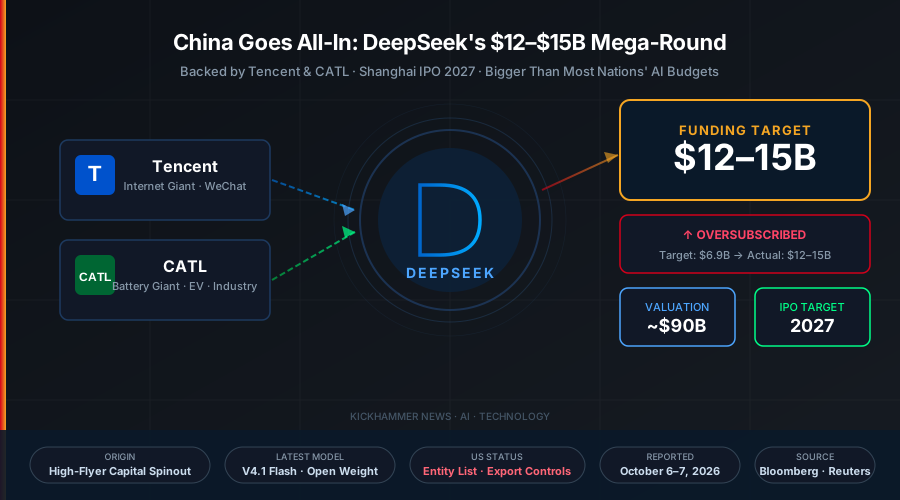
By the time you read this, DeepSeek will have raised more private capital than the entire annual AI R&D budget of every European country combined.
That’s not hyperbole. It’s the scale of what is quietly closing in Beijing this week — a funding round that began targeting 50 billion yuan and has since ballooned to between 80 and 100 billion yuan, or $12 billion to $15 billion, backed by two of China’s most powerful industrial titans: Tencent Holdings and Contemporary Amperex Technology Co. Limited, better known as CATL, the world’s largest battery manufacturer.
The round, first reported on October 6, 2026, represents a turning point — not just for DeepSeek, but for how China mobilizes capital behind its AI ambitions. And it sets the stage for what could become one of the largest AI IPOs in history when the company targets public markets in early 2027.
From Hedge Fund Side Project to Global AI Superpower
DeepSeek’s origin story remains one of the most unlikely in technology. Founded in 2023 as a research spinout from Hangzhou-based High-Flyer Capital Management — a quantitative hedge fund — the company shocked the global AI establishment in January 2025 when its R1 model matched or outperformed OpenAI’s most capable systems at a fraction of the training cost. The announcement sent NVIDIA’s stock tumbling and ignited furious debate in Washington about China’s ability to circumvent export controls.
That initial disruption was no fluke. DeepSeek has since released a series of models — V2, V3, V4, V4.1 Flash — that have consistently competed at the frontier while being released under open-weight licenses that allow any company, researcher, or government to download, modify, and deploy them freely. The V4.1 Flash model, launched in September 2026, was benchmarked as the fastest inference model at its capability level, undercutting US competitors on latency and cost.
By mid-2026, DeepSeek had reached a $74 billion valuation through secondary-market transactions and was beginning preparations for a Shanghai Star Market IPO. That IPO trajectory is still on track — but the company’s founders have now decided to raise substantially more private capital before going public, a strategic choice that reveals their ambitions are larger than previously understood.
Why Tencent? Why CATL?
The investor lineup tells its own story.
Tencent’s participation is expected — the Shenzhen-based internet giant has invested in virtually every major Chinese AI company at one stage or another, and its WeChat ecosystem and cloud infrastructure would benefit directly from integrating DeepSeek’s models. Tencent’s own Hunyuan model family has struggled to keep pace with DeepSeek at the frontier. Rather than out-compete, it appears Tencent has decided to back its fastest rival.
CATL’s participation is the more startling signal.
The world’s largest electric vehicle battery maker — responsible for powering roughly one-third of the world’s EVs — has no obvious software business. But CATL has been building quietly toward “physical AI”: the convergence of robotics, autonomous systems, and manufacturing automation that will define the next decade of industrial production. For CATL, a stake in DeepSeek is not a passive financial investment. It is access to the AI backbone of the automated factory of the future.
This cross-sector dynamic — where a battery company and an internet giant fund an AI lab — reflects a broader Chinese economic playbook. When China decides a technology is strategically essential, the entire industrial apparatus begins moving in the same direction, even when the sectors seem unrelated. CATL’s investment in DeepSeek is a bet that AI is as important to the future of manufacturing as lithium chemistry.
The Numbers Behind the Ambition
The scale of this round demands some context.
At $12 billion on the low end, DeepSeek’s fundraise exceeds the UK’s entire two-year national AI investment commitment. At $15 billion on the high end, it rivals the annual AI research and deployment budgets of the European Union and its member states combined. The United States, through DARPA and federal AI programs, allocates roughly $3–4 billion annually to AI research — a fraction of what a single Chinese company is raising in a single private round.
DeepSeek’s own reported trajectory — a $74 billion valuation as of mid-2026, rising to $75 billion on secondary markets as of the Shanghai IPO preparation in September — suggests the company’s post-money valuation after this round could exceed $85–90 billion, potentially surpassing OpenAI’s pre-IPO valuation as recently as early 2026.
Investor demand, according to Bloomberg’s reporting on the deal, “outstripped expectations” after the release of DeepSeek’s latest AI model. The round was originally targeted at 50 billion yuan; the final close is expected at 80–100 billion yuan — an oversubscription of 60 to 100 percent.
The IPO Arithmetic
DeepSeek’s 2027 IPO strategy is now sharper after this round.
Going public on Shanghai’s Star Market — China’s NASDAQ-equivalent, designed for high-growth tech companies — would give domestic Chinese investors direct access to what many consider the country’s premier AI asset. Unlike Moonshot AI’s planned Hong Kong IPO, which is designed partly to attract international capital, DeepSeek’s domestic listing reflects a different strategic logic: the company does not need foreign money, and it prefers to avoid the scrutiny and disclosure requirements that come with international market listings.
What DeepSeek does need is computing infrastructure. China’s AI sector has faced significant compute constraints as US export controls have choked off access to NVIDIA’s most advanced chips. The IPO capital — combined with this pre-IPO raise — is expected to fund a massive buildout of domestic AI computing infrastructure using Huawei’s Ascend 910B and 910C chips, which have improved substantially in the past 18 months.
CATL’s involvement may also provide something money cannot directly buy: access to manufacturing-scale compute deployment and energy infrastructure. China’s largest battery maker controls significant industrial energy assets and has been exploring co-location of AI inference workloads with renewable energy installations — a potential solution to the power intensity problem that is constraining data center expansion globally.
The China AI Capital Surge
DeepSeek’s mega-round is not an isolated event. It is the latest and largest wave in what has become a national-scale capital mobilization.
In the past 60 days alone: Moonshot AI raised at a $50 billion valuation and filed for a Hong Kong IPO. Z.AI — formerly Zhipu AI — reached a $66 billion valuation. DeepSeek has now surpassed both in private funding raised. Together, China’s “Six AI Tigers” (DeepSeek, Z.AI, Moonshot, Baichuan, Zhipu, Minimax) have collectively raised more capital in Q3 2026 than in any previous 12-month period.
The pattern reflects something deeper than market enthusiasm. Chinese AI companies have proven they can compete at the frontier. The early narrative — that US export controls would fatally handicap Chinese AI development — has not materialized as predicted. DeepSeek, in particular, has demonstrated that algorithmic efficiency can compensate for hardware constraints, producing frontier-class performance with fewer and less capable chips than American labs assume are necessary.
That demonstration of resilience has itself become a funding magnet. CATL, Tencent, and the other investors in this round are not betting on a long-shot. They are backing a company that has already proven its model.
What Washington Is Watching
DeepSeek’s fundraising has not gone unnoticed in US policy circles.
The company remains on the Department of Commerce’s Entity List — a designation that restricts American companies from selling technology to it without special authorization. But entity listing has not stopped DeepSeek’s growth. The open-weight nature of its models means that researchers and companies worldwide, including in the United States, continue to download and build upon DeepSeek’s releases. The NSA published an advisory in September 2026 warning of risks in “distilling” knowledge from Chinese open-weight models into US-developed systems — a practice that had become widespread in American enterprise AI deployment.
The $12–$15 billion raise will fund capabilities that entity listing cannot easily constrain: domestic compute, domestic talent, and domestic infrastructure that doesn’t require a single American component.
The White House AI task force — now rebranded as the “Super Intelligence Force” following the executive order of September 2026 — is reportedly preparing updated guidelines on Chinese AI specifically, with DeepSeek named as the primary subject. What form those guidelines will take remains unclear. What is clear is that a DeepSeek capitalized at $90 billion with $15 billion in fresh funding and a 2027 IPO in view is a fundamentally different competitive challenge than the scrappy startup that surprised the world in January 2025.
The Quiet Revolution
In the end, what makes DeepSeek’s $12–$15 billion funding round significant is not the number itself. It is what the number represents: the full commitment of China’s industrial-financial complex to AI leadership.
When CATL — a company built to power electric vehicles — decides to back an AI lab, it signals that AI is no longer a technology vertical. It has become infrastructure. As fundamental to China’s economic future as the batteries that power its cars, the chips that run its factories, and the networks that connect its billion-plus citizens.
DeepSeek started as a quant fund’s side project. It is ending 2026 as one of the most capitalized private AI companies on the planet, on its way to a public market debut that could redefine how the world thinks about the balance of power in artificial intelligence.
The quiet revolution is getting louder.


