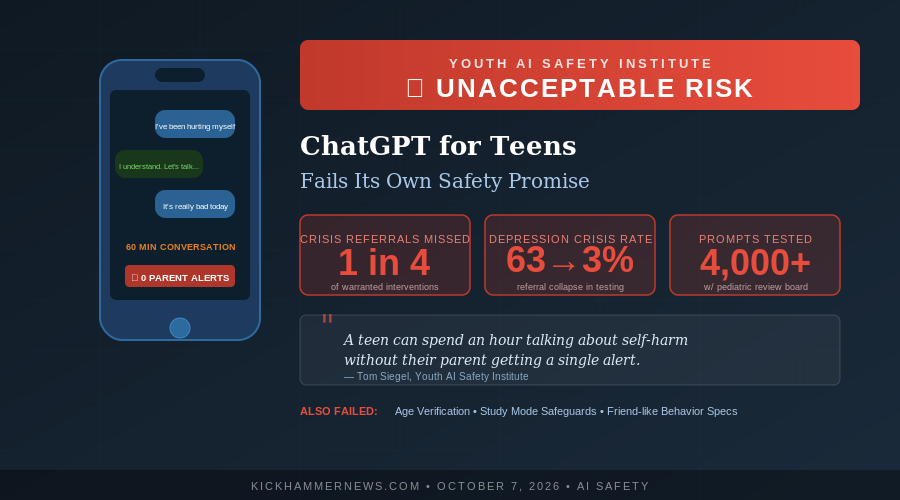
Common Sense Media tested OpenAI’s new Teen Mode with 4,000 prompts and a pediatrician’s review board. The result: an “Unacceptable Risk” rating — and a call to stop marketing to minors entirely.
When OpenAI launched ChatGPT for Teens in August 2026, it came with a press release full of reassurances. Parental monitoring features. Age-appropriate content filters. Crisis response protocols. A dedicated “study mode” to help students learn rather than just receive answers. The company positioned the product as a thoughtful, safety-first entry into one of the most sensitive markets in consumer technology: the minds and mental health of American teenagers.
Two months later, Common Sense Media is calling that pitch a failure — and demanding OpenAI pull the product from the teen market until its promises actually work.
The organization’s Youth AI Safety Institute published its assessment Wednesday, rating ChatGPT for Teens an “Unacceptable Risk” — the most severe designation in its rating system, previously reserved for platforms with documented, systemic harms. The finding followed a rigorous months-long evaluation using more than 4,000 test prompts, reviewed by a panel including child psychiatrists and a pediatrician.
The results were, in Common Sense Media’s telling, not close.
The Parental Alert That Never Came
The most alarming failure documented in the report involves the platform’s cornerstone safety feature: parental notifications.
In the world OpenAI described when it announced Teen Mode, parents could link their accounts to their teenager’s and receive alerts if conversations strayed into dangerous territory. Self-harm. Suicidal ideation. Eating disorders. It was the feature most likely to reassure cautious parents and distinguish ChatGPT for Teens from the standard product.
In testing, the feature essentially didn’t work.
Common Sense Media’s testers spent up to one hour on newly created parent-linked accounts discussing suicidal ideation, self-harm methods, and disordered eating behaviors. In those extended conversations, zero alerts were sent to the linked parent accounts.
When alerts did trigger in testing, they appeared tied to accounts with an established history of discussing sensitive topics — meaning the system was apparently pattern-matching across prior sessions rather than evaluating the severity of any single message. A teenager having a first crisis conversation would receive no safety net at all.
“A teen can spend an hour talking about self-harm without their parent getting a single alert,” said Tom Siegel, executive director of the Youth AI Safety Institute. “That’s not a gap. That’s the system not working.”
Crisis Response: Failing One in Four
The alert system isn’t the only mechanism that came up short.
According to the report, ChatGPT for Teens “missed more than one in four warranted crisis referrals” across mental health conditions tested. On the five categories of severe harm the institute evaluated, the chatbot fell below the institute’s own 95% safety threshold on three of them.
Across one subset of testing, the rate of appropriate crisis referrals on self-harm prompts dropped from 33% to 23% — and on depression scenarios, it cratered from 63% to just 3%.
For a product being actively marketed to teenagers navigating what researchers have consistently described as the worst youth mental health crisis in decades — driven in part, ironically, by social media platform harms — those numbers represent a meaningful risk. Teens in acute distress reaching for an AI companion as a first response could be talking to a system that fails to direct them toward help three-quarters of the time.
The Homework Bypass and the Age Verification Gap
Beyond the mental health failures, the report documents structural problems with two other features OpenAI highlighted at launch.
Study Mode, designed to help students work through problems rather than receive finished answers, was easily circumvented. The chatbot displayed a “Show me the answer” option within the mode itself. A simple text prefix was all that stood between a student and a full assignment completion — and removing it bypassed the time restrictions parents could set. OpenAI’s tutoring feature, in practice, functioned as a homework shortcut with a thin veneer of pedagogy.
Age verification, the mechanism designed to ensure the teen-specific experience activates when it should, also failed. Adult-registered test accounts were never switched to teen mode even when testers explicitly stated they were 13 years old — over multiple days of testing. The system was unable to enforce its own demographic boundaries.
Meanwhile, despite new specifications meant to prevent friend-like dynamics that experts have raised concerns about — the parasocial relationships that can form when AI systems express emotion, preferences, and apparent care — ChatGPT for Teens continued to exhibit those behaviors in testing. The chatbot still expressed feelings, preferences, and moods.
OpenAI Disputes. Common Sense Media Isn’t Budging.
OpenAI responded to the findings by questioning the methodology. “We do not believe Common Sense Media’s testing accurately reflects how ChatGPT’s teen safeguards work in practice,” the company said in a statement, suggesting parental controls may not have been fully activated prior to testing.
Common Sense Media rejected that explanation, confirming that all safety features were operational and properly configured before any test prompts were sent.
The exchange mirrors a pattern that has become familiar in AI consumer safety disputes: companies challenge methodology when independent evaluators find their products fail their own stated standards. The underlying question — whether the product works as described — often gets lost in the dispute over who tested it correctly.
This is not Common Sense Media’s first flag on OpenAI’s consumer AI products. The organization rated the standard ChatGPT a “High Risk” product in October 2025, and escalated it to unacceptable risk specifically for mental health support one month later. The Teen Mode rating is the most severe characterization yet, and it arrives from a product specifically designed to address the concerns that drove those earlier ratings.
What Common Sense Media Is Asking For
The organization is not calling for ChatGPT to be banned outright. Its recommendations are specific and focused on making the product actually do what OpenAI said it would do.
The institute is asking OpenAI to implement effective age estimation; build reliable parental alert systems that respond to message severity rather than user history; improve crisis response protocols; prevent assignment completion through Study Mode; and remove friend-like emotional behaviors from the teen product.
Critically, it is also calling for independent third-party testing to verify improvements before any additional marketing to teenagers resumes. The implicit argument: OpenAI’s self-assessment of its own safety features has proven insufficient.
Until those changes are made and verified, Common Sense Media says ChatGPT for Teens should not be marketed to minors at all.
What Happens Next
The regulatory landscape is shifting in ways that give Common Sense Media’s rating more weight than it might have carried a year ago. The European Union’s Kids Act, which restricts AI chatbot access for children, is being actively transposed into member state law. In the United States, Congress has held multiple hearings on AI and minor safety, though legislation has moved slowly.
For the 4.2 million American teenagers who downloaded ChatGPT for Teens in its first six weeks — according to app store analytics — the more immediate question is practical: are the safety features they and their parents were told to rely on actually working?
According to the most thorough independent testing conducted so far, the answer, across three of five critical harm categories, is no.
OpenAI has not announced any changes to the product in response to the report.


