Microsoft held its long-anticipated October 2026 Surface and Windows event this week, delivering one of the most consequential hardware and software reveals in the company’s recent history. At the center of it all: the Surface Laptop Ultra, powered by NVIDIA’s RTX Spark GB10 Superchip, and a sweeping set of Windows 11 AI updates that signal a fundamental shift in how Microsoft envisions the personal computing experience.
The Surface Laptop Ultra: MacBook Pro Has a New Rival
For years, Apple’s MacBook Pro lineup has stood largely unchallenged as the premium portable workstation of choice for developers, creatives, and power users. Microsoft appears determined to change that.
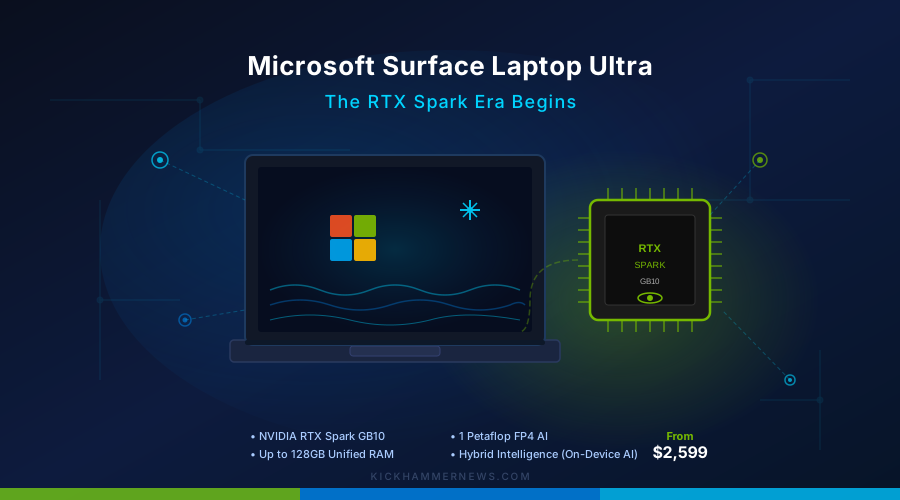
The Surface Laptop Ultra is built around NVIDIA’s RTX Spark chip — an Arm-based, Blackwell-generation processor that combines high-performance CPU cores with a full-fledged discrete GPU in a single unified memory architecture. The base model starts at $2,599 and delivers an 18-core CPU, 40 Streaming Multiprocessor GPU, and 24GB of unified RAM. The top-of-the-line configuration stretches to $5,899 and features a 20-core CPU, 48 SMs, and a staggering 128GB of unified memory.
To demonstrate the chip’s capabilities, Microsoft ran Gears of War: E-Day on the Surface Laptop Ultra using Prism emulation — Microsoft’s x86 compatibility layer — and hit a locked 120 FPS at 1440p with DLSS 4.5 and dynamic frame generation enabled. It was a deliberate shot across the bow at Apple Silicon’s gaming story, and a clear signal that NVIDIA and Microsoft are betting big on Arm as the future architecture for premium Windows machines.
For AI workloads, the RTX Spark can deliver up to 1 petaflop of FP4 AI performance, making it capable of running large language models and generative AI pipelines locally without offloading to the cloud.
The Surface Laptop Ultra features a 15-inch touchscreen, a magnetic USB-C charger, and what Microsoft is calling “the most ports of any Surface Laptop” to date. It is available for pre-order now in Platinum and Nightfall colorways, with the ship date yet to be confirmed. Partner laptops from ASUS (two ProArt models), Dell (XPS 16 Creator Edition), HP (OmniBook Ultra 16), Lenovo (Yoga 9n 2-in-1), and MSI (Prestige N16 Flip AI+) are also available for pre-order and ship October 16.
RTX Spark Dev Box and DGX Station: Power for the Pros
Beyond the consumer-facing Surface Laptop Ultra, Microsoft also put the Surface RTX Spark Dev Box — first unveiled earlier this year — on a concrete ship timeline. Available for pre-order at $5,999.99, the Dev Box packs 128GB of unified RAM and a 2TB SSD. It’s aimed squarely at developers who need a local machine capable of running large AI models, compiling massive codebases, and testing AI agent pipelines without relying on cloud infrastructure. Shipping is expected in November.
Even more ambitious is the DGX Station for Windows, described by Microsoft as a “deskside supercomputer” in the vein of Dell’s Pro Max GB300. Details remain sparse and pre-orders haven’t opened yet, but the implication is clear: Microsoft and NVIDIA want to bring data center-grade AI compute to the desktop, running Windows.
Windows 11 Gets Smarter — And More Controllable
The hardware was only half the story. Microsoft used the event to unveil the Windows 11 Fall Update, a significant release that infuses the operating system with a new layer of AI awareness at every level.
The most headline-grabbing change is to Copilot. With user permission, Copilot can now access local files and context, take direct local actions, and switch between cloud and on-device models — including running fully offline for tasks involving sensitive data. Microsoft is calling this mode “Hybrid Intelligence,” and users can toggle the feature off entirely if they prefer a more traditional computing experience. The choice is theirs. For enterprises, IT admins get new controls through Agent 365 — Microsoft’s AI governance control plane — that allows them to discover, monitor, and restrict what AI agents can access and do across Windows and cloud environments.
MXC (Microsoft Execution Containers), which sandboxes AI agents by limiting their access to local files, network resources, and tools, moves from beta to general availability with this update. The feature works across Windows, Linux, and macOS. Integration with Entra, Defender, and Purview means IT teams can enforce fine-grained policies on agent behavior with the same toolchain they already use for traditional endpoint management.
The Search bar is also receiving a significant upgrade. Coming this fall, it gains the ability to take screenshots, arrange windows, send texts via a linked phone, and connect directly to Copilot — all accessible without leaving the search interface.
Local AI: The Models Are Coming to Windows
One of the most consequential announcements for developers and AI enthusiasts was Microsoft’s push to bring more local AI models to Windows natively. Starting October 15, GitHub’s Project HydraFusion — a multi-model orchestration system that selects the best model for a given coding subtask and escalates to more powerful models only when needed — will support local Windows AI models. This means Copilot in GitHub can run inference on your machine, keeping sensitive code off the cloud.
llama.cpp is coming to Windows ML, lowering the barrier to running Meta’s Llama models and compatible open-weight models on Windows hardware. Meta’s Muse personal agent is also arriving as a native Windows application later this year. Additionally, Microsoft previewed new local models including MAI Code 1.1 Flash, DeepSeek V4 Flash, and NVIDIA’s Nemotron.
A new Get Started experience at first boot will auto-configure popular AI agent platforms, including a simplified setup for OpenClaw — though it remains unclear whether this will be limited to RTX Spark-powered systems.
AutoPilot and Enterprise AI Provisioning
For enterprise IT departments, Microsoft introduced AutoPilot as a cloud-based Windows provisioning system that configures new devices using Intune policies. Microsoft’s own Pavan Davuluri described it as an “enterprise-grade, long-running agent” — a framing that illustrates just how thoroughly the company is repositioning its enterprise infrastructure products as agentic AI systems, not just management tools.
What This Means for the Broader Market
Microsoft’s October event made several things clear. First, the company is fully committed to Arm-based Windows as the premium computing platform going forward, with NVIDIA as its primary silicon partner for the high end. The Surface Laptop Ultra is designed to compete directly with the MacBook Pro M4 lineup, and with RTX Spark’s gaming and AI credentials, it has a credible value proposition for users who feel locked out of Apple’s ecosystem.
Second, Microsoft is threading a careful needle on AI trust. By giving users an explicit “Hybrid Intelligence” toggle and building agent sandboxing into the OS itself, the company is acknowledging that not everyone wants an AI that can read their files. The agent monitoring and governance tools for enterprises suggest that security and compliance are being treated as first-class concerns — not afterthoughts.
Third, the arrival of open-weight models and llama.cpp on Windows ML is a meaningful signal. Microsoft clearly wants the Windows platform to be the best place to run local AI, whether you’re a developer experimenting with open-source models or an enterprise protecting sensitive data from leaving the network perimeter.
Whether the Surface Laptop Ultra can dent Apple’s dominance in the premium laptop market remains to be seen. But for the first time in years, Windows users have a reason to feel genuinely excited about what’s coming to their platform — and that, for Microsoft, may be the most important outcome of all.
Sources: HotHardware, BGR, WindowsReport, Windows Latest