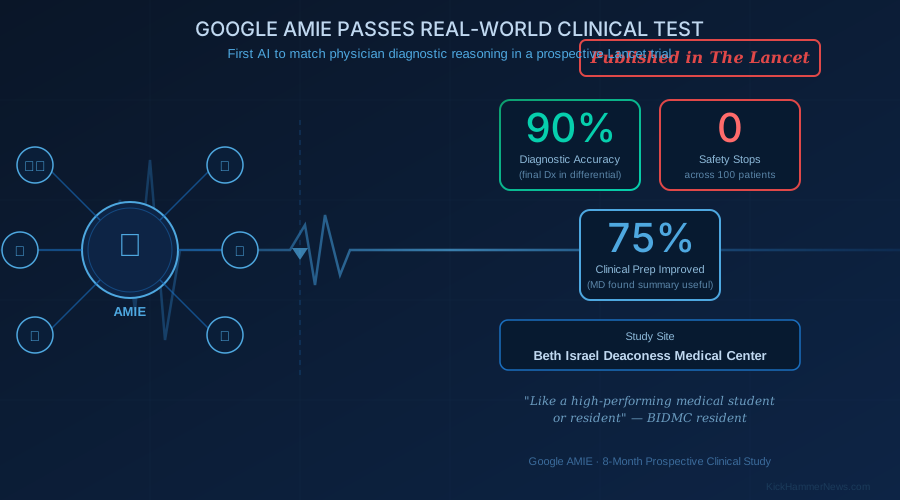
For two years, Google’s AMIE has been the most impressive medical AI nobody outside a lab had actually used. Today, that changed. A peer-reviewed study published in The Lancet confirms that AMIE — Google’s Articulate Medical Intelligence Explorer — successfully handled real patients at a Boston hospital, matching attending physicians on diagnostic reasoning while requiring zero safety interventions across hundreds of conversations.
The results are striking enough to shift the question in medical AI from “can it work in theory?” to “how do we deploy this safely at scale?”
From Simulation to Stethoscope
Google first unveiled AMIE in early 2024, positioning it as a large language model specifically tuned for diagnostic reasoning. Previous evaluations were promising but artificial: the AI sparred with patient actors, worked through standardized clinical scenarios, and competed in simulated OSCE assessments designed for medical students. Impressive, yes. But a script is not a sick person.
The new Lancet study, conducted in partnership with Beth Israel Deaconess Medical Center (BIDMC) in Boston, changed that. Over eight months, 100 real patients with new, non-emergency, episodic complaints — scheduling appointments for things like persistent headaches, unexplained fatigue, or skin rashes — were invited to chat with AMIE via a secure web link before their primary care visit. Participation was voluntary and did not affect their care. Ninety-eight of them showed up for their appointments.
The setup was deliberately cautious. A physician supervised every AMIE conversation live, watching via screen-share, with authority to halt the session at the first sign of patient distress, clinical risk, or a direct request to stop. The bar was low: if anything seemed off, the study required pulling the plug.
The plug was never pulled. Across hundreds of conversations, zero safety stops were required.
The Numbers That Matter
After each visit, blinded clinical evaluators — three per case — independently rated both AMIE’s differential diagnoses and those of the attending physician, then compared them against the actual confirmed diagnoses from chart review eight weeks later.
AMIE’s differential included the final diagnosis in 90% of cases. Top-3 accuracy came in at 75%; top-1 (the single most likely diagnosis AMIE named first) hit 56%. For context, the study compared this to attending physicians at the same clinic and found no statistically significant difference in the quality of differential diagnoses.
Where physicians clearly outperformed: management plans. Doctors were better at crafting practical, cost-effective treatment paths — reflecting the advantage of having EHR access, the ability to perform physical exams, and years of navigating the real-world economics of healthcare. AMIE had none of those things. It was text only, working blind from whatever the patient typed.
Peter Brodeur, a BIDMC resident involved in the trial, put it simply: they compared AMIE to “a high-performing medical student or resident.”
Adam Rodman, the BIDMC internist who helped run the trial, noted something subtler about how the dynamic shifted in practice: “None of our patients trusted it until they realized that it was handing off to their doctor.” The trust followed the handoff. Patients understood they were not replacing their physician — they were doing a better job of preparing for their physician.
AI That Makes Doctors More Effective
That framing — preparation, not replacement — runs through the study’s most practically significant finding. Clinicians reported that AMIE’s pre-visit summaries helped them prepare for appointments in 75% of cases and influenced their clinical approach in more than half of encounters.
The researchers described the effect as shifting visits “from simple data gathering to data verification.” Instead of spending the first ten minutes of a fifteen-minute appointment establishing why the patient was there and what symptoms they had, the physician already had a structured summary with a ranked differential. The visit could start at the point of clinical judgment, not at the beginning.
For healthcare systems perpetually stretched by appointment volume and time pressure, that shift has obvious value even independent of the diagnostic accuracy numbers.
One additional data point from the trial complicates the AI-skeptic narrative: patient attitudes toward AI became significantly more positive after interacting with AMIE, and stayed elevated even after the provider visit. Both the utility subscale and the concerns subscale of the General Attitudes towards AI Scale (GAAIS) moved in a more favorable direction. Whatever fears patients arrived with, the experience of a polite, competent AI that handed them off to a doctor they still saw and trusted tended to reduce those fears rather than confirm them.
The Limits Are Real
To the researchers’ credit, the paper does not overstate. The study enrolled 100 patients at a single Boston clinic. The sample skewed younger than the clinic’s general population — patients over 60 made up more than half of typical urgent care visits but were underrepresented here. Whether AMIE performs as well with older patients, patients managing multiple chronic conditions, or patients in rural settings with different care contexts is unresolved.
AMIE also had no access to electronic health records. It could not see prior diagnoses, medication lists, or lab results. It could not perform or interpret a physical exam. The gap in management practicality and cost-effectiveness — where physicians clearly outperformed — is almost certainly a function of these limitations rather than raw reasoning capability.
There was one hallucination. A single fabricated detail across hundreds of conversations. Whether that rate is acceptable in a clinical context is a policy question, not just a technical one, and the study does not try to answer it.
The Broader Picture
AMIE’s Lancet publication lands in a week already heavy with medical AI news. Utah is running an active pilot allowing an AI to issue dermatology prescriptions with reduced physician oversight. Epic Systems is using Anthropic’s Claude to scan hospital databases for security vulnerabilities. Arkana Labs is applying AI to kidney biopsy analysis.
The pattern is consistent: AI is not replacing physicians but slotting into specific, well-defined tasks where it demonstrably reduces friction — pre-visit preparation, diagnostic support, administrative security, specialized pathology — while human judgment retains authority over high-stakes decisions.
The Lancet imprimatur matters here because it sets a reproducibility standard. Preprints and company blog posts have been the currency of medical AI progress for years. Peer-reviewed clinical trials in one of medicine’s most respected journals is something different. It is the beginning of an evidentiary record.
Google’s researchers say larger controlled trials are planned. The natural next step is a randomized design that can actually demonstrate whether AI-assisted pre-visit preparation improves outcomes, not just preparation quality. That study, whenever it comes, will be harder to dismiss.
For now, the result is this: a conversational AI, in a real hospital, with real patients, working under real clinical supervision, matched the diagnostic reasoning of attending physicians with zero safety incidents. The lab era of medical AI may be ending.


