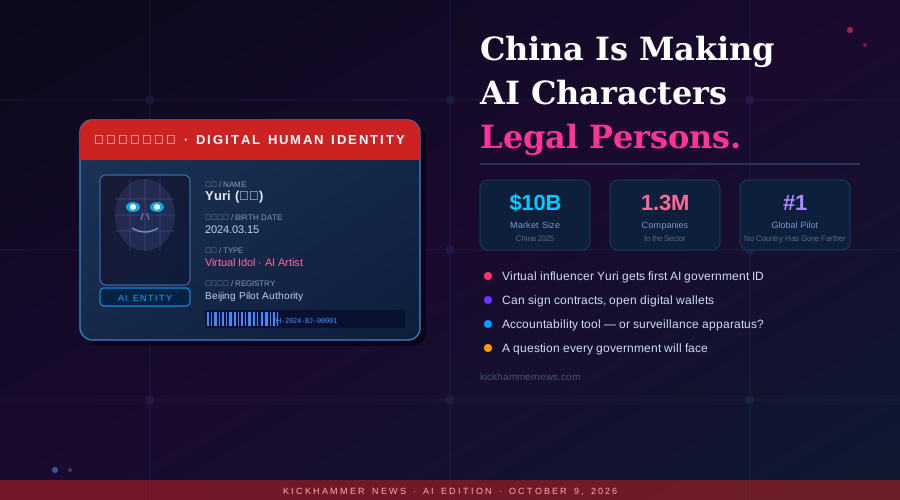
Beijing’s pilot program to issue government ID cards to AI-generated “digital humans” is the most radical act of AI governance anywhere in the world — and it’s already reshaping a $10 billion industry.
Her name is Yuri. She has a birthday, a registered address, and now, a government-issued identity card. She can open a digital currency wallet, sign commercial contracts, and act as a licensed artist under Chinese law. The only thing she cannot do is exist in the physical world.
Yuri is not a person. She is a virtual idol — an AI-generated digital human whose face, voice, and personality were created entirely by machine. But last month, she became the first of her kind to receive an official ID card from the Chinese government, making her, in the eyes of at least one municipal pilot program, something close to a legal entity.
The implications — for AI governance, digital commerce, privacy, and the future of identity itself — are only beginning to be understood.
The Pilot That Could Reshape Everything
Beijing’s pilot program assigns AI-generated virtual characters a formal record: a name, a date of birth, a home address, and a unique set of registered facial features. Once registered, a digital human’s operator can open accounts in its name, pursue commercial deals in fashion, gaming, and automotive industries, and receive recognition as a licensed creative professional.
The program is not a one-off curiosity. Last month, Chinese regulators issued a practice guide urging broadcasters and online video services to register the AI-generated characters they deploy. According to a report from the Communication University of China, at least 1.3 million companies are now active in the digital human sector. The industry was valued at approximately 48 billion yuan — roughly $10 billion — in 2025, and is growing fast.
Shanghai has been laying the groundwork even longer. In 2024, the city introduced a blockchain-based framework that assigns permanent “serial numbers” to digital humans operating in its jurisdiction — a kind of birth certificate for entities that were never born.
Together, these moves represent something unprecedented: a major government treating AI-generated characters as addressable entities within a legal framework, with traceable identities, commercial rights, and implicit accountability.
Why China Is Doing This
The most immediate motivation is accountability. China’s digital human economy has generated a wave of misuse cases that regulators found impossible to address under existing frameworks.
AI “doctors” have proliferated on Chinese social media, offering health advice with no qualifications and no entity to sanction when the advice turns out to be false. A digital influencer promoting contact lenses was pulled from advertising after viewers challenged the claims — but the company behind the avatar faced little consequence because the character had no registered existence. Deepfakes of real celebrities have been deployed in pornographic content and unauthorized commercials, with victims struggling to pursue legal remedies against virtual entities that exist in legal limbo.
Jeannie Paterson, a professor at the University of Melbourne who studies AI accountability, frames the logic clearly: digital humans cannot be sued or imprisoned. Identification, she argues, “is a way of tracing that wrongdoing to the company that’s made it available.” By giving virtual characters formal existence, China is really extending liability to the humans and organizations behind them.
There is also a strategic dimension. President Xi Jinping has made AI self-reliance a cornerstone of what he calls China’s development of “new quality productive forces.” Legitimizing the digital human economy — rather than suppressing it — aligns with a broader push to establish Chinese AI leadership in cultural production, entertainment, and commerce. Virtual humans already appear at the country’s most significant political gatherings. Last year, two AI-generated avatars were deployed to discuss China’s Government Work Report, the first time digital humans participated in the country’s major annual policy event. Dozens of local government agencies now use virtual characters to answer public inquiries.
Registering these entities creates the infrastructure for a fully commercialized AI identity economy — one that China is positioning itself to lead.
The Concerns No One Is Fully Answering
Registration sounds like transparency. But critics argue it may function as something else entirely: control.
Lennon Chang, a researcher at Deakin University, warns that mandatory ID registration could expose anonymous creators who have deliberately kept their identities out of the public record. “This could come with a chilling effect,” he says, as businesses and individuals self-censor rather than risk revealing who is behind a registered digital character. In a country where the government can compel disclosure of business records, a registry of digital human operators is also, inevitably, a surveillance apparatus.
The Cyberspace Administration of China issued its own rules for “human-like AI services” in April 2026, mandating that providers avoid creating “excessive dependence risks” and protect users’ “mental health.” Services designed to “replace social interaction, control user psychology, or induce addiction” are banned. But the same government uses virtual human technology to deliver ideological education to Communist Party members — an application that some critics argue is indistinguishable in form from the psychological manipulation the rules claim to prohibit.
The commercial concerns are just as tangled. Some Chinese companies are now reportedly paying ordinary people up to $20,000 to license their likeness for digital human productions — a nascent market in human identity that registration may accelerate rather than constrain. When your face can be legally assigned to a digital entity that signs contracts and earns revenue in its own name, the question of who owns your appearance — and who benefits from it — becomes urgent.
What This Signals to the World
No other country has moved this far, this fast. In the United States, the NO FAKES Act — federal legislation that would establish a right of publicity covering AI-generated likenesses — remains stalled in Congress. The European Union’s AI Act mandates transparency labeling for synthetic content but does not create legal identity frameworks for virtual characters. Japan and South Korea have active virtual idol industries but no equivalent registration infrastructure.
China’s experiment will be watched closely not because other countries are likely to copy it directly, but because it stress-tests questions that every society with a digital economy will eventually have to answer. Can an AI-generated entity hold rights? Who is liable when one causes harm? What happens when the character outlives the company that created it?
Yuri cannot answer these questions. But the government ID card in her name is already asking them.
Word count: ~1,030


