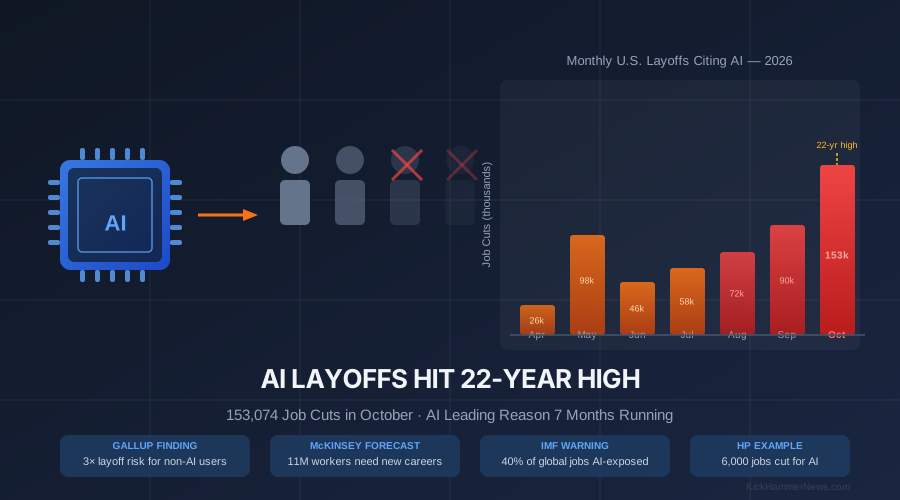
The numbers are in, and they are stark. October 2026 just recorded the highest volume of US corporate job cuts in 22 years, with employers announcing 153,074 layoffs — and for the seventh consecutive month, artificial intelligence is the leading reason companies cite for cutting their workforce.
The figures come from Challenger, Gray & Christmas, the employment research firm that has tracked corporate job-cut announcements since 1993. Their October report, released this week, describes a labor market caught in the fastest structural transformation in living memory — a moment economists are beginning to call the Great AI Reshuffling.
The Numbers Behind the Headlines
The 153,074 job cuts announced in October represent a staggering acceleration from 2025 levels. AI has been the number-one cited reason for US layoffs every single month since April 2026, starting when it accounted for 26% of April’s job cuts as tracked by CBS News. By June, Challenger reported AI had led for four consecutive months. By July, five. The October report makes clear that streak has only lengthened.
The scale is not evenly distributed. Technology and financial services have absorbed the sharpest cuts, with the two sectors losing a combined 28,000 positions monthly to AI-related restructuring at the peak of the summer wave. But the October surge points to something broader: consumer products, food manufacturing, and services companies are now accelerating automation plans that had previously been on hold.
Among the most prominent corporate announcements: HP declared it would eliminate up to 6,000 jobs globally by 2028, explicitly tying the cuts to its push toward an AI-driven product strategy. The printer-and-PC giant joins a roster of major employers — from investment banks to insurance carriers to retail chains — that have now publicly linked headcount reductions to AI adoption rather than traditional economic softness.
The two-decade record for October layoffs sets a troubling backdrop heading into year-end, when historically companies accelerate restructuring plans before closing their books.
The Gallup Finding That Should Alarm Every Worker Who Isn’t Using AI
The most striking data point to emerge in recent months did not come from a layoff tracker. It came from Gallup, the polling firm that has measured American workplace sentiment for decades.
Gallup found that technology and remote workers who do not regularly use AI tools face triple the layoff risk of their AI-fluent counterparts. The finding, surfaced in a June 2026 survey and reinforced by follow-up data in Q3, reveals that AI adoption has become a direct predictor of job security — not just a productivity metric. Managers, apparently, are no longer willing to wait for reluctant employees to come around. Workers who have not integrated AI into their daily workflows are increasingly viewed as structurally redundant before any specific task is even automated.
Fox Business, the Human Capital Management Association, and Staffing Industry Analysts all flagged the Gallup results as a watershed moment: for the first time in major survey data, AI tool usage has become a stronger predictor of individual job security than seniority, educational credentials, or even performance reviews.
McKinsey’s Uncomfortable Forecast
McKinsey’s September 30, 2026 report on the AI-labor transition tried to thread a needle between alarm and reassurance — and only partially succeeded.
The headline finding: AI will ultimately create more American jobs than it destroys. The full forecast is more sobering. McKinsey estimates that approximately 11 million US workers will need to transition into entirely new careers by 2035 — not just reskilled into adjacent roles, but genuinely displaced into different fields. Across the broader economy, up to 36 million jobs face significant automation-driven restructuring within the same window.
The new jobs AI creates, the report argues, will skew heavily toward roles that support, oversee, and extend AI systems: prompt engineers, AI quality validators, automation architects, model trainers, synthetic data curators. But those positions require digital fluency and often advanced education — two resources that are not evenly distributed across the working population. Critics of the McKinsey framing, including several labor economists quoted in response pieces, argue that “AI creates more than it destroys” glosses over a brutal distributional mismatch: the workers losing jobs in back-office functions, call centers, and routine cognitive roles are not the same workers positioned to fill the AI-adjacent roles being created.
The IMF has been similarly measured, noting that 40% of global jobs are now meaningfully exposed to AI capabilities and that the transition “requires support infrastructure that most countries have not yet built.”
China Blinks First
The international dimension of AI-driven labor disruption surfaced in an unexpected policy move this summer. China dropped its numeric urban job-creation target for the first time in over 30 years, a metric that had been a fixture of the country’s annual government work reports since the early 1990s.
The decision, attributed to AI reshaping the labor outlook in ways that make fixed numerical targets untenable, marked a significant psychological shift for Beijing. China’s government had long used job creation numbers as a proxy for political legitimacy — proof that economic growth was translating into visible gains for working citizens. Quietly abandoning that benchmark signals that even China’s central planners are uncertain about what AI-era employment will look like at scale. Workers across Chinese manufacturing and services sectors have reported mounting anxiety about replacement, as ABC News and BNN Bloomberg documented in late August.
What Comes Next: Adapt or Be Replaced
The emerging policy response in the United States has been uneven. A handful of retraining programs — funded through a mix of federal workforce grants and corporate commitments — are attempting to channel displaced workers toward AI-adjacent roles. MetaIntro has documented nine active cash and retraining programs for AI-displaced workers as of October 2026, ranging from community college AI certificates to corporate reskilling stipends. But critics note the scale of these programs remains far too small relative to the pace of displacement.
The fundamental dynamic has become difficult to escape: companies that deploy AI aggressively are generating cost savings that fund further automation. Companies that move slowly are being outcompeted. Workers who adapt are becoming more valuable. Workers who don’t are becoming targets.
The October Challenger data makes clear this is not a theoretical future. The reshuffling is underway, and its pace is accelerating — not slowing.
For workers still on the fence about investing time in learning AI tools, the Gallup data offers perhaps the starkest possible incentive: in the current environment, the cost of not adapting may be measured in pink slips.
Sources: Challenger, Gray & Christmas October 2026 Report; McKinsey Global Institute, “The Future of Work in the Age of AI,” September 2026; Gallup Workforce Survey Q2/Q3 2026; International Monetary Fund Staff Discussion Note SDN/2026/001; Cryptobriefing, Fox Business, CNBC, The Globe and Mail, Yahoo Finance.


