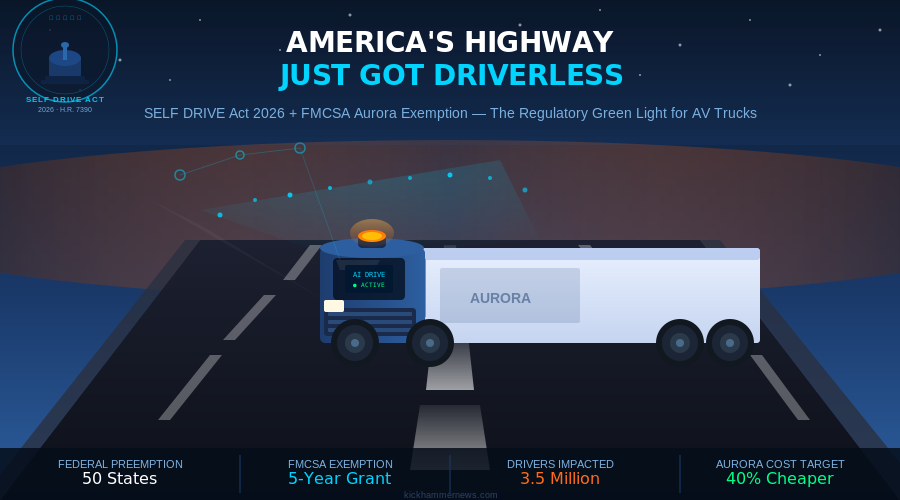
The two biggest regulatory barriers to full-scale autonomous trucking in the United States collapsed in the span of a single week. First, Congress passed the SELF DRIVE Act of 2026 (H.R. 7390), the first federal law to create a unified national framework for autonomous commercial vehicles including 80,000-pound big rigs. Then, on October 9, the Federal Motor Carrier Safety Administration (FMCSA) published a notice in the Federal Register granting Aurora Innovation a landmark five-year exemption from the rule that requires human workers to physically place reflective warning triangles behind disabled trucks. For an industry that has waited years for regulatory clarity, the message from Washington is unmistakable: the era of commercial driverless trucking in America has officially begun.
The Triangle Problem That Blocked Driverless Trucks
To understand why this week’s regulatory changes matter, you have to understand a seemingly mundane safety rule that quietly stood in the way of the entire autonomous trucking industry. Federal regulations require that when a commercial truck breaks down or stops on a road, a driver must physically exit the cab and place bright reflective triangles on the pavement behind the vehicle to warn approaching traffic. The rule was designed for the era of human drivers. For a driverless truck, it is simply impossible to comply with.
For years, Aurora and others petitioned the FMCSA for an exemption, arguing that modern cab-mounted warning beacons — automated LED flashers that activate the moment a truck stops — are actually safer than the current rules, because they require no human to step out onto a dangerous shoulder or highway lane. The agency rejected the request in 2024. Aurora went to federal court. The case dragged on. That court fight is now over.
The FMCSA’s new five-year exemption — published in the Federal Register under Docket No. FMCSA-2025-0261 — permits Aurora and other AV operators to substitute automated cab-mounted warning beacons for the legacy reflective triangle system. It is not symbolic. It is the specific legal authorization that AV truck companies needed to operate their vehicles commercially on public roads without a human on board.
The SELF DRIVE Act: Ending the State-by-State Patchwork
The FMCSA exemption arrived alongside something even bigger. The SELF DRIVE Act of 2026 (H.R. 7390), passed by Congress and now headed to the President’s desk, is the first comprehensive federal autonomous vehicle legislation to explicitly cover commercial trucks. Every previous federal AV proposal — including the original 2017 SELF DRIVE Act — covered only passenger vehicles up to 10,000 pounds. Trucks were left in a legal gray zone, subject to a patchwork of sometimes conflicting state rules.
The 2026 Act changes three things of consequence. First, it establishes federal preemption: states can no longer independently ban or materially restrict the commercial operation of autonomous trucks. California’s 2023 moratorium on AV trucks, and similar legislation in eight other states, will no longer apply. Second, it creates a revenue-generating permit system managed by the FMCSA — companies can apply for a nationwide commercial operation permit covering interstate routes, replacing the current state-by-state approval circus. Third, it establishes a national AV safety data repository, requiring companies to report incidents, near-misses, and system disengagements on a standardized federal template.
“This is not a permission slip — it’s a framework,” one senior congressional aide involved in drafting the bill told FreightWaves. “Companies still need to meet rigorous safety standards and earn those permits. But at least now there’s a clear process and a single regulator responsible.”
Aurora Moves First — and Has a Head Start
Aurora Innovation is best positioned to take advantage of the new legal environment. The company has been running commercial driverless freight hauls between Dallas, Houston, and El Paso on Interstate 45 since April 2026, partnering with FedEx, Werner Enterprises, and Uber Freight. But those early operations were conducted under carefully monitored experimental conditions with dedicated safety monitoring systems — not full commercial scale.
The FMCSA exemption removes the final procedural barrier to expanding those routes and adding trucks without the same restricted operating conditions. Aurora CEO Chris Urmson called the exemption “the last piece of the regulatory puzzle we needed to scale” in a statement released Thursday. The company has been training its Aurora Driver AI system on millions of miles of Texas highway data and says its safety record — zero at-fault accidents in more than 2 million driverless commercial miles — exceeds the industry average for human-operated freight trucks on the same corridors.
Competitors are close behind. Torc Robotics (a Daimler Truck subsidiary) is running supervised commercial trials on I-81 in Virginia. Waabi, backed by Khosla Ventures and NVIDIA, is operating on Texas routes under a partnership with Uber Freight. Plus.ai has deployments in both Texas and Arizona under existing state permits that will now automatically fall under federal preemption.
The Labor Question Nobody Wants to Fully Answer
There are approximately 3.5 million commercial truck drivers employed in the United States today. Autonomous trucking will not displace all of them overnight — the technology is currently most suited to predictable, long-haul interstate routes, and short-haul, last-mile, and urban delivery remain heavily human-dependent. But the trajectory is clear, and the regulatory momentum now matches the technology’s pace.
The Teamsters union, which represents approximately 600,000 professional truck drivers, called the SELF DRIVE Act “a sell-out of American workers dressed up as innovation” and pledged to challenge the federal preemption clause as unconstitutional. The union’s argument — that safety rules for human drivers cannot simply be waived for machines — carries real legal weight, and court challenges are expected to delay full implementation in some states.
McKinsey’s Global Institute estimated in its September 2026 report that autonomous systems could handle between 35 and 60 percent of current long-haul truck-miles within six years of regulatory authorization. That range — 35 to 60 percent — represents somewhere between 1.2 million and 2.1 million jobs that face structural disruption, not all at once, but steadily and probably faster than retraining programs can absorb.
The SELF DRIVE Act does include a provision requiring AV operators to contribute to a newly created Workforce Transition Fund, with fees set at $0.50 per automated commercial mile. At Aurora’s current volumes, that’s less than $1 million per year — a rounding error against the billions the company is investing in deployment. Labor advocates called the provision “insulting”; industry groups called it “a reasonable start.”
What Happens at TechCrunch Disrupt Tomorrow
Timing is not a coincidence in tech, and this week’s regulatory news arrives exactly as TechCrunch Disrupt 2026 opens in San Francisco tomorrow. At least four autonomous trucking companies — Aurora, Waabi, Torc, and newcomer RobotX AI — are scheduled to appear on Disrupt’s “Real-World AI” stage. Aurora’s appearance was expected to be relatively low-key; after this week, it will likely be the event’s headline story.
What investors and industry observers are watching most closely is not the regulatory news itself, which has been telegraphed for months, but how quickly Aurora and its rivals can demonstrate that the commercial economics actually work. Driverless trucks need to move freight cheaper than human drivers, not just similarly. Aurora has publicly said it targets a cost-per-mile advantage of approximately 40 percent once at scale. That number — if achievable — would reshape American logistics as profoundly as containerization did in the 1960s.
The Road Ahead
Regulatory authorization does not equal deployment at scale, and the autonomous trucking industry has made promises it has broken before. But this week marks something qualitatively different from previous milestone announcements. The FMCSA exemption is law. The SELF DRIVE Act is heading for a presidential signature. The practical, legal barriers that blocked commercial AV truck operations for years have been cleared.
Whether the technology, the economics, and the political will can converge fast enough to fulfill what regulators have now authorized — that is the next question. And it is a question that, for the first time in the history of autonomous trucking, the regulatory system is no longer blocking anyone from trying to answer.


