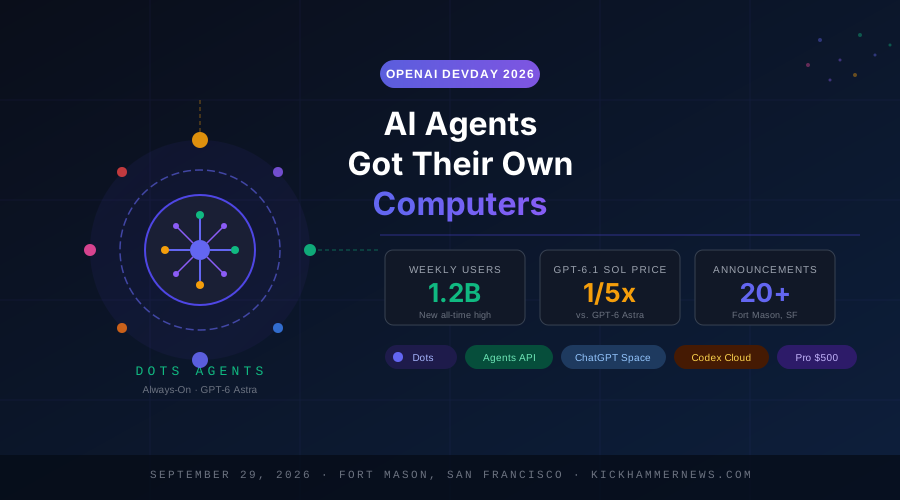
On September 29, OpenAI held its largest developer conference yet at Fort Mason in San Francisco — a sprawling, two-day event the company billed as its “biggest DevDay ever.” With more than 20 major product announcements, the keynote delivered a clear signal: OpenAI is done building chatbots. It is building workers.
Dots: The Always-On Agent That Never Clocks Out
The headline product of DevDay 2026 is Dots — always-on AI agents powered by GPT-6 Astra, each provisioned with its own cloud computer and browser. Unlike a traditional AI assistant that only acts when you prompt it, a Dot runs in the background, connecting to over 4,000 apps through OpenAI’s plugin ecosystem and executing multi-step tasks around the clock.
OpenAI demoed Dots handling tasks like turning customer feedback into tested code fixes, updating launch materials after a scope change mid-project, and preparing and sending an invoice after a human approval. The demos didn’t all go flawlessly — the live demonstration crashed several times on stage — but the concept landed clearly.
Each Dot keeps context across tasks, learns from user feedback, and can be reached through ChatGPT, Slack, or Microsoft Teams. For sensitive actions — changing a password, making a purchase, sending a company-wide email — a human must approve first. The personal computer stays isolated unless the user explicitly grants access.
Rollout has begun for Pro and Business Premium subscribers in eligible markets. Enterprise customers can enable Dots in beta through their admin settings. Free and Plus users are not included in the initial launch.
“These aren’t chatbots you consult,” OpenAI’s CEO Sam Altman said during the keynote. “They’re colleagues who get things done.”
GPT-6.1 Sol: The Model That Changes the Economics of AI Development
Arguably the most practically significant announcement wasn’t the flashiest — it was a new model called GPT-6.1 Sol. At $2 per million input tokens and $10 per million output tokens, Sol is priced at roughly one-fifth what GPT-6 Astra costs, and OpenAI’s benchmarks show it nearly matches Astra in performance.
On DeepSWE v1.1, the company’s agentic software engineering benchmark, Sol matches Astra at that fraction of the price. On OSWorld 2.0, it comes within 2.1 percentage points of Astra at maximum reasoning effort. Its factual error rate dropped to 7.7% from the 11.4% recorded for the prior GPT-6 Sol.
For developers building agents at scale, the math is transformative. A task that costs $100 at Astra prices could now cost $20 at Sol prices — not a marginal improvement but an economic shift that opens up use cases that were previously not viable.
GPT-6.1 Sol is live now in the API and in ChatGPT for paid tiers.
What Didn’t Launch: GPT-6.1 Astra Cancelled Over Safety Concerns
Equally notable was what OpenAI chose not to ship. The company had previously signaled a October launch for GPT-6.1 Astra — a next-generation frontier model expected to leapfrog the current Astra. That launch was quietly cancelled, with reports pointing to unresolved safety testing.
OpenAI did not explain the cancellation in detail during the keynote. The company has said internally that the model failed to clear its safety bar under certain adversarial conditions. The cancellation follows the broader trend of frontier labs exercising more caution — or facing more pressure — before releasing the most capable systems.
It was an unusual counterpoint to an otherwise triumphant announcement day: OpenAI pulled back from the frontier while simultaneously expanding its product footprint at scale.
1.2 Billion Weekly Users — and a Platform to Match
OpenAI announced that ChatGPT now has 1.2 billion weekly active users — a figure that, if accurate, makes it one of the most widely used software products in history. For context, that is roughly the population of Europe and North America combined using the product every week.
To serve and monetize that user base, the company announced a new Pro 500 plan at $500 per month, delivering 25 times the usage allowance of Plus and access to Astra Ultrafast — a premium speed tier that generates tokens up to 8× faster in Codex and up to 6× faster in the API. Astra Ultrafast is already live for Pro 500 and Enterprise customers. A GPT-6.1 Sol Ultrafast tier is coming soon.
ChatGPT Space, Pages, and the Collaboration Stack
The third major theme of DevDay was collaboration. ChatGPT Space is a shared workspace where humans, ChatGPT, and Dots work on the same project files together. Within Space, Pages are collaborative documents that people and AI agents can edit in tandem — think Google Docs with an AI collaborator that actually reads and modifies your content in real time.
Collaborative Slides are arriving in the coming weeks, with export to PowerPoint and Google Slides. Team Tasks allow Business and Enterprise admins to schedule recurring workflows across the team. ChatGPT is now available inside Slack and Microsoft Teams without requiring individual ChatGPT licenses for each user.
A Meetings plugin — now in macOS beta for Pro and Business — records and summarizes meetings, generates action items, and deletes the audio once notes are ready.
For Developers: The Agents API, Codex Security Cloud, and Decisions API
Developers received a substantial set of new tools. The Agents API now supports computer use, letting developers build agents that click, type, and navigate software through an OpenAI-hosted cloud browser. Multi-agent orchestration, tool search, tool calling, and context compaction are all included.
Codex Security Cloud scans GitHub repositories on demand or on schedule, investigates findings, and prepares code fixes automatically. It is available to Pro, Business, Enterprise, and Edu users.
The Decisions API uses Luna, OpenAI’s cheapest model, to answer developer-defined questions with predefined answers — useful for classification, routing, and agent action selection. It launched in limited preview at DevDay, with broader availability expected within days.
Amazon partnership: OpenAI also announced Bedrock Managed Agents, a collaboration with Amazon that lets enterprise customers run OpenAI agents entirely within their AWS infrastructure — addressing a key enterprise concern about data leaving the controlled cloud environment.
OpenAI Marketplace lets eligible enterprise customers apply prepaid OpenAI commitments toward 32 partner software products, including Adobe, Salesforce, Harvey, CrowdStrike, and Figma.
Privacy and Security: The Enterprise Play
For security-conscious enterprise customers, OpenAI announced Private Intelligence — a combination of Zero Data Retention and Private Safety Processing that enables automated safety checks without OpenAI personnel accessing customer content. A Private Inference preview, using confidential computing, is expected this fall.
Sign in with ChatGPT lets users apply their ChatGPT plan allowance inside 16 partner tools including Devin, Notion, and Vercel — an identity layer that extends ChatGPT’s usage economy beyond its own interface.
The Bigger Picture: From Model Company to Platform Company
DevDay 2026 was the clearest statement yet that OpenAI is no longer primarily a model company. It is a platform company — and the platform is ChatGPT.
GPT-6.1 Sol makes the underlying intelligence cheaper and more accessible. Dots turn that intelligence into persistent, delegated labor. Space and Pages create a collaborative environment where AI and humans work side by side. The Marketplace creates a commercial ecosystem where partners can build on top of OpenAI’s infrastructure at enterprise scale.
Anthropic, Google, and Meta are building excellent models. OpenAI is building the place where people — and businesses — actually use them. After 1.2 billion weekly users and a developer ecosystem with tens of thousands of plugins, the gap between “AI lab” and “AI platform” has never been wider.
The question now is whether the competition will catch up to where OpenAI already is — or whether OpenAI will be building the next layer before anyone else reaches this one.


