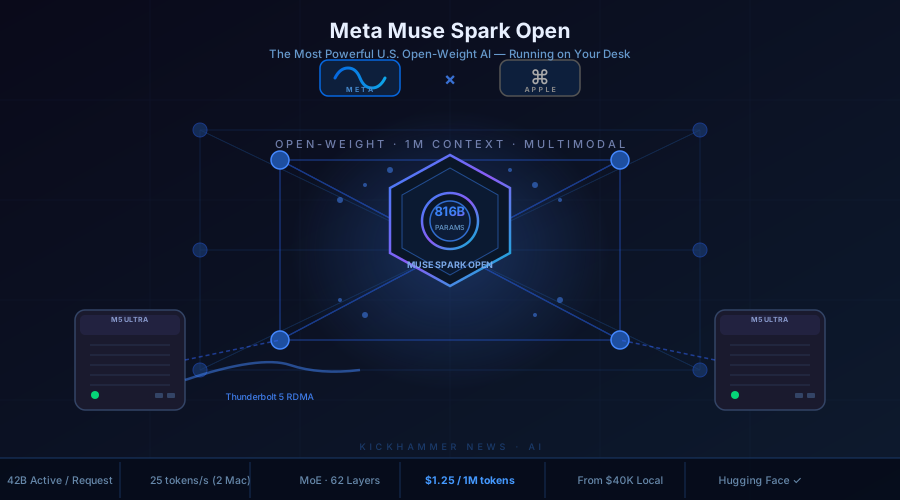
Meta Superintelligence Labs dropped one of the most significant AI releases of the year Thursday: Muse Spark Open, an 816-billion-parameter open-weight model that represents the largest and most capable model any US lab has ever publicly released. The kicker? You can run it on your desk — if your desk can hold two Mac Studios and your bank account can absorb a $40,000 hardware bill.
The model’s technical specs are staggering. It uses a mixture-of-experts architecture with 816 billion total parameters but only 42 billion active per request — meaning the compute cost per token is much closer to a 42B dense model than to an 816B one. It has a 1-million-token context window, natively handles text, images, video, and audio as input, and was specifically tuned for complex coding tasks and long-horizon agentic work. Meta calls it “the most capable US open-weight model to date.” Chinese models still lead the overall AI leaderboards, but among Western open-weight releases, nothing else is in the same zip code.
Apple and Meta: A Diplomatic Thaw Worth Watching
The story behind the story is almost as interesting as the model itself. For years, Apple and Meta were about as friendly as two companies can be when they’re suing each other over privacy practices and competing for the same developer mindshare. Apple CEO Tim Cook spent the better part of a decade framing Meta’s data-collection model as an existential threat to privacy. Mark Zuckerberg spent part of that same decade implying Apple’s App Store monopoly was strangling innovation.
And yet here they are.
The collaboration that produced this launch apparently has a human face: Daniel Gross, a former Apple executive now at Meta, who reportedly played a key role in engineering the partnership. “He played a really big role,” Scale AI CEO Alexandr Wang said this week in an interview that quickly made the rounds on social media. Wang, with characteristic understatement, described the outcome as “mommy and daddy” playing “nice again.”
To be clear, this isn’t a full strategic alliance. Meta isn’t integrating Muse Spark Open into Apple Intelligence. Apple isn’t promoting it in the App Store. The deal is more limited and more technical: Apple updated its MLX machine learning framework to support running the model split across multiple machines over Thunderbolt 5, and the model is now optimized to run on the M5 Ultra chip in Mac Studio. Both sides have obvious incentives. Meta gets a high-profile demonstration that its open models can run on consumer hardware. Apple gets a reason for developers to spend $10,000 to $11,000 on a Mac Studio instead of renting GPU time from AWS.
What Running It Actually Costs
If you want to run Muse Spark Open locally, the math is sobering. The model’s weights at native BF16 precision occupy about 1.6 terabytes. The NVFP4 quantized version brings that down to roughly 493 gigabytes — plus working memory overhead. You need at least a terabyte of unified memory, which currently means two Mac Studios with M5 Ultra chips linked via Thunderbolt 5 with RDMA.
The Mac Studio with M5 Ultra starts at $5,499 for the 96GB memory configuration, and maxes out at $10,799 for 256GB. The 512GB configuration ships later this month with pricing still unannounced. A minimum two-machine setup runs well over $40,000.
Performance benchmarks on the Mac setup show tensor parallelization across two machines achieving 24.99 tokens per second decode speed with an 8.2-second time to first token. On four machines, that improves to 36.73 tokens per second with a 4.8-second wait. For reference, that’s roughly real-time conversational speed — fast enough for interactive use, slow enough to remind you that you’re running 816 billion parameters on silicon that ships in a box with an Apple logo on it.
For those without a five-figure hardware budget, Meta simultaneously made the model available through hosted APIs on day one, including Baseten, Fireworks AI, Groq, Modal, Nebius, OpenRouter, and Together AI. OpenRouter prices it at $1.25 per million input tokens and $4.25 per million output tokens — considerably cheaper than the frontier closed models from OpenAI and Anthropic.
What the Model Is Actually Good At
Meta’s benchmark comparisons show Muse Spark Open performing well on agentic tasks and hard knowledge retrieval. It scores 89.2 on MCP-Atlas (versus 84.5 for Qwen3.8 and 84.2 for GLM 5.3), 61.0 on HLE with tools, and 50.0 on ZeroBench with tools. On the AA Omniscience benchmark — a test of broad knowledge reliability — Meta claims the top score in its published comparison table.
The model’s weaknesses are also instructive. On Terminal-Bench 2.1, a complex long-horizon coding evaluation, Muse Spark Open scores 76.4 against 85.0 for Kimi K3 and 83.9 for GLM 5.3. On DeepSWE 1.1, a software engineering evaluation using vendor harnesses, it scores 60 against Kimi K3’s 67.5. On the Artificial Analysis Intelligence Index, it sits at 39 against GLM 5.3’s 45 and Kimi K3’s 44.
The pattern is consistent: strong on agentic tool use and knowledge-intensive tasks; mid-pack to trailing on pure coding. Meta paired the model with Muse Code, its AI coding terminal, and demonstrated it building a full Mastodon client from scratch and performing multi-file editing in DaVinci Resolve. The demos showed real capability. But if raw coding performance is the metric, Chinese open-weight models are still setting the pace.
The License Terms (Read the Fine Print)
Muse Spark Open ships under Meta’s custom Muse Model License, which is more permissive than some prior Meta model licenses but still contains commercial limits. You can use it, fine-tune it, distill it, and redistribute it. Products built on it must display “Built with Muse Spark Open.” The catch: model-as-a-service providers generating more than $20 million in annual revenue need a separate commercial agreement with Meta.
Internal use, research, and building your own product features are exempt from the revenue clause. For individual developers, startups, and research institutions, the license is effectively open. For established AI infrastructure companies, it means negotiating with Meta before the model becomes a revenue center.
What This Means for the Open-Weight AI Landscape
The release comes at an interesting moment for open-source AI. The dominant narrative for most of 2026 has been that the most capable models are closed — that OpenAI’s GPT-6, Anthropic’s Claude Opus 5, and Google’s Gemini 4 have pulled far enough ahead of open alternatives to make the distinction meaningful for production use.
Muse Spark Open doesn’t fully close that gap. The Chinese open-weight models from Kimi, GLM, and Qwen outperform it on several key benchmarks. The closed frontier models still lead on the most demanding tasks. But the release demonstrates something important: open-weight models at frontier scale are now possible, deployable, and competitively priced on hosted infrastructure.
For enterprises that have been reluctant to run their workloads through OpenAI or Anthropic APIs — whether for privacy, cost, or vendor-lock-in reasons — Muse Spark Open at $1.25/$4.25 per million tokens is a credible alternative for a wide range of tasks. For researchers and developers who need to inspect model internals, fine-tune on proprietary data, or avoid license agreements with the big labs, it’s the most capable US-origin tool that’s ever been available.
The Apple partnership is a strategic signal too. It suggests Meta is serious about normalizing the idea that cutting-edge AI runs locally, on consumer hardware — even if “consumer” currently means a $40,000 two-Mac-Studio rig. As memory prices drop and Apple’s silicon roadmap continues, that number will fall. What costs $40,000 to run today will cost $10,000 in two years. Meta is positioning Muse Spark Open as the model that will be there when the hardware catches up.
For now, the release is a milestone. It’s the largest, most capable open-weight model ever released by a US AI lab. It runs locally on hardware you can buy in an Apple Store. And it marks a genuine, if limited, thaw in one of tech’s longest-running corporate cold wars.
Whether that’s the beginning of something larger between Apple and Meta — or just a carefully managed product collaboration with clear expiration terms — is a question neither company seems eager to answer.


