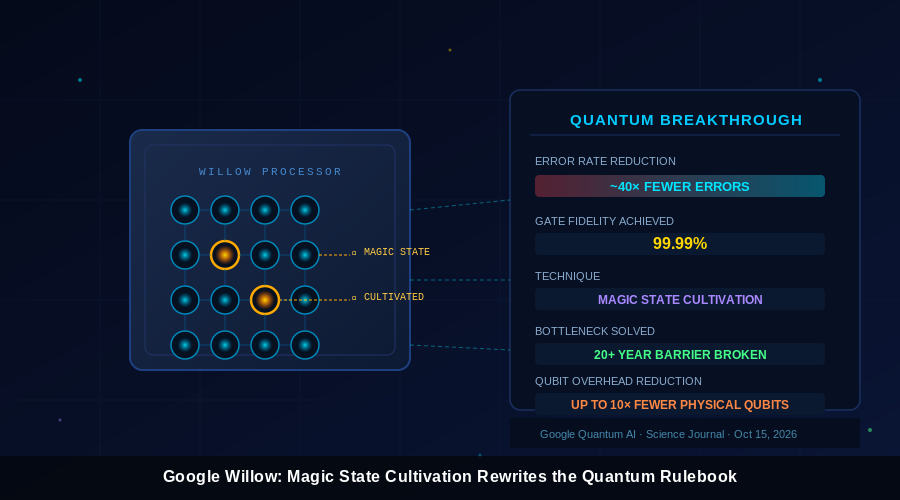
On October 15, 2026, Google Quantum AI published a landmark paper in the journal Science announcing that its Willow quantum processor had achieved a technique called “Magic State Cultivation” — reducing quantum computation error rates by approximately 40 times and hitting a sustained gate fidelity of 99.99%. The announcement is being called one of the most significant milestones in quantum computing history, cracking a bottleneck that has stalled the field for more than two decades.
What Is the Willow Chip?
Google first unveiled the Willow quantum chip in late 2024 as its most advanced superconducting quantum processor to date. The chip employs physical qubits arranged in a way that supports sophisticated error-correction schemes — a prerequisite for running the kind of complex algorithms that make quantum computers genuinely useful for real-world tasks like drug discovery, financial modeling, and cryptography. Since its unveiling, Google engineers have been pushing Willow toward fault tolerance, the state in which errors are corrected faster than they accumulate — and with Thursday’s announcement, they have made a decisive leap in that direction.
The 20-Year Bottleneck: Magic States
To understand why this matters, it helps to understand the problem that Magic State Cultivation solves. Quantum computers operate on qubits, which — unlike classical binary bits — can exist in superpositions of 0 and 1. This is what gives quantum computers their theoretical advantage. But qubits are extraordinarily fragile: heat, electromagnetic interference, and even the act of measuring them can cause errors. Every practical quantum algorithm requires not just low error rates, but fault-tolerant logical qubits — clusters of physical qubits whose collective behavior mimics a perfect, error-free qubit.
The challenge is that not all quantum operations can be made fault-tolerant using standard error-correcting codes alone. Certain essential gates — particularly the T-gate, required for universal quantum computation — produce errors in ways that standard codes cannot directly protect against. To perform T-gates fault-tolerantly, quantum engineers have long relied on a workaround: magic states, specially prepared quantum states that are injected into computations to enable these tricky operations without catastrophic error amplification.
Historically, producing high-quality magic states has been brutally inefficient. The standard approach — called magic state distillation — requires taking many noisy magic states and combining them through a resource-intensive purification process that consumes up to 90% of a quantum computer’s total capacity just to keep errors manageable. This overhead has been described as the single largest barrier to building a practical, large-scale quantum computer. Researchers have known about this problem since at least 2005 — making Thursday’s result the culmination of more than 20 years of searching for a better path.
What Google Actually Did
Rather than distilling imperfect magic states into better ones, Google’s team demonstrated that Willow can grow high-quality magic states directly through a carefully choreographed sequence of operations on a small patch of physical qubits — a process they call cultivation. By precisely controlling interactions between qubits in the Willow chip, the team was able to generate magic states with dramatically lower intrinsic error rates, bypassing most of the costly distillation overhead entirely.
The result: error rates on magic state production fell by a factor of roughly 40. Gate fidelity hit 99.99%. Crucially, the team demonstrated that the quality of cultivated states improves as the size of the qubit patch is increased — a hallmark of genuine progress toward fault-tolerant computation, since it means the technique scales in the right direction as hardware grows.
“This is not incremental progress,” said Hartmut Neven, head of Google Quantum AI, in a blog post accompanying the paper. “Magic state cultivation fundamentally changes the resource calculus for fault-tolerant quantum computing. Problems that previously would have required millions of physical qubits may now be tractable with hundreds of thousands.”
Why This Matters
The implications ripple outward in several directions.
For fault-tolerant quantum computing: The resource overhead of distillation was so severe that early estimates suggested running useful fault-tolerant algorithms would require physical qubit counts in the millions — far beyond today’s hardware. If cultivation can replace distillation, those estimates collapse. Analysts at the Quantum Computing Report noted that the new approach could shrink required qubit counts by a factor of ten or more for certain key algorithms.
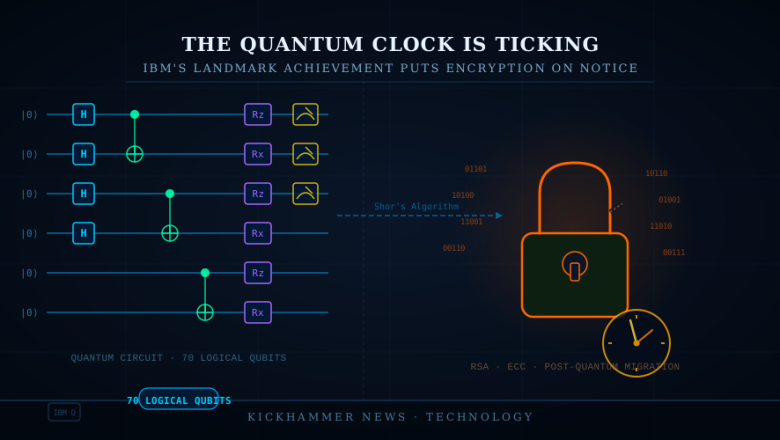
For cryptography and “Q-day”: One of the most discussed scenarios in cybersecurity is “Q-day” — the hypothetical moment when a sufficiently powerful quantum computer cracks RSA and elliptic-curve encryption, the backbone of internet security. Google’s announcement has renewed that conversation. Observers are quick to note that Thursday’s result is a materials and physics achievement, not a system-level one: Willow still has a relatively modest qubit count compared to what Shor’s algorithm would require to break 2048-bit RSA. But the efficiency gains from cultivation bring that horizon meaningfully closer.
For the broader quantum race: The announcement lands at a moment of intense competition among Google, IBM, Microsoft, and a growing roster of well-funded startups. Microsoft has been pursuing a distinct approach based on topological qubits; IBM has bet heavily on massive gate-based processors with its Heron architecture. Google’s cultivation result gives its superconducting roadmap a fresh competitive argument: that extreme hardware scale may not be necessary if error-correcting techniques become sufficiently efficient.
What Comes Next
Google has not announced a specific timeline for demonstrating the first fully fault-tolerant logical qubit using cultivation, but the company says experiments are already underway. The next milestone, researchers say, is showing that a logical qubit built with cultivated magic states outperforms its physical components across a sustained, end-to-end computation — the moment the quantum-error-correction overhead finally works in the algorithm’s favor rather than against it.
For the global quantum computing ecosystem, Thursday’s announcement is both exciting and sobering. Exciting because a real technical barrier — one that had eaten careers and billions of dollars in research funding — has been cracked. Sobering because fault-tolerant, practically useful quantum computers remain a hard engineering challenge even with cultivation in hand. The path forward is clearer now. It is not yet short.
What is certain is that the race to build a machine capable of reshaping industries — from pharmaceuticals to financial markets to national security — just got a significant gear change. Google’s Willow chip has, for the first time, turned a theoretical shortcut into a working reality.
Sources: Google Quantum AI Blog, Quantum Computing Report, Interesting Engineering, The Block, BusinessToday, Decrypt