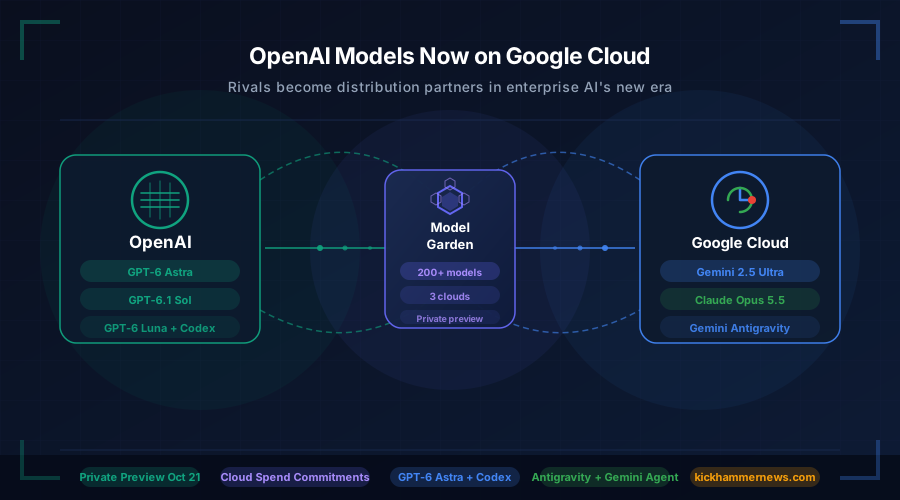
In the most counterintuitive deal of 2026’s already-strange AI landscape, OpenAI announced today that it is bringing its most capable frontier models — GPT-6 Astra, GPT-6.1 Sol, and GPT-6 Luna — to Google Cloud’s Model Garden. Codex, OpenAI’s agentic coding workflow, will also be available, with developers able to connect their local Codex CLI and Desktop setups to Google’s Gemini infrastructure starting today.
Let that land for a moment. The company that built ChatGPT, the product that spooked Google into pulling its “code red” alarm in late 2022, is now distributing its most powerful technology through the cloud infrastructure of its most direct competitor.
And both companies are celebrating it.
The Model Garden Fills Up
Google Cloud’s Model Garden is now home to more than 200 AI models from dozens of providers. With today’s announcement, it becomes the first hyperscale cloud platform to offer all three of the leading closed-source frontier model families under one roof: Google’s own Gemini, Anthropic’s Claude (Opus 5.5 and Sonnet 5.5 joined the Garden on October 20), and now OpenAI’s GPT-6 line.
For enterprise customers, the practical consequences are immediate. Existing Google Cloud spending commitments — the often-enormous contractual minimums enterprises use to lock in pricing and capacity — can now be applied to OpenAI model usage. That matters enormously for procurement teams. A separate vendor contract for an OpenAI API key triggers a whole procurement cycle: legal review, security assessments, budget reallocation. Buying OpenAI models through a Google Cloud invoice sidesteps that entirely. It counts toward a company’s existing Flexible Savings Plan.
“The models come to where the data already lives,” is how analysts at Moor Insights & Strategy summarized the logic to reporters today. “Once every cloud offers the top models, the competitive advantage goes to whoever does the best job with a company’s data, governance, and costs.”
What’s Actually Available
GPT-6 Astra, GPT-6.1 Sol, and GPT-6 Luna represent OpenAI’s full current commercial portfolio — from the most capable (Astra) to the fastest and most cost-efficient (Luna). All three are entering private preview for select enterprise customers today, with general availability expected in the coming weeks.
Codex, OpenAI’s flagship coding agent, is available from day one. Developers can route Codex CLI and Desktop inference through Google Cloud’s Gemini platform, which means enterprise developers get Codex’s code generation and autonomous software engineering capabilities running on Google’s infrastructure — with all the data governance, access controls, and compliance tooling that entails.
OpenAI’s models will also come to Google Antigravity — Google Cloud’s agentic AI development environment — and to the Gemini Agent enterprise product in subsequent rollouts. This means OpenAI models will be embedded not just as options in a catalog, but as first-class providers inside Google’s core enterprise AI development stack.
Data security terms are notable: customer prompts, context, and outputs remain inside each customer’s designated data perimeter and are explicitly not used to train OpenAI’s foundation models. The OpenAI models run on dedicated Google Cloud infrastructure, with queries routed through isolated gateways. Zero Data Retention options and Confidential Compute support are listed as “coming soon.”
How We Got Here
OpenAI’s distribution path has changed dramatically in 2026. The company spent its first several years under an exclusive cloud partnership with Microsoft Azure, which was central to the economics of both companies. That exclusivity arrangement expired in April 2026.
What followed was a rapid expansion. OpenAI moved onto Amazon Web Services, where its models became available through the Bedrock managed AI platform. Today’s announcement extends that footprint to Google Cloud, meaning OpenAI’s models are now available on all three of the major hyperscale cloud providers. Microsoft remains OpenAI’s “primary” cloud partner — as OpenAI was careful to note in today’s announcement — but primary no longer means exclusive.
The context matters: Anthropic’s IPO filing, which circulated to underwriters this morning, showed that 47% of Anthropic’s 2025 revenue came from Amazon’s and Google’s cloud platforms. OpenAI is watching the same playbook. When your models run where enterprise customers already have their data, spend commitments, and developer teams, you remove every friction point between interest and adoption.
The Strange Logic of Cloud Distribution
There’s something philosophically unusual happening here that’s worth naming. Google and OpenAI are not just competitors — they are perhaps the two most intense rivals in generative AI. Google’s Gemini family is OpenAI’s primary competition in the flagship model tier. Google’s NotebookLM competes with ChatGPT’s advanced capabilities. Google DeepMind and OpenAI compete for the same researchers, the same benchmark achievements, and increasingly the same enterprise budgets.
And yet today, Google Cloud CEO Thomas Kurian is celebrating the fact that his platform now sells the products of the company that, four years ago, was considered an existential threat to Google Search.
The reason isn’t complicated: Google Cloud earns revenue regardless of which models customers choose. It earns on compute, on storage, on data services, on security, and on the Marketplace transaction itself. If a Google Cloud customer who might have gone to Azure to get OpenAI models stays on Google Cloud because the models are now there, that’s a win for Google Cloud even if it never touches Gemini.
Mike Leone at Moor Insights & Strategy made the point plainly: “I don’t think this hurts Gemini at all. Google earns on compute, data, and cloud services either way.” OpenAI, meanwhile, gains enterprise distribution to the hundreds of thousands of companies that already have data estates anchored to Google Cloud — without having to sell them directly.
Both companies win. The customer gets model choice. And the real competition, as Leone frames it, shifts to “who does the best job with a company’s data, governance, and costs” — which is exactly where Google, with its full-stack cloud capabilities, believes it has an advantage.
What This Means for the Broader AI Market
Today’s announcement cements a structural reality of the enterprise AI market in 2026: the three hyperscale clouds have become the primary distribution channel for every major frontier model, including models built by companies they compete with.
That’s an unusual market structure. It means the companies building the most capable AI models are increasingly dependent on the infrastructure of their rivals for enterprise distribution. And it means the clouds have become neutral platforms, or at least nearly-neutral — competing to offer the broadest model catalog rather than exclusive access to any one.
For enterprises, this is broadly positive. It normalizes AI model procurement, simplifies security assessments (since the data governance is already certified for the cloud), and lets organizations switch between models by task and cost without moving data.
For OpenAI, it’s a necessary concession to market reality. The days when enterprises would build custom Azure integrations just to get GPT-4 are over. Distribution has to go where enterprises are — and enterprises are on all three clouds.
For Google Cloud, it’s a bet that the platform layer is more durable than any individual model. Gemini will continue to compete on quality. But Google Cloud’s competitive position no longer hinges on winning that race alone.
Greg Brockman, OpenAI’s president, called today’s partnership “an important step in making our most capable models and Codex available where customers are already building.” It’s a studied understatement. OpenAI’s models are now on the infrastructure of the company that once feared them most. The AI war is real — it’s just being fought in procurement terms, not existential ones.
OpenAI’s frontier models are entering private preview in Google Cloud’s Model Garden today, with general availability expected in the coming weeks. Enterprises can request early access through OpenAI’s website. Codex CLI and Desktop inference via Google Cloud is available starting today.


