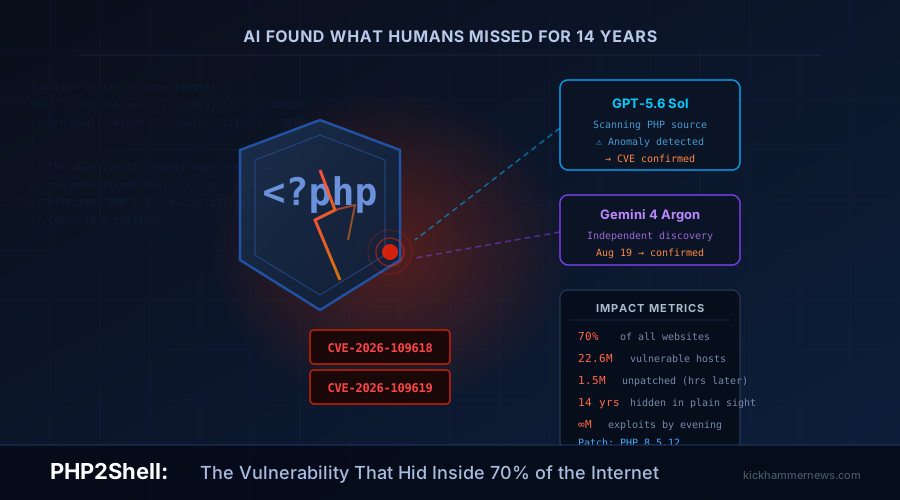
October 24, 2026 — For 14 years, a critical flaw lurked undetected in the code running roughly 70 percent of the world’s websites. It wasn’t a novel exploit or a sophisticated zero-day. It was a bug hiding in plain sight in PHP — the foundational web language powering everything from WordPress blogs to government portals. It took an AI to find it. And once word got out, the global scramble to patch it before hackers could weaponize the same AI tools began — and immediately started losing ground.
The vulnerability, or rather pair of vulnerabilities, is now known as PHP2Shell (CVE-2026-109618 and CVE-2026-109619). The name captures its most alarming capability: on an unpatched server, a remote attacker can gain shell access — direct command-line control over the machine — without ever logging in. The PHP Foundation issued emergency patches and PHP 8.5.12 on October 21, 2026, and within 45 minutes of the disclosure news leaking, Cloudflare’s sensors were already detecting tens of thousands of exploit attempts. By that evening, the count had climbed into the millions.
How AI Found What Human Researchers Missed for Over a Decade
The story begins on August 1, 2026, when a researcher at Calif, an AI-focused security firm, fed lines of PHP’s source code into OpenAI’s GPT-5.6 Sol. The model flagged a subtle interaction between a core PHP function and a widely used library — the kind of chained logic error that human reviewers had skimmed past thousands of times during routine audits. Within days, Calif had confirmed the flaw was exploitable and reported it to Volker Dusch at the PHP Foundation under coordinated disclosure.
OpenAI was notified in parallel. Its security team investigated, then learned that Wiz — the Google-owned cloud security firm — had independently identified related vulnerabilities on August 19, using a combination of GPT-5.6 Sol, Google’s Gemini 4 Argon, and Wiz’s own internal model, Atlas. What had eluded security researchers for more than a decade was, once an AI with sufficient reasoning capability looked at the codebase, findable within hours.
The coordinated response that followed was unprecedented in scale. OpenAI convened a working group that included Wiz, Calif, the PHP Foundation, Cloudflare, security firm Quarkslab, and multiple U.S. government agencies. The goal: patch the vulnerability, test the patch, push it to the web’s major CDN and hosting providers, and release a public advisory — all without the details leaking to attackers first.
They came close. But the information leaked before the PHP Foundation was ready to disclose.
22.6 Million Instances, 1.5 Million Still Unpatched Hours After the Fix
The scope became clear almost immediately. Palo Alto Networks identified approximately 22.6 million potentially vulnerable PHP instances exposed to the internet. Censys, which monitors a sample of around 2.6 million internet-facing hosts, found that roughly 1.5 million were still running unpatched PHP versions in the hours immediately following the patch release on October 21. Fastly and SentinelOne deployed emergency network-level blocking rules to catch exploit attempts in transit — a critical stopgap for any site whose operators hadn’t yet applied the fix.
The PHP Foundation’s advisory urged immediate patching or taking sites offline altogether. The FBI, NSA, and cybersecurity agencies from multiple countries issued their own urgent warnings. In the Netherlands and Finland, government agencies preemptively took websites offline as a precaution while they assessed their exposure. Archive.org, the nonprofit internet archive, also went temporarily dark. One startup founder described hackers exfiltrating source code, session cookies, and legal documents before the company knew it was compromised.
This pattern — a patch drops, a fraction of the internet scrambles to apply it, and attackers swarm the gap in between — is not new. It echoes the 2021 Log4Shell crisis, when a similarly foundational flaw in the Log4j logging library turned the internet into a shooting gallery. PHP2Shell shares Log4Shell’s most dangerous qualities: it is nearly ubiquitous, it is remotely exploitable without authentication, and the universe of potentially exposed systems is far larger than any single organization can inventory, let alone patch, in a weekend.
The Double-Edged Sword: AI as Both Finder and Attacker
What makes PHP2Shell different from Log4Shell is the context in which it was discovered — and the implications that carries. In 2021, a human researcher found Log4Shell; the patch-and-exploit race was driven by conventional attacker tools and scanning infrastructure. In 2026, an AI model found PHP2Shell. Within days of the disclosure, attacker infrastructure was already being augmented by AI tools scanning for unpatched targets and crafting exploit payloads.
The math is uncomfortable. FIRST, the global vulnerability coordination body, projected earlier this year that AI-accelerated discovery would push 2026’s total CVE count toward 66,000 — roughly triple the pace of just three years ago. The same models that enable a researcher at a boutique security firm to surface a 14-year-old bug in PHP’s source code can be pointed by anyone, including criminal groups and nation-states, at any other codebase. The discovery window — the gap between when a vulnerability exists and when someone capable of finding it looks — is collapsing.
The Calif researcher who made the initial discovery used OpenAI’s GPT-5.6 Sol, a model not publicly available for general use. But GPT-5.6 Sol is not meaningfully more capable than tools already in the hands of advanced threat actors. Wiz’s independent confirmation using the same model within weeks underscores how thin the margin is.
70% of the Web Runs on a 30-Year-Old Language — and Always Will
PHP was created in 1994. It powers the core of WordPress, which in turn powers roughly 40 percent of all websites on the internet. It underpins hundreds of major e-commerce platforms, government portals, university sites, and media organizations. At this scale, the language is not going to be replaced. The question for security teams is whether the discovery pace of critical flaws in foundational infrastructure has now outrun the industry’s ability to respond.
The PHP Foundation is continuing to audit its codebase. Cloudflare, Fastly, and SentinelOne are maintaining active blocking signatures. But as of publication, Censys data suggests millions of PHP instances remain unpatched. The attackers know this. So do the AI models they are using to find them.
For website operators, the immediate action is unambiguous: confirm you are running PHP 8.5.12 or later, or contact your hosting provider to do so. Organizations running older PHP branches — 8.3 or earlier — should treat themselves as potentially compromised until an audit confirms otherwise.
What PHP2Shell has demonstrated is something broader than a patching crisis. It is an early data point for a world in which the most important security question is no longer whether a given piece of software has a critical vulnerability. It almost certainly does. The question is which side — researchers or attackers — points an AI at it first.


